

🔍 Read the full analysis: 10 Mesh WiFi Systems To Consider For Whole-Home Coverage In 2027 on ThorstenMeyerAI.com

Get business pricing on tech for your team
- Business-only prices and quantity discounts
- Tax-exempt purchasing
- Multiple users, one account, clear invoices
TL;DR
A buyer’s guide from ThorstenMeyerAI.com compares 10 mesh Wi-Fi systems for different home sizes, internet plans and smart-home needs. Its recommendations favor Wi-Fi 6E for value, Wi-Fi 7 for households with compatible multi-gigabit equipment, and dual-band models for more modest demands; the source does not provide independent test results or verify 2027 pricing and availability.
ThorstenMeyerAI.com has published a 2027 buyer’s guide to 10 mesh Wi-Fi systems, recommending options that span Wi-Fi 6, Wi-Fi 6E and Wi-Fi 7. The guide says the right choice depends on home layout, internet speed and smart-home needs, but it does not present independent benchmark results or confirm current prices and availability.
The source names the TP-Link Deco XE75 as its best overall option, citing its Wi-Fi 6E support and price positioning. It also highlights the NETGEAR Orbi 770 Series for Wi-Fi 7 and the Amazon eero Pro 7 for smart-home integration. These are the source’s recommendations, not independently verified rankings.
The remaining systems in the guide are the TP-Link Deco X55, Amazon eero 6+, TP-Link Deco S4, Amazon eero 7, NETGEAR Orbi 770, TP-Link Deco XE75 Pro and NETGEAR Orbi 970. The source material does not give model-by-model test data, prices, coverage figures or a complete explanation of how each model ranked.
The guide’s central tradeoff is wireless backhaul capacity versus cost. Tri-band Wi-Fi 6E systems add a 6GHz band that can carry traffic between nodes, while dual-band models share radio capacity between connected devices and node links. Wi-Fi 7 can offer wider channels and more capacity, but the source says buyers need compatible network equipment and client devices to benefit fully.
The 10 picks
- 1
 Amazon eero Pro 7 tri-band mesh Wi-Fi 7 router (newest model) – Supports inte…View on Amazon →
- 2
 NETGEAR Orbi 770 Series WiFi 7 Tri-Band Mesh System, 3-Pack, Covers Up to 8,0…View on Amazon →
- 3
 Amazon eero 7 dual-band mesh Wi-Fi 7 router (newest model) – Supports interne…View on Amazon →
- 4
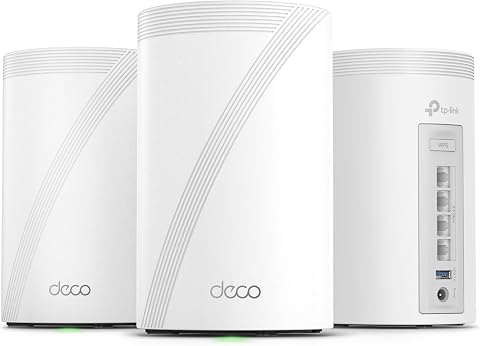 TP-Link Deco 7 Pro Tri-Band WiFi 7 BE10000 Whole Home Mesh System (3-Pack)View on Amazon →
- 5
 Amazon eero 6+ Dual-Band Wi-Fi 6 Mesh System, 3-PackView on Amazon →
- 6
 NETGEAR Orbi 370 Series WiFi 7 Mesh System for Home (RBE373) – Wireless Route…View on Amazon →
- 7
 TP-Link Deco 7 BE5000 Dual-Band Wi-Fi 7 Mesh SystemView on Amazon →
- 8
 TP-Link Deco XE75 AXE5400 Tri-Band Wi-Fi 6E Mesh System, 3-PackView on Amazon →
- 9
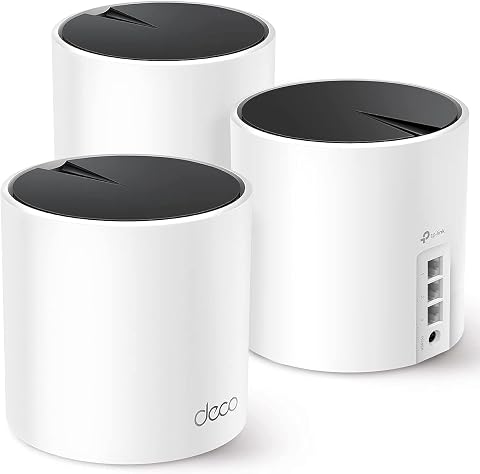 TP-Link Deco X55 AX3000 Wi-Fi 6 Mesh System (3-Pack)View on Amazon →
- 10
 TP-Link Deco S4 AC1900 Mesh Wi-Fi System (3-Pack)View on Amazon →
Matching Wi-Fi to Home Demands
The choices matter because mesh performance depends on the whole setup, not just the router’s advertised standard. A larger home, thick walls or several people streaming and gaming at once can place more demands on node-to-node connections than a smaller home with a modest device count.
For buyers, the guide’s practical message is to match spending to actual needs. Its source says dual-band systems may suit homes under 2,500 square feet with moderate device counts, while larger properties or heavier use may benefit from a tri-band model. That is guidance from the publisher, not a guarantee of coverage: building materials and placement can change results.
Internet speed and wired ports also affect value. A Wi-Fi 7 system cannot provide its full benefit if the modem, service plan or client devices are limiting the connection. Similarly, Gigabit Ethernet ports can cap wired throughput on a faster-than-1Gbps plan. Buyers should check the hardware at every point in the connection before paying for higher specifications.
Products Worth Considering

DJI Mini 5 Pro Fly More Combo Plus with DJI RC 2

Amazon Kindle Scribe (3rd Generation), 64GB, 11-inch Display, Graphite, with Premium Pen

Apple AirPods Pro 3 Wireless Earbuds with Active Noise Cancellation
As an affiliate, we earn on qualifying purchases.
What the Guide Compares
ThorstenMeyerAI.com says it assessed systems using coverage consistency, backhaul efficiency and setup simplicity, with attention to advertised coverage, node count and mobile-app onboarding. It also says its ranking logic gives weight to value in the mid-range Wi-Fi 6E and Wi-Fi 7 categories, while including budget and premium options.
The source distinguishes among three generations: Wi-Fi 6 as a baseline for handling multiple devices, Wi-Fi 6E as an addition of the 6GHz band, and Wi-Fi 7 as a newer option with wider channels and potential latency benefits. It cautions that manufacturer coverage claims can assume open layouts, and says walls and interference may reduce real-world reach. It does not publish a reproducible testing method or measurements to support those comparisons.
“The TP-Link Deco XE75 stands out as the best overall pick for balancing Wi-Fi 6E performance with reasonable cost.”
— ThorstenMeyerAI.com
Prices and Test Evidence
Current prices, stock and regional availability are not established in the supplied source material, and can change before or during 2027. The source also does not provide measured throughput, latency, range tests, detailed model specifications or a full explanation of its scoring. Its ranking should be read as a publisher’s buying advice rather than a verified performance comparison.
It is also unclear which exact hardware configurations and node bundles the recommendations refer to. Buyers should confirm port speeds, included node count, firmware support and compatibility with their internet equipment before purchasing. No particular home can be guaranteed the guide’s stated or manufacturer-advertised coverage without an on-site assessment.
Check Models Before Buying
Readers considering a system should compare live pricing and product specifications with their home’s floor plan, wall construction and internet tier. They should check whether their devices support the relevant Wi-Fi standard, whether each node has suitable Ethernet ports, and whether the system allows additional compatible nodes.
The source provides no announced testing update or future product milestone. As products and prices change, the guide’s recommendations may need to be reassessed against current availability and independent testing. For now, the next step for shoppers is to treat the list as a shortlist, not a promise of specific coverage or speed.
Key Questions
Which system does the guide recommend overall?
ThorstenMeyerAI.com names the TP-Link Deco XE75, citing its Wi-Fi 6E support and balance of performance and cost. The source does not provide independent benchmark data to verify that ranking.
Do most households need Wi-Fi 7?
Not necessarily. The source says Wi-Fi 7 is most relevant to buyers with compatible devices and fast internet service. A household on a 1Gbps plan may not benefit from every feature, depending on its equipment and usage.
When is a tri-band mesh system useful?
A tri-band system can reserve a band for traffic between mesh nodes, rather than sharing all wireless capacity with client devices. The guide presents this as more useful for larger homes or households with heavy bandwidth demands, though walls and placement still affect performance.
Are the coverage figures guaranteed?
No. The source warns that advertised coverage can assume open layouts. Walls, floors, interference and node placement can reduce real-world coverage, so published square footage should be treated as an estimate.
Source: ThorstenMeyerAI.com