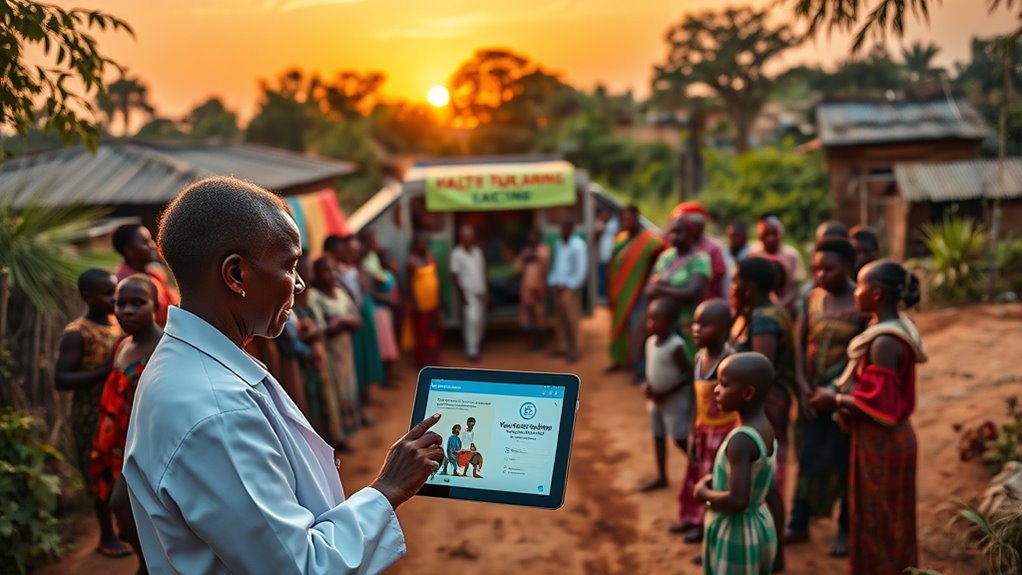

AI-powered health messages have the potential to boost vaccination rates in Africa by delivering culturally tailored, quick, and scalable communication that builds trust. They can address local barriers, counter misinformation, and reach diverse populations in multiple languages. However, challenges like infrastructure gaps and concerns over message accuracy mean oversight is essential. Continuing through this will reveal how combining technology with community efforts can truly improve vaccination efforts across the continent.
Key Takeaways
- AI enables culturally tailored health messages in multiple languages, improving relevance and acceptance among diverse African populations.
- Digital tools powered by AI can identify low-coverage areas and target populations for focused vaccination campaigns.
- AI-driven communication fosters trust by delivering credible, culturally sensitive information that addresses community concerns.
- Integration of AI with data analytics enhances disease surveillance, informing effective vaccination strategies and resource allocation.
- Combining AI messaging with community engagement can overcome barriers, ultimately increasing vaccination rates across the continent.

Artificial intelligence is transforming health communication and vaccination efforts worldwide. It enables rapid, scalable messaging in multiple languages, making it easier to reach diverse populations. In Africa, where vaccine hesitancy and logistical challenges persist, AI can play a pivotal role in improving outreach. AI-generated health messages are more creative and adaptable, which helps capture attention and resonate with local communities. However, studies in Kenya and Nigeria reveal that these messages tend to be error-prone, emphasizing the need for careful oversight to guarantee accuracy. Traditional health messages remain authoritative but often lack the flexibility needed to address cultural nuances or changing circumstances. Balancing the accuracy of information with cultural relevance is key to designing effective communication strategies.
AI enhances health messaging but requires careful oversight to ensure accuracy and cultural relevance.
AI’s capacity for linguistic and cultural adaptation makes it ideal for tailoring messages in local languages, like Igbo in Nigeria, or addressing specific community concerns. This personalization increases understanding and engagement, helping dispel myths and misinformation. Digital health tools such as vaccine verification initiatives like VaxiGlobal are also making strides by using biometric data to track vaccine delivery across regions like Zimbabwe. These innovations combat vaccine fraud and improve data reliability, which is essential for evaluating immunization programs. Integrating such tools into existing healthcare apps simplifies their adoption by health workers and enhances overall program management. Furthermore, research indicates that AI-driven predictive models help identify populations with low vaccine acceptance by analyzing demographic and socioeconomic data. This allows health authorities to target interventions more effectively, optimizing resource allocation. Large datasets, like those from the Demographic and Health Surveys, feed these models, yielding insights that guide tailored outreach efforts. During the COVID-19 pandemic, digital health strategies—such as real-time dashboards and social media analytics—proved indispensable for disease surveillance and addressing hesitancy. These tools support policy reforms and improve health literacy, both critical for boosting vaccine uptake.
Moreover, the availability of comprehensive data from various sources enhances the ability of AI systems to generate precise and contextually relevant health messages, which can significantly influence vaccination rates. Despite advancements, barriers remain, especially in Africa, where trust issues, infrastructure gaps, and access inequities hinder vaccination efforts. Strengthening trust through culturally sensitive, credible messages, powered by AI, can markedly improve vaccination rates. By combining technological innovation with targeted community engagement, AI has the potential to transform health communication and increase immunization coverage across the continent.
Frequently Asked Questions
How Do AI Messages Personalize Health Advice for Different Communities?
You see AI personalize health advice by analyzing individual data like medical history, genetic profiles, and local environmental factors. It then creates tailored messages that match each community’s language, culture, and specific health risks. This guarantees the information resonates more deeply, increasing understanding and trust. Interactive AI tools also engage people actively, providing relevant guidance on vaccination and prevention that’s adapted to their unique circumstances.
What Privacy Measures Protect Individuals Receiving AI Health Messages?
Did you know that over 60% of data breaches involve unauthorized access to personal health information? You’re protected through encryption protocols that secure data during transmission and storage. Access controls restrict who can view your information, while anonymization minimizes identification risks. Regular monitoring detects cyber threats early, ensuring your privacy stays intact. These security measures work together to keep your health data safe when you receive AI-driven health messages.
Are There Cultural Barriers Affecting AI Message Effectiveness?
Yes, cultural barriers can affect AI message effectiveness. You might find that messages lacking cultural depth or linguistic nuance don’t resonate well with diverse communities. When AI tools ignore local beliefs, traditions, or languages, people may distrust or dismiss the information. To improve, you need culturally sensitive content, involve local leaders, and make certain AI respects community norms, making health messages more relatable and increasing vaccination acceptance.
How Cost-Effective Is AI Intervention Compared to Traditional Campaigns?
You’re surprised AI isn’t more expensive, right? Well, it actually saves you money by quickly reaching large populations with tailored messages, cutting down on labor costs and reducing waste through smart logistics. Plus, it optimizes resources by targeting hesitant groups precisely. While upfront investments exist, the long-term savings and increased efficiency make AI interventions more cost-effective than traditional campaigns, especially when scaled across Africa’s diverse communities.
What Training Is Needed for Local Health Workers to Implement AI Tools?
You need training in operating AI-based platforms for vaccine logistics and outreach. Focus on managing data entry, interpreting AI reports, and troubleshooting hardware or software issues. Learn privacy and security protocols for sensitive health data. Develop skills to read AI-driven predictive models, analyze demographic data, and assess forecasts. Additionally, adapt AI-generated messages to local cultures, combine traditional communication methods, and gather community feedback to guarantee effective, trustworthy health messaging.
Conclusion
Imagine AI-powered health messages as a gentle breeze guiding hesitant hearts toward vaccination. By weaving personalized, compelling stories into your community’s fabric, you can turn doubt into trust and fear into hope. These digital whispers have the power to plant seeds of change, blooming into higher vaccination rates. Together, with the right messages, you can transform your health landscape into a vibrant garden of protection—where every shot is a blossom of safety and every voice a guiding star.