
🔍 Read the full analysis: Why Tractors Took The Place Of Horses On Farms on ThorstenMeyerAI.com

Get business pricing on tech for your team
- Business-only prices and quantity discounts
- Tax-exempt purchasing
- Multiple users, one account, clear invoices
TL;DR
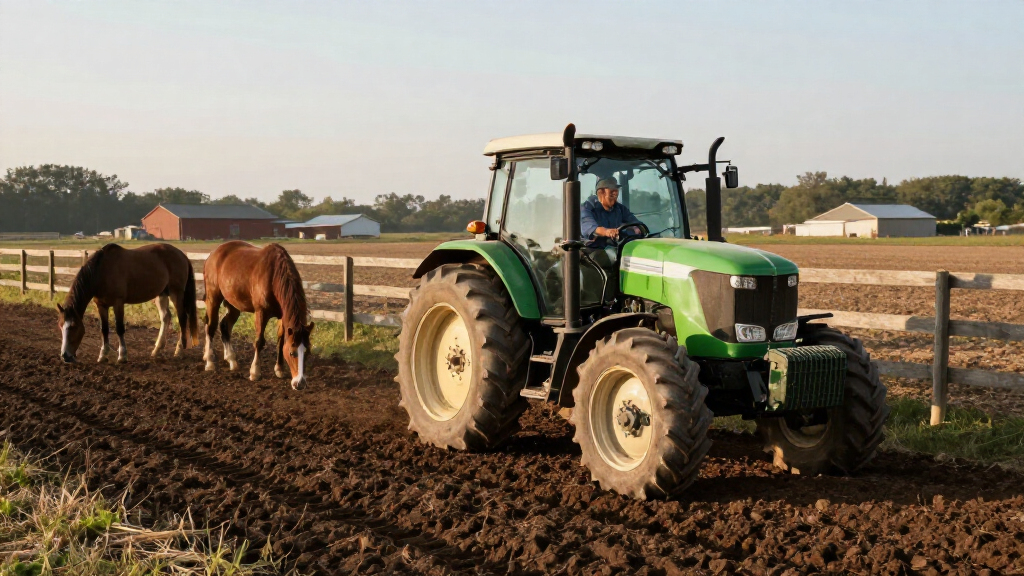
Tractors replaced horses and mules on U.S. farms over several decades, with tractors first outnumbering the animals around 1955. The change freed cropland from growing animal feed and increased farm output per worker, while employment on farms fell and many people moved to other work.
Tractors replaced horses and mules on U.S. farms over roughly half a century, rising from about 1,000 machines in 1910 to 4.69 million in 1960. Farm animals, which peaked at 26.7 million in 1918, fell to 3.1 million by 1960, a shift that changed how land was used and reduced the number of workers needed on farms.
The scale of the older system is visible in the land devoted to feeding it. U.S. historical statistics estimate that in 1915, farmers used about 93 million acres of harvested cropland to grow feed for horses and mules—more than a quarter of the country’s 340 million harvested crop acres. The estimate remained about 90 million acres in 1920. By 1960, the land used for that feed had fallen to about five million acres.
Tractor adoption accelerated after the introduction of the Fordson in 1917. The Henry Ford museum describes it as a mass-produced, relatively inexpensive lightweight tractor designed for smaller farms. U.S. tractor numbers reached 246,000 in 1920, 920,000 in 1930 and 3.39 million in 1950. Around 1955, tractors outnumbered horses and mules: 4.35 million compared with 4.31 million, according to the figures cited in the source account.
Mechanization extended beyond tractors. Combine harvesters, which cut, thresh and clean grain in one operation, grew from about 4,000 on U.S. farms in 1920 to more than one million in 1960. Other machinery, along with changes such as improved seed and fertilizer, raised output per worker. The U.S. Department of Agriculture’s estimate of the number of people supplied by one farm worker rose from 7.1 in 1910 to 47.1 in 1970; that figure includes people abroad supplied through exports.
Land and Labor After Mechanization
The change mattered because tractors did more than replace animal power. Horses required feed throughout the year, while tractors used fuel when operated. As fewer animals were kept, land once devoted to oats, corn and hay could be put to other uses. That shift helped expand the amount of food and other farm products available without a matching increase in farm labor.
The gains came with a major employment change. U.S. farm employment peaked at 13.6 million in 1916 and had fallen to 4.5 million by 1970, while the national labor force doubled, according to the source. Many new jobs were in cities, meaning workers and families often had to relocate. The history therefore connects higher farm productivity with a long movement of labor away from agriculture, rather than showing that the transition was cost-free for affected communities.
Products Worth Considering

Jackery Solar Generator 1000 V2 with 200W Solar Panel, 1070Wh

Apple Watch Ultra 2 GPS + Cellular, 49mm Natural Titanium Case with Natural Titanium Milanese Loop, Large

Kindle Paperwhite 16GB (2024) – 7 Glare-Free Display, Weeks Battery Life – Black
As an affiliate, we earn on qualifying purchases.
From Animal Power to Fordson
Horses and mules were not simply tools used occasionally; they supplied the pulling power for ploughs, seed drills, reapers and wagons. The combined number of working animals on U.S. farms reached 26.7 million on January 1, 1918, including 21.2 million horses and 5.5 million mules. Horses alone had reached their reported peak of 21.4 million in 1915.
Early gasoline tractors existed before World War I, but the source says they were heavy, expensive and better suited to large farms. The Fordson’s arrival in 1917 helped bring tractors to smaller operators. The historical account draws on U.S. Census Bureau and Department of Agriculture series, but notes that tractor figures for several census years were recorded on slightly different dates and that the government changed how it counted horses and mules after 1951.
The account also raises the horse’s replacement as an analogy for automation affecting human work. In 1983, economist Wassily Leontief compared workers with horses displaced by tractors. The source notes a key limit to the comparison: horses could not vote. The parallel is a warning or interpretation, not proof that human workers will experience the same outcome.
Limits of the Horse Analogy
The historical counts establish a broad change in farm technology and animal numbers, but they do not by themselves explain what happened to every farm worker or community. The figures also have limits: tractor counts come from census years with somewhat different dates, and the method for counting horses and mules changed from 1951. The source says the annual animal estimates ended soon after 1960.
How far the horse story predicts the effects of modern automation remains uncertain. The account identifies driverless farm equipment as a current development, but describes its use as narrow: John Deere’s 16-camera autonomy kit, announced in February 2025, performs tillage on selected large tractors. It also reports China’s claim that about 74% of ploughing, sowing and harvesting was mechanized in 2023. Those details do not establish how quickly autonomous equipment will spread, how many jobs it will affect or whether workers will find comparable employment elsewhere.
Tracking Farm Automation Now
The next test is whether current autonomous systems expand beyond selected tasks and large farms. The source account provides examples of existing equipment and national mechanization figures, but no forecast for adoption or employment effects. Future reporting would need to track where the machines are deployed, what work they perform, and how farm staffing and production change over time.
For the historical comparison, the key point is that tractor adoption unfolded across decades alongside other advances, not through a single sudden replacement. Any judgment about modern automation should account for that longer timeline, the differences between animal and human workers, and the political and economic choices that shape where displaced labor can go.
Key Questions
When did tractors outnumber horses and mules on U.S. farms?
They crossed around 1955, when the cited figures show 4.35 million tractors and 4.31 million horses and mules.
How many horses and mules worked on U.S. farms at the peak?
The combined farm population peaked at 26.7 million on January 1, 1918, according to the historical estimates cited in the source account.
Why were tractors attractive to farmers?
Tractors replaced animal pulling power and did not require crops to be grown as feed year-round. In 1915, about 93 million acres of harvested U.S. cropland were used to grow feed for horses and mules.
Did mechanization reduce farm employment?
Yes. The source reports that U.S. farm employment declined from a peak of 13.6 million in 1916 to 4.5 million in 1970. It also says the national labor force doubled over that period, as work increasingly shifted to other sectors.
Does the horse-to-tractor shift predict what automation will do to workers?
Not on its own. The comparison is an analogy, and the source notes that human workers differ from horses, including because people have political rights. The scale and effects of current farm automation remain uncertain.
Source: ThorstenMeyerAI.com