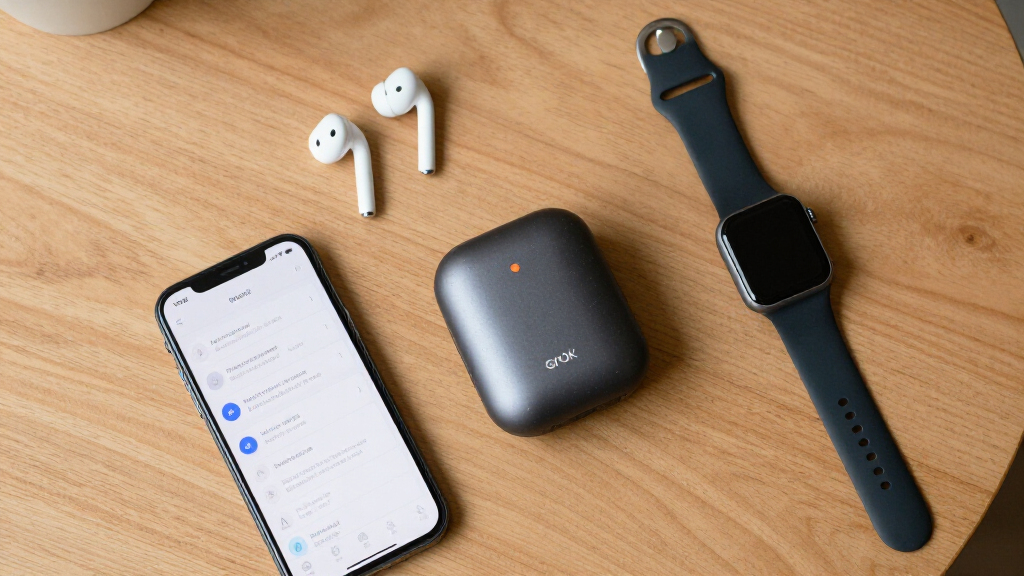
🔍 Read the full analysis: The Future Of Audio AI: How Grok Voice Realtime And xAI Lead The Way on ThorstenMeyerAI.com

Get business pricing on tech for your team
- Business-only prices and quantity discounts
- Tax-exempt purchasing
- Multiple users, one account, clear invoices
TL;DR
xAI has introduced Grok Voice Realtime, an audio-to-audio model aimed at enabling real-time spoken interactions. While its capabilities suggest potential for more natural voice assistants, many specifics about performance, deployment, and availability are still unknown.
xAI’s latest development, Grok Voice Realtime, has been identified as an audio-to-audio model designed for real-time voice interaction, marking a significant step in advancing conversational AI. While the company has not officially announced its release or detailed specifications, the technology’s existence signals a move toward more seamless, spoken exchanges within the Grok ecosystem. This development could impact how voice assistants are integrated into customer support, accessibility tools, and hands-free applications, making interactions more natural and responsive. For more details, see the latest on XAI Grok 4.6.
The core of this development is the identification of Grok Voice Realtime as an audio-to-audio system, a technology that processes spoken input and generates spoken responses directly, without converting speech into text and back. For a detailed technical overview, see the original analysis. This approach aims to reduce latency and preserve vocal nuances such as tone, emphasis, and hesitation, potentially leading to more natural conversations. However, current information does not specify whether the model is publicly available, in testing, or still under development.
Details about the system’s architecture, supported languages, latency, safety measures, or deployment options have not been disclosed by xAI. To understand the broader context of AI voice models, visit this overview. The company’s description emphasizes the model’s real-time capabilities but stops short of providing performance metrics or operational benchmarks. As a result, the actual responsiveness, reliability in noisy environments, and privacy safeguards remain unverified. The lack of published specifications means users and developers cannot yet assess its competitive advantage over existing voice systems.
Industry observers note that if Grok Voice Realtime performs as described, it could broaden the scope of voice AI beyond typed interactions, enabling more intuitive voice-based customer support, creative applications, and accessibility features. Nonetheless, without independent testing or official documentation, these prospects remain speculative. The next steps will likely involve detailed technical documentation, API access, and pilot programs, which are crucial to validate its capabilities and safety features.
Potential Impact on Voice Interaction Technology
The emergence of Grok Voice Realtime as an audio-to-audio model could mark a significant shift in voice AI technology, emphasizing faster, more natural interactions. If proven effective, it could improve user experience in applications ranging from virtual assistants to customer service chatbots, particularly in scenarios demanding quick exchanges and emotional nuance recognition. This development also underscores xAI’s focus on native voice interfaces, positioning the company as a competitor in a rapidly evolving market where real-time, high-fidelity voice communication is increasingly valued.
However, the practical benefits depend heavily on real-world performance metrics, safety controls, and accessibility. The absence of detailed specifications means the true impact remains uncertain until independent evaluations and official product releases occur. Still, the focus on an integrated audio-to-audio approach suggests a future where spoken interactions are more fluid, less delayed, and more expressive, aligning with broader industry trends toward natural language understanding and voice-first interfaces.
As an affiliate, we earn on qualifying purchases.
Advances in Audio AI and Market Trends
Over recent years, voice AI has transitioned from text-based commands to sophisticated spoken interactions, driven by improvements in speech recognition, natural language processing, and speech synthesis. Major players like Google, Amazon, and Apple have developed voice assistants that rely on staged pipelines—converting speech into text, processing the text, then generating speech responses. These systems, while effective, can introduce delays and lose vocal nuances.
The concept of audio-to-audio models aims to streamline this process, enabling more direct and potentially faster interactions. Several startups and tech giants are exploring this architecture, but few have publicly demonstrated fully operational systems. xAI’s Grok Voice Realtime appears to be among the earliest identified examples, signaling a possible industry shift toward integrated, low-latency voice models that preserve vocal qualities and improve responsiveness.
As the market for native voice interfaces expands, applications in customer support, accessibility, and hands-free computing are expected to grow. The success of Grok Voice Realtime will depend on its technical performance, safety protocols, and ease of integration, which remain to be seen.
audio-to-audio voice recognition software
As an affiliate, we earn on qualifying purchases.
As an affiliate, we earn on qualifying purchases.
Unverified Performance and Deployment Details
Many specifics about Grok Voice Realtime remain undisclosed, including its latency, accuracy, safety measures, supported languages, and deployment regions. There is no independent evaluation or benchmarking data available yet, making it difficult to assess its real-world performance or competitive standing. The system’s privacy controls, handling of overlapping speech, and robustness in noisy environments are also unknown. Until xAI publishes detailed documentation or the system is tested publicly, these uncertainties will persist.
As an affiliate, we earn on qualifying purchases.
Upcoming Milestones for Validation and Release
The next steps involve xAI releasing technical documentation, API access, and pilot programs that clarify the system’s capabilities, safety features, and deployment options. Independent testing by researchers and industry experts will be crucial to verify latency, reliability, and privacy safeguards. Watch for official announcements regarding product availability, regional rollout, pricing, and developer access, which will determine how quickly Grok Voice Realtime can influence the voice AI landscape.
As an affiliate, we earn on qualifying purchases.
Key Questions
When will Grok Voice Realtime be publicly available?
The exact release date has not been announced. xAI has yet to publish detailed plans or timelines for general availability.
How does Grok Voice Realtime compare to existing voice assistants?
Without published performance metrics or independent evaluations, it is unclear how Grok Voice Realtime will compare in terms of latency, accuracy, or naturalness against established systems like Siri or Alexa.
Will Grok Voice Realtime support multiple languages?
Support for languages has not been disclosed. Details about language coverage remain unknown until official documentation is released.
What safety and privacy measures are planned for Grok Voice Realtime?
Safety protocols, data retention policies, and privacy safeguards have not been publicly detailed. These will likely be clarified in future documentation or testing results.
Could this technology be used for malicious purposes?
Potential misuse, such as impersonation or harmful speech generation, is a concern with any advanced voice technology. Responsible deployment will depend on safety controls and regulatory compliance, which are yet to be specified by xAI.
Primary source: xAI · via ThorstenMeyerAI.com
Fall Picks
fall essentials
As an affiliate, we earn on qualifying purchases.