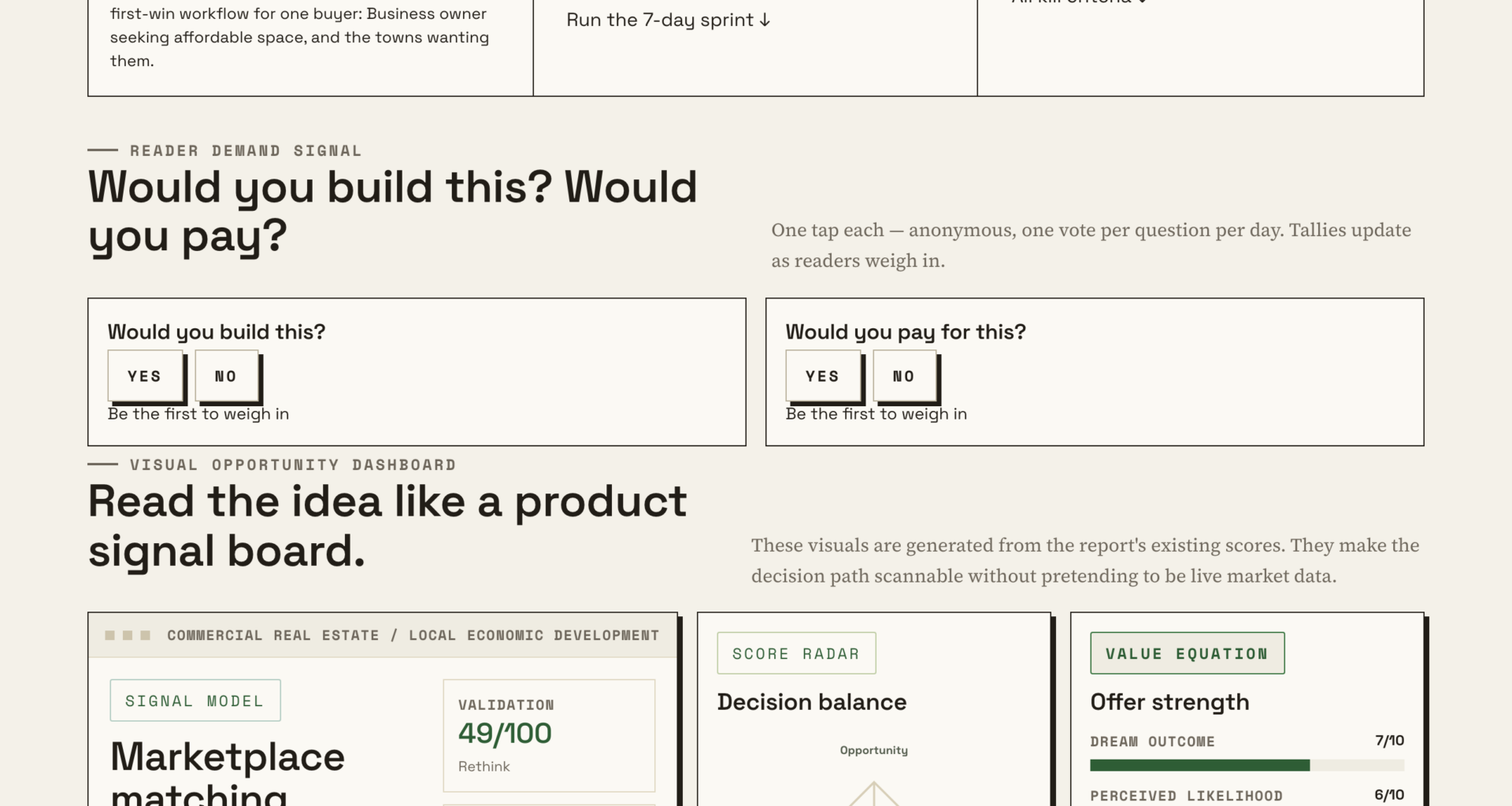

📊 Full opportunity report: A Marketplace Connects Businesses With Vacant Small-Town Storefronts on IdeaNavigator AI — validation score, market gap, and execution plan.

Get tech for your team delivered free — and shop member deals
- Fast, free delivery on millions of items
- Access to Prime Big Deal Days deals on October 6–7
- Prime Video, Amazon Music and more included
TL;DR
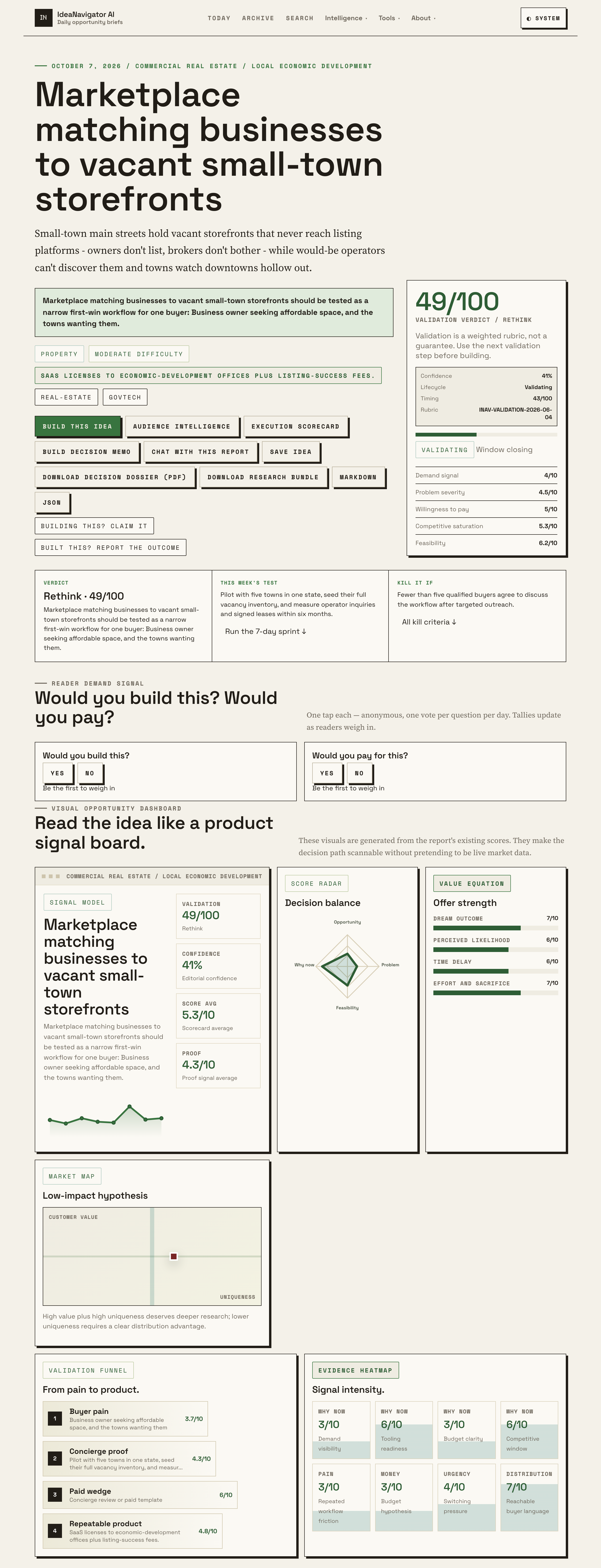
A proposal outlines a marketplace where small towns and property owners list vacant storefronts and business operators can search for spaces and local incentives. The concept recommends testing the service in five towns in one state, measuring inquiries and signed leases over six months; no pilot launch or results are reported.
IdeaNavigator AI has outlined a proposed marketplace to connect business operators with vacant storefronts in small towns, recommending a five-town pilot to test whether the service can generate inquiries and signed leases. The proposal describes a potential product, not a launched platform, and reports no participating towns, completed matches or results.
The proposed service would let towns and property owners post available storefronts with photos, floor area, rent and information about incentive programs. Business operators could search locations using town profiles and foot-traffic data, then send inquiries through a process that routes possible matches to a local economic-development office. The office could share relevant grants or other local incentives with prospective tenants.
The concept is aimed at two groups: business owners seeking affordable commercial space and towns seeking new occupants for empty downtown properties. It addresses a discovery problem described in the proposal: some owners do not list spaces on commercial platforms, while brokers may not take on listings in smaller markets. The proposal does not provide vacancy counts or evidence quantifying how often this occurs.
For an initial test, IdeaNavigator AI recommends choosing five towns in one state, gathering a complete inventory of their vacant storefronts and tracking operator inquiries and signed leases over six months. The proposed business model combines software subscriptions for economic-development offices with fees tied to successful listings. No pricing, pilot budget, participating communities or lease outcomes are provided.
Testing a Main Street Matchmaking Tool
If tested, the marketplace could make less-visible commercial vacancies easier to find and give towns a direct role in connecting prospective tenants with property owners. That could reduce the effort required for an operator to compare available spaces and learn which incentives might apply. For economic-development offices, a shared inventory could also offer a clearer view of vacancies and interest, though the proposal provides no evidence yet that the platform would increase occupancy.
The suggested six-month measures—operator inquiries and signed leases—would help distinguish online interest from actual business openings. A high number of searches or messages would not, by itself, establish that the service has helped fill storefronts. Lease agreements and their timing would provide a more concrete early measure, while longer-term effects on business survival, downtown activity and town finances would remain outside the initial test.
The model also depends on practical participation. Owners would need to provide accurate rents, availability and property details; local offices would need to keep listings and incentive information current. Without a sufficiently complete inventory, operators could search the platform and still miss relevant spaces. The pilot is therefore framed as a way to test both demand and the work needed to maintain the listings.
As an affiliate, we earn on qualifying purchases.
How the Proposed Marketplace Works
The idea sits between commercial property listings and local economic development. A typical listing service can help advertise a space, but the proposal focuses on storefronts that may not appear on established platforms. It would pair property information with town-level details and route prospective matches to a public development office rather than treating the transaction only as a landlord-and-tenant exchange.
IdeaNavigator AI identifies renewed interest in small towns linked to remote-work migration and the availability of grants for local economic-development efforts as reasons to explore the idea. These are the proposal’s stated rationale, not independently documented measurements of migration, grant funding or demand for storefronts. It does not name specific grant programs or towns with committed funding.
The recommended sequence is limited: select a small group of towns, collect their vacancy information, make it searchable and observe whether business operators respond. The concept does not describe a finished technology product or set out how listing accuracy, eligibility for incentives, privacy or fee collection would be handled. Those are operational questions a pilot would need to address.
As an affiliate, we earn on qualifying purchases.
Pilot, Funding and Demand Remain Unconfirmed
No launch, partner towns or operating marketplace are identified in the proposal. It is not clear whether any economic-development offices or property owners have agreed to participate, whether grant funding has been secured, or when a pilot might begin. There are also no reported inquiries, leases or other performance results.
The proposal does not specify how many storefronts would be needed for a useful inventory, how towns would verify rents and availability, or how foot-traffic data would be collected and compared. It also leaves open the fees charged to offices or property owners and what counts as a listing-success fee. Without those details, the cost and likely sustainability of the service cannot be assessed.
Demand is also untested. The stated interest associated with remote work does not establish that enough operators are seeking small-town premises, or that prospective tenants would use this platform instead of existing channels. Whether local incentives can be matched to particular businesses, and whether those incentives help secure leases, remains unknown.
As an affiliate, we earn on qualifying purchases.
A Five-Town Trial Would Test Demand
The next step proposed by IdeaNavigator AI is a six-month pilot across five towns in one state. Organizers would first need to identify participating communities, assemble a full inventory of vacant storefronts and determine which local grants or incentives can be displayed. The proposal does not give a start date or say that this work is underway.
If the pilot proceeds, the stated measures are operator inquiries and signed leases. Reporting those results alongside the number of listings and participating towns would help readers judge whether the service moved beyond online discovery. Any conclusions about long-term occupancy, downtown activity or business survival would require follow-up beyond the proposed six-month measurement period.
Source: IdeaNavigator AI
As an affiliate, we earn on qualifying purchases.
Key Questions
Has the marketplace launched?
No launch is reported. IdeaNavigator AI describes a proposed marketplace and suggests a pilot; it does not identify an operating service.
Who would use the service?
The proposal is intended for business operators looking for space, property owners with vacant storefronts and local economic-development offices that could manage listings and share available incentives.
What would a pilot measure?
The suggested six-month test would track operator inquiries and signed leases across five towns in one state. No baseline or target for either measure is specified.
How would the marketplace make money?
The proposed model combines software licenses for economic-development offices with fees tied to successful listings. Pricing and the definition of a successful listing are not provided.
Source: IdeaNavigator AI
Halloween Picks
halloween
As an affiliate, we earn on qualifying purchases.