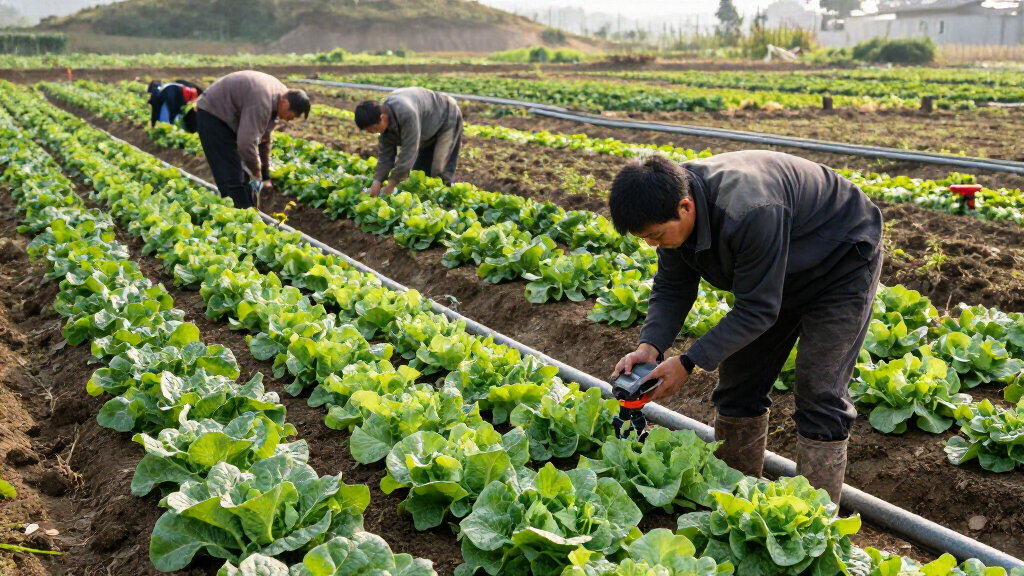

🔍 Read the full analysis: What If Almost Everyone Worked On Farms? on ThorstenMeyerAI.com

Get business pricing on tech for your team
- Business-only prices and quantity discounts
- Tax-exempt purchasing
- Multiple users, one account, clear invoices
TL;DR
A November 3, 2026 article from ThorstenMeyerAI.com examines how farming’s share of work fell from about 74% of the U.S. labor force in 1800 to roughly 1.5% today, while food production rose. The account argues that agricultural history offers a case study in long-term automation, but its prediction that other sectors could lose up to 90% of their human work is explicitly the author’s thesis, not an established forecast.
ThorstenMeyerAI.com published an article on November 3, 2026, tracing how farming’s share of work fell from about three in four U.S. workers around 1800 to roughly 1.5% today, as tools, fertilizer and crop breeding helped raise food production. The article uses agriculture as a historical case study for debates about automation, while stressing that the shift took generations and that its projection of up to 90% automation in other sectors is the author’s thesis, not a confirmed forecast.
The article cites economic historian Stanley Lebergott’s estimate, published by the U.S. Census Bureau, that 1.4 million of 1.9 million U.S. workers in 1800 were employed in agriculture, or 73.7%. The series counts workers aged 10 and older and includes about 530,000 enslaved people. Figures before 1840 are estimates rather than census counts, so the article describes the share as about three in four.
It traces productivity gains to a sequence of changes rather than one invention. These include a steel plough made by John Deere in 1837, the industrial production of ammonia fertilizer following Fritz Haber’s 1908 patent, and short-straw wheat varieties that spread in India and Pakistan in the 1960s. India’s wheat harvest rose from 12.3 million tonnes in 1964–65 to 26.4 million tonnes in 1971–72, according to the article’s cited official statistics.
The shift in employment was gradual. The article says the number of U.S. farm workers continued to rise until about 1910, reaching 11.8 million, even as agriculture’s share of the workforce fell. It also cites an International Labour Organization estimate that 928 million people worked in agriculture worldwide in 2025, about one in four workers. The reported share varies widely by country: about 43% in India, 1.5% in the United States and 1% in Germany.
How Farm Productivity Reshaped Work
The historical change matters because it shows that a sharp decline in a sector’s share of employment does not necessarily mean that the sector stops producing. The article cites estimates that global cereal harvests grew 4.2-fold between 1961 and the period covered by the source, while the world population grew 2.7-fold. It also reports that U.S. farm output in 2023 was nearly three times its 1948 level, with only a small increase in total inputs. These figures support the article’s central point: fewer workers can produce more when productivity rises.
That history is relevant to current arguments about automation and jobs, but it does not establish that other sectors will follow the same path at the same speed. Agriculture’s transformation unfolded over roughly two centuries in the United States, and its effects depended on new tools, scientific advances, markets and the availability of other employment. The article’s forecast that automation could reach up to 90% in a sector within a decade or a few decades is presented as the author’s thesis, not a measured outcome or a settled prediction.
Products Worth Considering

Bose QuietComfort Wireless Noise Cancelling Headphones – Petal Pink Limited Edition

DJI Mic 3 Wireless Microphone (2 Transmitters, 1 Receiver, Charging Case)

EcoFlow DELTA 3 Portable Power Station, 1024Wh, 1800W
As an affiliate, we earn on qualifying purchases.
From Muscle to Modern Inputs
The article begins with the large share of people historically needed to grow food. Before mechanized equipment and industrial fertilizer, farm output depended heavily on human and animal labor, hand tools and weather. A household could produce only a limited surplus, which meant a large share of the population had to work on food production.
It places the U.S. experience alongside estimates for other countries: roughly 85% of workers in Japan’s primary sector in 1872, 83.5% in China’s primary sector in 1952, and 69.7% of Indian workers classified as cultivators or agricultural laborers in 1951. These figures come from historical reconstructions or national data series with different definitions and dates, so they are not perfectly comparable. The article also notes that an 1882 German occupational census counted 43.4% of workers in agriculture and forestry, but may have undercounted women working on family farms.
The sequence of changes included better equipment, fertilizer and improved crop varieties. Haber filed a patent on ammonia synthesis in 1908, and an industrial ammonia factory opened in 1913, according to the source. Later, dwarf wheat varieties developed through plant breeding were paired with fertilizer and irrigation. Together, these changes raised output and reduced the amount of labor needed per unit of food.
“Farming shows a whole sector can be emptied of human hands. It also shows that it took about 200 years in America.”
— Thorsten Meyer, author of the November 3, 2026 article
Limits of the Automation Forecast
The article provides a historical account and a thesis about future automation, but it does not establish how many jobs in other sectors will be automated, which occupations would be affected, or on what timeline. Its estimate of up to 90% is not tied in the supplied material to a defined sector, measurement method or independent forecast. It should not be read as a finding that 90% of jobs will disappear.
Historical workforce figures also have limitations. Some are estimates or reconstructions, and the countries and years use different categories, such as agriculture alone versus the broader primary sector. The article’s global figure of 928 million agricultural workers is attributed to an ILO estimate for 2025; the material does not specify further details about the estimate’s methodology. The source’s long-run production comparisons describe gains in output, but do not by themselves show how benefits were distributed among workers, farmers and consumers.
The Series Turns to Machinery
The article is the second installment of “Work After Work,” a series examining how the economy is built across field, factory and office work. It says the next episode will focus on mechanical reapers, threshers and tractors, continuing the account of how equipment changed farm labor. The broader question—whether other sectors will experience a comparable long-term drop in human work—remains a subject for further evidence, not a conclusion established by this installment.
Key Questions
How many U.S. workers farmed around 1800?
Stanley Lebergott’s estimate, published by the U.S. Census Bureau, puts the figure at 1.4 million of 1.9 million workers, or 73.7%. The data before 1840 are estimates, and the count includes enslaved people.
How many people work in agriculture worldwide?
The article cites an International Labour Organization estimate of 928 million people in 2025, or about one in four workers worldwide.
Does a smaller farm workforce mean less food?
Not necessarily. The article cites growth in cereal harvests and U.S. farm output alongside a much smaller share of workers in agriculture. Those figures show that production can rise as labor needs fall, though they do not explain every effect on prices, incomes or access to food.
Does the article predict that 90% of jobs will be automated?
No. The author describes automation reaching up to 90% in a sector within a decade or a few decades as his thesis, not a fact. The article does not present it as an established forecast.
Source: ThorstenMeyerAI.com