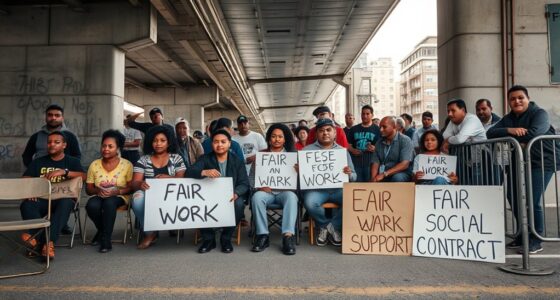

The zero marginal cost economy is reshaping how goods and services are produced and shared, making many things nearly free and more accessible. Advances in digital tech like AI, IoT, and open platforms lower costs and foster collaboration, leading us toward a post-scarcity society where basic needs are easily met. While challenges remain around ownership and regulation, exploring this shift reveals how a more equitable, sustainable future might emerge if these trends continue. Keep exploring to see what’s possible.
Key Takeaways
- Advances in digital technology and IoT are driving near-zero marginal costs for goods and services.
- Sharing economy models and open licenses reduce traditional market costs, promoting resource efficiency.
- Increasing global internet connectivity enables widespread access, fostering a shift toward shared prosperity.
- Societal frameworks are evolving to accommodate new regulations, collaborative ownership, and digital platform economies.
- These trends suggest a move toward post-scarcity conditions where basic needs become accessible and production costs decline significantly.
Understanding Zero Marginal Cost and Its Origins

Understanding zero marginal cost begins with recognizing that it describes a situation where producing one more unit of a good or service costs almost nothing. This concept hinges on the difference between fixed setup costs and marginal costs, with the latter approaching zero as output increases. As you produce more, your average costs decline because fixed costs are spread over a larger volume, while variable costs become negligible. This idea mainly applies to digital goods and services like software and media, where reproduction and distribution are virtually free. Its origins trace back to digital technology advancements and the internet, which made copying information incredibly cheap. This shift has been facilitated by technological innovations that enable near-instantaneous replication and dissemination. Additionally, lean manufacturing and sharing platforms like Uber or Linux have helped operationalize this model, shifting economic paradigms toward near-zero reproduction costs, often leading to cost reduction and increased accessibility across industries.
Shifting Economic Paradigms Beyond Traditional Systems

The shift beyond traditional economic systems is driven by the rise of the sharing economy and innovative business models that prioritize access over ownership. Platforms like Uber and Airbnb demonstrate how reducing the need for personal ownership can lower costs and increase efficiency. Community-driven collaboration, seen in projects like Linux, further cuts production expenses. Technological advances, including IoT and renewable energy, enable more efficient production and distribution, supporting this progression. New business models favor collaboration over ownership, impacting industries beyond digital services. Automation of basic industries and redistribution of efficiency gains through measures like UBI help support this shift. Additionally, breakthrough technologies such as quantum computing and AI are poised to accelerate these changes, fundamentally transforming economic and societal structures. As these changes unfold, they challenge conventional economic structures, paving the way for a more equitable, sustainable, and post-scarcity society. Furthermore, understanding Private Placement Memoranda can be crucial for investors navigating these emerging opportunities. Recognizing how regulatory frameworks adapt to these innovations will be essential for ensuring long-term growth and stability. Advances in technology integration continue to drive innovation, making the transition toward a post-scarcity economy increasingly feasible. Moreover, fostering a culture of dynamic communication can enhance cooperation and trust among stakeholders involved in this transition.
The Rise of Digital and Sharing Platforms

As digital and sharing platforms continue to expand rapidly, they are fundamentally transforming how people connect, access services, and conduct commerce. With internet users growing by 136 million in 2024, more people are online, especially through mobile devices, which are crucial for digital access. Social media platforms are reaching over 5.4 billion users, turning into marketplaces for product discovery and shopping, with social commerce expected to hit $1.08 trillion by 2028. Sharing platforms like Airbnb and Uber are reshaping industries, reducing costs and increasing efficiency. Digital collaboration tools such as Slack and Google Workspace support remote work and sharing. These advancements foster new economic models, making digital platforms more accessible, integrated, and influential in everyday life. The total number of internet users now exceeds 5.56 billion, surpassing two-thirds of the global population, reinforcing the pervasive reach of digital connectivity. As these platforms grow, they also promote more sustainable consumption habits by enabling resource-sharing and reducing unnecessary purchases. Additionally, digital collaboration tools enhance global cooperation and knowledge exchange, creating a more interconnected economy. The proliferation of access to information accelerates innovation and democratizes opportunities across diverse regions, highlighting the importance of digital literacy in maximizing these benefits. Developing Cultural Intelligence can further enhance global engagement and ensure respectful, effective cross-cultural interactions within this expanding digital landscape.
How Collaborative Commons Are Reshaping Production

Have you ever considered how collaborative commons are transforming the way goods and services are produced? These shared spaces rely on collective production without traditional hierarchies, often operating as non-profits and driven by voluntary contributions. Using open licenses, they allow free access, modification, and redistribution of resources, fostering innovation and diversity. The internet enables widespread collaboration, reducing production costs and challenging traditional market models. This shift also emphasizes the importance of fiber-rich resources in supporting sustainable and resilient production models. Resources like knowledge and designs are shared seamlessly, mutualizing efforts and means of production. Additionally, the adoption of recycled materials in shared initiatives promotes environmental sustainability and reduces reliance on finite resources. Governance is participatory, with community involvement driving sustainability and innovation. Moreover, embracing local urban agriculture practices can further enhance resource sharing and community resilience. Recognizing the role of collective ownership in fostering sustainable development can strengthen community-based initiatives. Overall, collaborative commons are reshaping production by emphasizing openness, cooperation, and shared ownership, leading to more efficient and inclusive economic models. Additionally, the reliance on renewable and sustainable materials further enhances their potential for long-term resilience and environmental stewardship.
Implications for Resource Use and Societal Access

With zero marginal costs, resource use becomes more efficient as digital goods and renewable energy reduce material consumption and waste. This trend can also foster sustainable consumption, encouraging consumers and producers to prioritize long-term ecological balance. You’ll find that access to goods and services can surpass ownership, making them more affordable and widespread. This paradigm shift can also promote resource efficiency by minimizing unnecessary waste and optimizing usage. Additionally, renewable energy sources play a crucial role in decreasing reliance on finite resources, further advancing sustainability. This shift can also help lower societal inequalities by opening up opportunities for more people to participate and benefit. Technological advances continue to enhance efficiency and expand access across various sectors.
Enhanced Resource Efficiency
Enhanced resource efficiency in a zero marginal cost economy markedly improves societal access by making goods and services more affordable and widely available. Because companies can produce more without extra costs, waste decreases, and production becomes more sustainable. You benefit from lower prices and broader availability, especially for digital products like software and e-books, which can be replicated infinitely with minimal resources. This efficiency allows for better resource management, optimizing production schedules and inventory. Additionally, costs saved can be redirected to improve access for marginalized communities and foster economic inclusion. Technology, such as AI and automation, further supports these shifts, expanding access and promoting a more equitable distribution of resources.
- Reduced waste through efficient production processes
- Greater sustainability and eco-friendly practices
- Increased digital and global access to goods and services
- Enhanced economic inclusion for low-income populations
Access Over Ownership
Adopting access over ownership models fundamentally shifts how society uses and values goods and services, leading to significant implications for resource use and societal access. You benefit from lower upfront costs, making products more affordable and accessible to a broader audience. This flexibility lets you use items without long-term commitments, encouraging sustainable consumption. Businesses optimize resources with higher utilization rates and generate recurring revenue through subscriptions and rentals. Environmentally, this reduces waste and conserves resources by promoting reuse and recycling. As consumer preferences shift toward experiences over ownership, access models foster community engagement and social trust. They also require digital platforms, data management, and smart technologies to ensure secure, efficient access. Research indicates that these models promote economic efficiency and broader societal inclusion, shaping a more sustainable, connected future.
Reducing Societal Inequalities
Near-zero marginal cost technologies like IoT, renewable energy, and 3D printing are expanding access to goods and services at minimal additional expense, making resources more affordable for everyone. You can now tap into shared platforms, like ride-sharing or tool libraries, which help low-income populations access resources they previously couldn’t afford. Digital education through MOOCs and open-source content breaks down geographic and income barriers, providing learning opportunities globally. Cheaper energy sources, such as solar and wind, reduce costs for basic needs and promote equitable resource distribution. Additionally, prosumer models encourage people to produce and share, democratizing access. These shifts foster a more inclusive society where cooperation replaces competition, and shared value creation becomes central to reducing inequalities.
- Shared technology platforms expand resource access
- Digital education widens learning opportunities
- Cheaper renewable energy lowers costs
- Prosumer models democratize production
Transforming Business Models in a Zero Marginal Cost World

As digital technologies continue to lower marginal costs, you must fundamentally rethink your business models to stay competitive. Digital products like software and online courses can be replicated and distributed at nearly zero cost after initial development. Platforms such as Facebook and Google expand without significant additional expenses, exemplifying zero marginal cost economies. The sharing economy, through companies like Uber and Airbnb, leverages existing assets and digital coordination to minimize costs, shifting focus from ownership to access. Platform models facilitate connections between producers and consumers, generating revenue through fees, ads, or subscriptions with minimal incremental costs. These innovations challenge traditional approaches, prompting you to adopt new pricing strategies—freemium, subscription, or ad-supported—to monetize zero marginal cost offerings effectively and sustain growth in this evolving landscape.
Challenges to Intellectual Property and Value Creation

As the cost of sharing IP approaches zero, you face new challenges in valuing and protecting intellectual property within evolving value chains. Traditional models struggle to balance innovation incentives with fair compensation, risking reduced creativity and investment. You’ll need to rethink ownership and legal frameworks to adapt to a landscape where distribution is nearly free and competition intensifies.
Intellectual Property Reconsidered
How should we rethink the traditional role of intellectual property in a world where digital goods can be reproduced at almost no cost? The old model relies on high fixed costs and low marginal costs to grant exclusive rights, enabling creators to recoup investments. But with digital reproduction near zero, the value of IP rights diminishes, challenging traditional incentives. Governments’ price controls risk under-compensating innovators, risking innovation stagnation. Claims that IP has “no relevant cost” ignore decreased production compared to free markets. To adapt, you might explore alternative models like microtransactions, subscriptions, or open licenses.
- Digital reproduction reduces the need for exclusive rights
- Incentive mechanisms shift from ownership to access and sharing
- Traditional IP systems face obsolescence challenges
- New compensation methods are required for sustainable innovation
Value Chain Reconfiguration
The reduction of marginal costs driven by digital technologies is fundamentally reshaping traditional value chains, enabling companies to scale rapidly and disrupt established industries. You can now bypass intermediaries, lowering costs and increasing efficiency. This transformation creates new competitive advantages and challenges existing business models. As core technologies become easily replicable, industries face disruption, forcing you to rethink value creation.
| Disruption Drivers | Impact on Value Chain |
|---|---|
| Near-zero marginal costs | Enables rapid scaling and disintermediation |
| Digital platforms | Reduce costs and streamline processes |
| IoT and digital tools | Enable new value configurations |
| Sharing economies | Promote access over ownership |
| Open innovation | Foster collaboration and reduce IP barriers |
Innovation and Ownership
Have you considered how zero marginal costs challenge traditional notions of ownership and intellectual property? As digital goods become easier to copy and share at near-zero costs, the value of exclusive rights diminishes. This shifts the landscape, raising questions about fair compensation and innovation incentives.
- Zero marginal costs weaken the control of IP by making reproduction and distribution cheap and widespread
- High fixed costs for R&D remain, but recouping these through traditional IP protections becomes harder
- Digital commons promote shared ownership and collaboration, challenging traditional proprietary models
- Debates continue on whether IP should be regulated like utilities or maintained as market-driven exclusivity
These shifts threaten the very foundation of innovation models based on scarcity and ownership, urging a reevaluation of how we create and sustain value.
Regulatory and Policy Considerations for New Economies

Managing regulatory and policy frameworks in a zero marginal cost economy requires proactive adaptation to rapidly evolving business models and technological innovations. You need to respond to new technologies like IoT and AI that enable near-zero production costs. The sharing economy, exemplified by Uber and Airbnb, challenges traditional industries by leveraging existing resources, demanding updated regulations. Open source software and collaborative models, such as Elon Musk’s open patents, blur ownership lines and require new intellectual property laws. Traditional vertical integration faces disruption, prompting revisions in competition and antitrust laws. Policymakers must balance protecting innovation with safeguarding consumer interests, while reforming tax systems to reflect shared resource models. Supporting innovation, regulating digital platforms, and fostering public-private partnerships are essential to navigate these transformative changes effectively.
Potential for Reducing Inequality and Promoting Sustainability
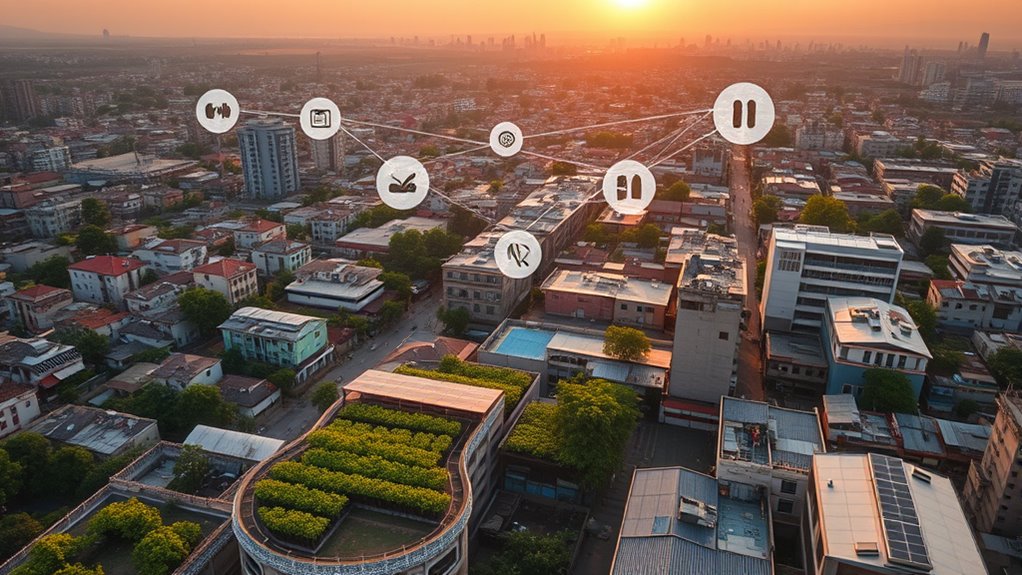
The zero marginal cost economy offers a real chance to improve equitable resource access and reduce social divides. By enabling community-driven prosperity, it shifts power from big corporations to local groups and individuals. Emphasizing sustainable resource use, it aligns economic growth with environmental health, creating a more resilient and inclusive future.
Equitable Resource Access
As shared resources become more accessible through the rise of the collaborative commons and digital platforms, the gap between different socio-economic groups starts to close. You can access goods and services without ownership, lowering financial barriers. Sharing economy models let you utilize resources at a fraction of traditional costs, promoting fairness. IoT technology enables real-time sharing and efficient management, making resources more available. With digital goods produced at near-zero marginal costs, unlimited distribution at minimal prices becomes possible, reducing exclusion. Shifting focus from ownership to use-based access encourages equitable resource distribution.
- Access to shared goods reduces economic barriers
- Digital platforms democratize resource availability
- IoT enhances real-time sharing and management
- Lower costs promote fairness across socio-economic groups
Community-Driven Prosperity
Community-driven prosperity harnesses collective ownership and local decision-making to create more equitable and sustainable neighborhoods. Models like community land trusts, worker cooperatives, and credit unions allow residents to build local assets and influence decisions, especially in marginalized areas. This approach helps prevent rapid housing and commercial price spikes, fostering stability. It builds on traditions of mutual aid and collective care, often supported by public, private, and philanthropic funding, which expands shared prosperity. Cross-sector collaborations—bringing together business, health, recreation, and utility sectors—use innovative impact investments to boost community well-being. The solidarity economy emphasizes mutual aid and collective care, reducing reliance on top-down forces. Altogether, these strategies promote economic stability and social cohesion, ensuring prosperity benefits everyone and mitigates inequality.
Sustainable Resource Use
Advancing sustainable resource use offers a powerful pathway to reduce inequality while promoting environmental stability. By maximizing resource efficiency and embracing new technologies, you can help lower emissions and conserve essential ecosystems. Increased renewable energy capacity, especially solar, is making clean power more accessible and affordable. Localized solar projects, like those in Texas, demonstrate how communities can generate their own energy, reducing reliance on fossil fuels. However, challenges such as permitting and grid constraints still exist. You can also support policies that prioritize equitable resource distribution and push for corporate commitments to sustainability. When consumers choose eco-friendly products, their demand encourages businesses to adopt sustainable practices, creating a cycle that benefits both people and the planet.
- Invest in renewable energy and support local initiatives
- Advocate for fair resource management policies
- Choose products with sustainable packaging
- Support companies committed to decarbonization
Envisioning Society in a Post-Scarcity Future

What will society look like when goods and services become nearly free to produce and access? You’ll see a world where basic needs like food, shelter, and healthcare are readily available, eliminating scarcity-driven worries. With advanced automation, nanotechnologies, and renewable energy, production costs plummet, making goods affordable or even free. Resources once reserved for survival become abundant, shifting human focus from mere survival to creativity and innovation. In this future, wealth disparities diminish, and communities thrive on sharing and collaboration. Life’s purpose evolves from acquiring possessions to contributing meaningfully to society. As traditional market forces weaken, new models rooted in cooperation and open access emerge, fostering a society where abundance fuels social progress and individual fulfillment.
Frequently Asked Questions
How Might Zero Marginal Cost Economies Impact Traditional Job Markets?
You’ll see traditional job markets shift as automation and digital tools replace routine roles, making labor less necessary and driving down costs. You might find more opportunities in tech-driven sectors like AI, data analytics, and renewable energy, but also face job displacement in manufacturing and service industries. To thrive, you’ll need to upskill continuously, adapt to new economic sectors, and stay flexible as the balance between high- and low-skill jobs evolves rapidly.
What Role Do Governments Play in Regulating Collaborative and Digital Platforms?
Imagine a digital landscape where lines blur and borders fade, reflecting how governments now regulate collaborative platforms. You see laws like the EU’s DSA and DMA shaping transparency, safety, and fairness. Governments actively enforce rules, penalize unfair practices, and address data privacy concerns. They aim to balance innovation with user protection, asserting sovereignty over tech giants. Your role involves understanding these evolving regulations to navigate the digital world responsibly and confidently.
Could Increased Access Lead to New Forms of Social Inequality?
You might think that increased access to technology and resources would reduce social inequality, but it can actually create new disparities. If some people don’t have the skills or infrastructure to benefit, gaps could widen. You need to guarantee fair distribution and digital literacy programs so everyone can access opportunities. Without careful policies, the digital divide might deepen, making inequality worse despite greater access.
How Will Intellectual Property Laws Need to Evolve in This New Economy?
You’ll need to rethink how you handle intellectual property laws in this new economy—balancing protection, access, and innovation. You’ll want to embrace open licensing, promote flexible frameworks, and support collaboration. You’ll also need to adapt regulations, foster international coordination, and explore new incentives. By doing so, you’ll guarantee that IP laws encourage creativity, facilitate sharing, and remain relevant in a landscape where ideas can be freely replicated at minimal cost.
What Are Potential Risks of Over-Reliance on Digital and Sharing Platforms?
You risk facing instability if you overly depend on digital and sharing platforms. They can create job insecurity, as gig work lacks benefits and steady income. Privacy breaches and data misuse threaten your personal info. Market dominance by a few big players limits your choices and bargaining power. Additionally, unclear regulations can leave you vulnerable to unfair practices, and systemic failures might impact your access to essential services or resources.
Conclusion
As you consider the shift to a zero marginal cost economy, remember that over 70% of digital content is now freely shared online. This trend hints at a future where scarcity diminishes, making resources more accessible and sustainable. Embracing these changes could reduce inequality and foster innovation. If you stay open to this new paradigm, you’ll be part of a society that values collaboration over ownership, shaping a more equitable and abundant world.