🔍 Read the full analysis: Will AI Replace Dockworkers In Container Shipping? on ThorstenMeyerAI.com

Get business pricing on tech for your team
- Business-only prices and quantity discounts
- Tax-exempt purchasing
- Multiple users, one account, clear invoices
TL;DR
Containerization transformed dock work by replacing the handling of individual crates and sacks with standardized boxes moved by cranes, sharply reducing the labor needed per shipment. That history does not establish that AI will replace today’s dockworkers: a 2024 U.S. government report found automated terminals stacked containers more densely but also had slower moves and more breakdowns at some sites.
A November 23 article on ThorstenMeyerAI.com examines whether AI and automation will replace dockworkers, drawing a distinction between the dramatic labor impact of containerization and the less settled performance of automated terminals today. The article cites a 2024 U.S. government report that found denser container stacking at some automated terminals, alongside slower moves and more breakdowns at some sites; it does not establish that AI will eliminate dock jobs.
The article traces the earlier shift from break-bulk shipping, in which workers moved sacks, barrels and crates individually, to standardized containers that could travel between trucks, ships and trains without being unpacked. It cites historian Marc Levinson’s account of the 1954 freighter Warrior carrying 194,582 separate pieces of cargo from Brooklyn to Bremerhaven. The work of loading and unloading such a ship required repeated manual handling.
On April 26, 1956, a crane in Newark lifted 58 truck bodies onto the Ideal X, a tanker adapted to carry containers. The ship reached Houston five days later. According to figures reported by Levinson, loading loose cargo cost about $5.83 a ton in 1956, compared with 15.8 cents a ton for the Ideal X. The source calculates that difference at about 36 to one. The container itself was not new; the change was the integrated transport system built around moving a sealed box between modes.
The source also describes a 1960 agreement between West Coast dockworkers’ union ILWU and employers’ group the Pacific Maritime Association. Employers gained room to mechanize, while registered workers received protections including an employer-funded $29 million fund, income guarantees tied to reduced hours, retirement benefits and a no-layoff promise for the workers covered. The article says the protections applied to registered “Class A” workers, a limitation that matters when assessing who benefited.
Infographic 01 · Before the box
Why the port cost more than the ocean
Before the container, every sack and crate was handled one by one. The port, not the sea, was the expensive part of a trip.
One truckload of medicine, Chicago → Nancy (France) · estimate ca. 1960 · total $2,386
Cost of loading one ton · 1956
Roughly 36 times cheaper to load (5.83 ÷ 0.158, our calculation). The loading figures are from Levinson’s own article; other authors cite them to The Box, 1st ed. (2006), p. 52.
Sources: M. Levinson, The Box, 2nd ed. (Princeton UP, 2016), ch. 1, Table 1, p. 12 (American Association of Port Authorities data); M. Levinson, The Box That Shrank the World, Works That Work No. 2.
Powered by Thorsten Meyer AI
Automation’s Effects Are Not Settled
The container episode shows how a technology can reduce the amount of labor required for each unit of cargo while changing the structure of work across an industry. The source reports that the Port of New York and New Jersey had more than 35,000 longshoremen in the early 1960s and about 3,500 in 2013, citing the Waterfront Commission. Those figures mark a long-term change, but they do not isolate containerization’s effects from other changes in trade, port operations and employment.
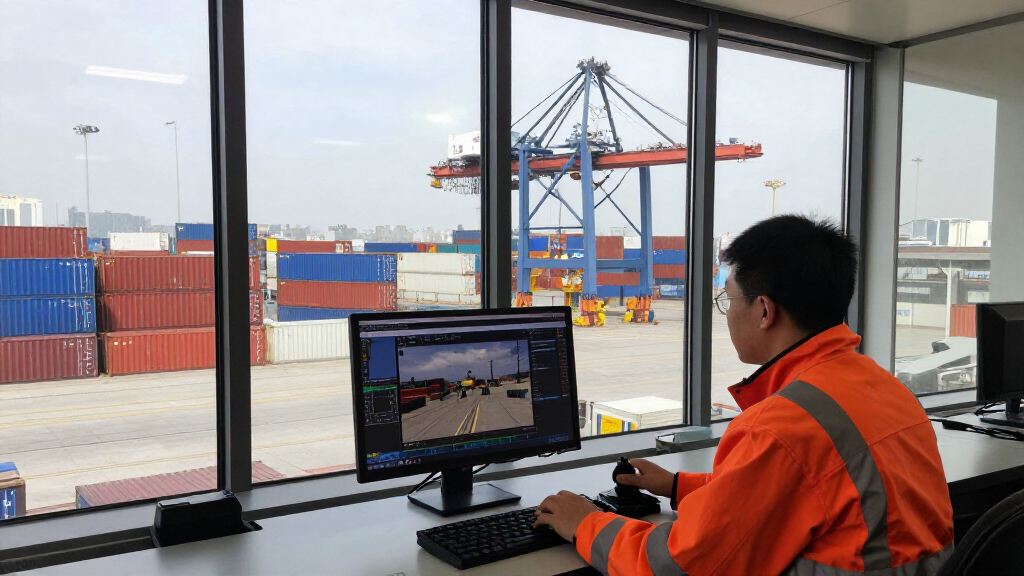
Today’s automation debate has direct consequences for workers, employers and shipping customers. Ports are central links in supply chains, so performance affects cargo movement as well as jobs and bargaining power. But the available evidence described in the article does not support a simple claim that automated terminals are always faster or that AI will remove dockworkers altogether. The cited 2024 report found both an operational advantage—denser stacking—and drawbacks, including slower moves and more breakdowns at some terminals.
Labor agreements also shape how technology affects workers. The 1960 West Coast deal paired mechanization with protections for covered workers; it is an example of negotiated change, not proof that future agreements will follow the same terms. The source notes that East and Gulf Coast dockworkers struck in 2024 over wages and automation, underscoring that the dispute involves pay and control over the pace of technological change as well as the number of jobs.
Products Worth Considering

Sonos Era 100 SL Compact Microphone-Free Speaker, Black

Samsung Odyssey G55C 32-Inch QHD Curved Gaming Monitor

Bose QuietComfort Wireless Noise Cancelling Headphones – Petal Pink Limited Edition
As an affiliate, we earn on qualifying purchases.
From Cargo Crates to Containers
Before containerization, port cargo was commonly handled as “break-bulk”: each package had to be lifted, sorted, stacked and secured separately. The source cites a cost estimate, reproduced in Levinson’s book, for shipping a truckload of medicine from Chicago to Nancy, France, around 1960. Port costs were $1,163 of a $2,386 total, or 48.7% of the listed bill; ocean shipping was $581. The figures illustrate how costly port handling could be in that example, not a current or universal shipping-cost breakdown.
Malcom McLean, a trucking businessman, helped establish the container system. The source cautions that the well-known story that he conceived the idea while waiting at a pier has no contemporary record identified in its research, and should be treated as a legend. The documented event it describes is the Ideal X’s 1956 voyage. The Port Authority of New York and New Jersey is cited for the point that metal cargo boxes existed before McLean’s system.
The labor impact unfolded over decades and was accompanied by bargaining and conflict. The article reports that registered British dockworkers fell from a peak of 82,000 to 9,400 in 1989, and that West Coast dockworkers struck for 134 days in 1971. These historical examples offer context for current disputes, but they do not predict the exact effect of AI or automation at any particular port.
““epochal in the annals of industrial relations””
— ThorstenMeyerAI.com article, citing the U.S. Bureau of Labor Statistics on the 1960 labor agreement
What Automation Data Cannot Show
The source gives no estimate of how many dock jobs AI will eliminate, how quickly that could happen, or which tasks are most likely to change. The cited 2024 government report is summarized rather than identified by title, and the article does not provide terminal-by-terminal figures or a common comparison period. Its reported findings therefore should not be read as a verdict on every automated port.
It is also unclear how much of the historic decline in dock employment can be attributed to containerization alone. The article supplies employment figures from different years and places, but those totals do not separate technology from changes in shipping volumes, port organization or other economic conditions. Nor does the historical 1960 agreement establish what protections workers will receive in current negotiations.
Finally, the article’s title asks whether AI will replace dockworkers, but the evidence presented mainly concerns containerization and terminal automation. It does not document a specific new AI system, deployment, job-cut announcement or forecast. The current record supports a discussion of technological change, not a definitive prediction of full replacement.
Watch Port Deals and Performance
The next meaningful evidence will come from detailed results at individual terminals: how automation affects throughput, breakdowns, staffing and working conditions over time. Comparisons will need to account for different cargo volumes and terminal layouts rather than treating one port’s results as universal. The source does not identify a scheduled report or a specific upcoming decision.
Labor negotiations will also show how employers and unions divide the gains and costs of mechanization. The 1960 agreement demonstrates one historical approach, while the 2024 East and Gulf Coast strike cited by the article shows that automation remains part of live labor disputes. Until newer, comparable data and specific job-impact agreements are available, the scale of AI’s effect on dock employment remains open.
Key Questions
Has AI been shown to replace dockworkers across container ports?
No. The source describes historical job reductions following containerization and mixed findings on automated terminals, but provides no evidence that AI has replaced dockworkers across ports.
What did the 2024 government report find about automated terminals?
As summarized in the article, the report found denser stacking, but also slower moves and more breakdowns at some terminals. The article does not supply the report’s title or detailed figures.
Why was containerization a major change for dock labor?
It replaced the handling of individual sacks, barrels and crates with standardized containers that cranes could move between ships and land transport. The source’s historical cost figures show a much lower loading cost for the Ideal X than for loose cargo in 1956.
Did dockworkers receive protections when West Coast ports mechanized?
A 1960 agreement between the ILWU and the Pacific Maritime Association provided a fund and other benefits for registered workers, along with a no-layoff promise for those covered. The article says the guarantees applied to registered “Class A” workers.
What remains unknown about AI and dock jobs?
The available material does not quantify future job losses, give a timeline for AI adoption, or show how effects will vary by port. It also does not separate containerization’s role in historical employment declines from other economic and operational changes.
Source: ThorstenMeyerAI.com