

🔍 Read the full analysis: 15 AI Automation Tools Small Businesses Can Consider In 2027 on ThorstenMeyerAI.com

Get business pricing on tech for your team
- Business-only prices and quantity discounts
- Tax-exempt purchasing
- Multiple users, one account, clear invoices
TL;DR
A roundup lists 15 books small-business owners can use to learn about AI automation, from broad business guides to titles focused on no-code workflows or ChatGPT. The source says the books are learning resources, not software platforms, and does not verify their detailed contents, integrations or results.
A roundup of AI automation resources for small businesses offers owners several ways to learn about automating marketing, sales, customer service and routine work. The list covers learning resources, not working software platforms; readers still need to choose and configure the tools that carry out any workflows.
The roundup names AI Automation for Small Businesses: A Practical Guide to Automating Marketing, Sales, Customer Service, Operations, and Everyday Work as its best overall pick, based on the wide range of business functions named in its title, while other AI automation guides for small businesses offer additional learning resources. It describes AI Automation Made Simple for Small Business as a beginner-oriented, no-code option and ChatGPT for Business: The 10X Playbook as a source of workflow ideas that readers may adapt.
The source also identifies 12 other titles, but supplies no individual descriptions or titles for them. To avoid inventing information, the entries below distinguish the three named books from 12 additional places in the roundup whose titles and details are not provided. The source says its comparisons rely on titles, stated audiences and promised formats, rather than verified assessments of each book’s contents.
Its selection criteria favor practical workflow coverage, a clear starting point for nontechnical owners and relevance to common business functions, much like roundups of AI automation tools for small businesses. The source cautions that titles alone cannot establish which software, integrations or setup instructions a book covers, or whether the advice produces a particular result.
The 15 picks
- 1
 Smart AI for Small Business: 50 Simple Hacks to Grow Revenue, Cut Costs, and…View on Amazon →
- 2
 The Small Business Owner’s AI Handbook: How to Use Artificial Intelligence to…View on Amazon →
- 3
 AI Tools for Small Business: A Practical Guide to Automation, Saving Time, an…View on Amazon →
- 4
 AI-Powered Automation and Workflows for Small Business OwnersView on Amazon →
- 5
 ChatGPT for Business: The 10X Playbook — 100 AI Workflows to Save Time, Grow…View on Amazon →
- 6
 AI Automation for Small Businesses: Build Smarter Workflows, Save Time, Reduc…View on Amazon →
- 7
 Claude AI Made Practical: A Beginner’s Guide to Everyday Work, Small-Business…View on Amazon →
- 8
 AI Automation for Small Businesses: A Practical Guide to Save Time, Work Smar…View on Amazon →
- 9
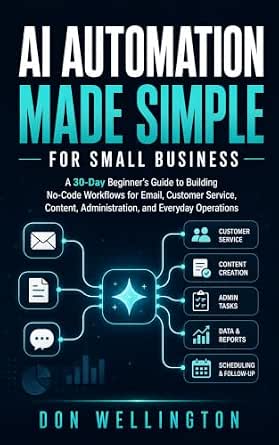 AI Automation Made Simple for Small Business: A 30-Day Beginner’s Guide to No…View on Amazon →
- 10
 AI Automation for Small Business: Simple AI Workflows for Everyday TasksView on Amazon →
- 11
 AI Automation for Small Business: A Practical Guide to Automating Marketing,…View on Amazon →
- 12
 AI for Small Business, Volume I: Getting Started — Set It Up Yourself, No Tec…View on Amazon →
- 13
 AI for Small Business: From Marketing and Sales to HR and OperationsView on Amazon →
- 14
 AI Automation for Small Businesses: Build Semi-Passive Income Systems Without…View on Amazon →
- 15
 AI for Entrepreneurs and Small Business Owners: How to Compete with Larger Bu…View on Amazon →
Choosing a Practical Automation Guide
For a small business, the choice of guide can shape whether an owner starts with a broad overview or a defined task. A no-code or beginner-focused book may suit someone who wants a structured entry point; a guide spanning several departments may be more relevant when the goal is to map multiple processes. These are signals in a title, not verified measures of instructional quality.
The practical distinction is between learning about a workflow and implementing it. Owners need to check whether suggested processes fit their existing email, calendar, customer-management and payment systems. They also need to decide which AI-generated outputs require human review, particularly for customer communications, sensitive information and business records. A book can suggest an approach, but tool compatibility and operating safeguards require separate checks.
Products Worth Considering

DJI Mic 3 Wireless Microphone Kit (2 Transmitters, 1 Receiver, Charging Case)

Jackery HomePower 2000 Plus v2 Portable Power Station, 2048Wh

Samsung Galaxy Tab S11 128GB Wi-Fi Android Tablet with S Pen, Silver
As an affiliate, we earn on qualifying purchases.
How the 15-Book List Was Framed
The supplied source evaluates the books as business learning resources, not as AI products. Its stated comparison considers the subject and format suggested by each title, including broad coverage, no-code workflows, a setup-yourself approach or a 30-day plan. It gives more weight to resources that appear to combine practical application with relevance across everyday business functions.
The source also recommends starting with a specific repetitive task, such as sorting inquiries or drafting follow-ups, and checking a book’s description or sample pages for usable setup detail. It does not provide a complete bibliography in the material supplied for this article. The following 15-item guide therefore includes the three identifiable titles and marks the remaining entries as unidentified in the source material, rather than assigning them fabricated names or features.
“These are learning resources, not automation platforms.”
— ThorstenMeyerAI.com roundup
Details Missing for Twelve Picks
The supplied source material does not name 12 of the 15 titles, so their authors, subject matter and place in the list cannot be independently represented here. It also gives no publication dates, editions, prices or links to contents. Its ranking is presented as an assessment based on title wording and stated scope, not on a documented review of chapters or tested workflows.
It remains unclear which AI services or software integrations any of the books cover, how current their instructions are, and whether their examples apply to a particular business. No performance results, customer outcomes or independent evaluations are supplied. Readers should confirm those details in the publisher’s description or a sample before buying.
Check the Guide Before Buying
Owners considering a title can begin by defining one repetitive process, identifying the software already used to handle it and deciding what outputs need human approval. They can then compare that need with the book’s description and sample pages, checking for step-by-step instructions, examples and relevant tool coverage.
The roundup provides no announced follow-up, testing schedule or update plan for 2027. Until a full list and supporting details are available, the 12 unnamed entries cannot be assessed. Any implementation should be tested on a limited workflow before expanding to customer-facing or sensitive tasks.
Key Questions
Are these 15 picks AI automation software?
No. The source describes them as books and learning resources. Businesses still need to select and configure software to run any automation.
Which titles are identified in the source?
The material names AI Automation for Small Businesses, AI Automation Made Simple for Small Business and ChatGPT for Business: The 10X Playbook. It does not identify the other 12 titles.
Which book does the roundup favor for broad coverage?
The source calls AI Automation for Small Businesses its best overall pick because its title covers marketing, sales, customer service, operations and everyday work. That is the roundup’s assessment, not an independently verified finding about the book’s contents.
What should a business check before choosing a guide?
Match the guide to a specific repetitive task, then check sample pages for practical instructions and confirm whether its advice fits the business’s existing software. Set human review rules before automating customer-facing or sensitive work.
Source: ThorstenMeyerAI.com