TL;DR
Diffusion models learn from images by adding noise in stages and training a neural network to predict what was added. During generation, they start with random noise and repeatedly remove it, with text prompts guiding the process. The method’s design helps explain common errors and why researchers have raised questions about reproducing training images.
Diffusion models generate images by starting with random noise and gradually removing it, guided by a text prompt, according to an explainer published by Thorsten Meyer AI on November 23, 2026. The process helps explain both how these systems create pictures and why they can struggle with lettering, counting objects and placing them correctly.

Get business pricing on tech for your team
- Business-only prices and quantity discounts
- Tax-exempt purchasing
- Multiple users, one account, clear invoices
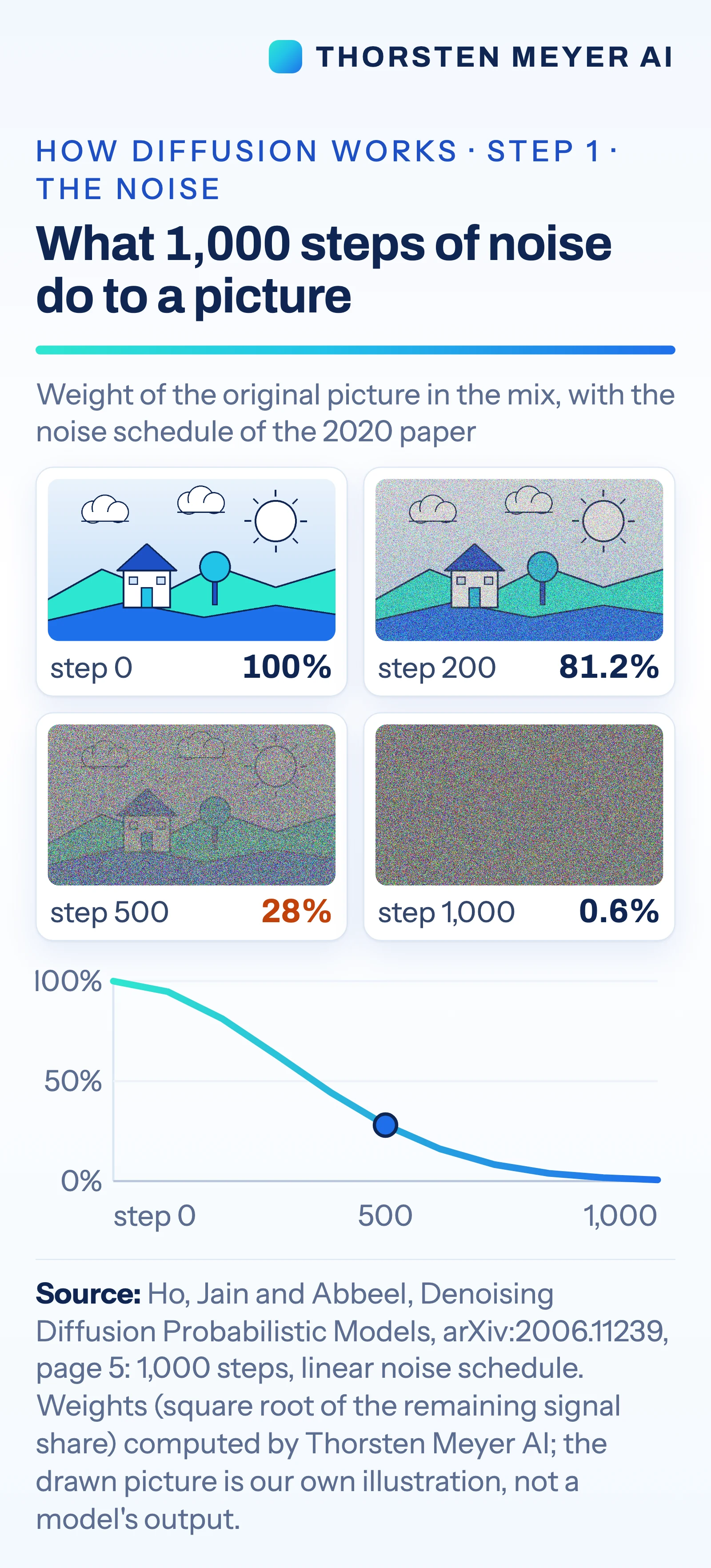
Training runs the process in the opposite direction. A model is shown real images that have been progressively mixed with noise, then learns to predict the noise at each stage. In the 2020 paper Denoising Diffusion Probabilistic Models, Jonathan Ho, Ajay Jain and Pieter Abbeel used 1,000 noise steps in their experiments. At the end of the sequence, the original image signal is largely gone.
To generate an image, the trained model begins with noise and repeatedly estimates what to remove. The explainer says a widely used open-source pipeline commonly runs 50 generation steps by default. Broad shapes tend to emerge before finer details as the process proceeds. A text encoder converts the prompt into numerical representations, and guidance steers the model’s successive estimates toward those words.
Many systems reduce the amount of data they process by working in a compressed representation called a latent space. The explainer gives Stable Diffusion v1 as an example: a 512 × 512 image is represented with 48 times fewer numbers during this stage. The source also notes a trade-off in prompt guidance: stronger guidance can make an output follow the text more closely, while reducing image quality.
Why Image Errors Persist
The stepwise process helps account for recognizable weaknesses. A model predicts patterns and relationships from learned data; it does not necessarily track objects as a person would. That can make exact counting and spatial relationships difficult, while letter shapes may break down because coherent text is a demanding visual pattern to reproduce.
Training data also matters beyond image quality. The explainer reports that researchers have extracted near-copies of some training images from models, raising questions about memorization and the use of copyrighted material. It cites a 2025 UK court finding that Stable Diffusion itself was not an “infringing copy”. That ruling addresses a particular legal question; it does not settle every dispute about training data or outputs.
Products Worth Considering

Anker SOLIX S2000 Portable Power Station, 2,010Wh, 1,500W

Kindle Paperwhite Signature Edition (2024), 32 GB, Metallic Black

Apple Watch Ultra 3 GPS + Cellular 49mm Smartwatch with Natural Titanium Milanese Loop
As an affiliate, we earn on qualifying purchases.
From Early Theory to Image Tools
The basic idea predates today’s image generators. In 2015, Jascha Sohl-Dickstein and colleagues described gradually destroying structure in data and learning a reverse process to restore it. The approach became practical for image generation through the 2020 work by Ho, Jain and Abbeel, which set out a diffusion model trained to predict noise added to images.
The explainer places diffusion models alongside other AI components. Text encoders turn prompts into representations the image model can use, while attention mechanisms help connect parts of a prompt with image features. It directs readers seeking more detail on neural networks and language models to related explainers. The article’s diagrams and noise levels are described as illustrative; they are not outputs from a particular model.
“systematically and slowly destroy structure in a data distribution through an iterative forward diffusion process”
— Jascha Sohl-Dickstein and colleagues, describing the 2015 method
Open Questions on Copying
The explainer does not specify which models or studies produced the reported near-copies, how often they occur, or how representative those cases are. It also does not resolve how different training datasets and model designs affect the risk of reproducing particular images.
The cited 2025 UK court finding concerns whether Stable Diffusion itself was an “infringing copy.” The material does not establish that all legal questions about training on copyrighted works or about generated images have been settled. Those questions remain distinct from the technical explanation of how noise removal works.
What Research Can Clarify
Further research and legal decisions will help clarify how training data relates to model outputs and what safeguards can reduce unwanted reproduction. For readers evaluating an image generator now, the explainer’s account points to practical limits: prompts guide the process, but they do not guarantee correct text, object counts or spatial arrangements.
Key Questions
Does a diffusion model search for an image matching the prompt?
No. In the process described here, it starts with random noise and repeatedly removes estimated noise, guided by the prompt.
How does a diffusion model learn?
During training, noise is added to real images in stages. A neural network learns to predict the added noise so it can estimate what to remove during generation.
Why can generated images get words or object positions wrong?
The model’s stepwise predictions can produce plausible visual patterns without reliably handling lettering, exact counts or spatial relationships. The explainer identifies these as familiar limitations.
Can diffusion models reproduce training images?
Researchers have extracted near-copies of training images from some models, according to the explainer. The material does not give rates or establish how common the behavior is across models.
What did the 2025 UK court find about Stable Diffusion?
The explainer says the court found that Stable Diffusion itself was not an “infringing copy.” It does not say that every legal question about training data or generated images was resolved.
Source: Thorsten Meyer AI