🔍 Read the full analysis: How To Choose A High Refresh Gaming Monitor For 2027 on ThorstenMeyerAI.com

Get business pricing on tech for your team
- Business-only prices and quantity discounts
- Tax-exempt purchasing
- Multiple users, one account, clear invoices
TL;DR
A ThorstenMeyerAI.com buying guide compares eight high-refresh gaming monitors by resolution, panel type, screen format and refresh rate. Its main point is that a higher refresh number is useful only if it fits your PC, games and viewing setup; the source does not establish 2027 pricing, availability or independent test results.
ThorstenMeyerAI.com has compared eight high-refresh gaming monitors for buyers weighing resolution, speed and screen format ahead of 2027. The guide names the MSI MAG 272URDFA E16 as its overall pick for combining 4K resolution with a stated 320Hz refresh rate, while cautioning that such a pairing calls for a powerful graphics card to make use of the speed.
The guide’s other leading options target different setups, as discussed in the original analysis. It describes the AOC Q27G41ZE as a conventional 27-inch QHD choice with a 240Hz native refresh rate and a 260Hz overclocked mode. The Samsung Odyssey OLED G6 is its panel-technology alternative, using QD-OLED rather than taking the same IPS-focused approach as several other entries; see these OLED gaming monitor picks. These rankings and descriptions are the source’s editorial assessments, not independently verified test findings provided in the material.
The remaining models cover distinct formats and budgets. The guide includes the ASUS VG259QM5A and Dell SE2426HG among 24-inch-class 1080p options focused on high refresh without the GPU load associated with 4K. It also lists the Sceptre 34-inch ultrawide, the 32-inch SANSUI, and the AOC C27G4ZH, a curved 27-inch 1080p monitor. The source does not provide full specifications for every model in its supplied material, so features not stated there should not be assumed.
Rather than ranking displays by their highest advertised refresh rate alone, the guide says it considered how refresh, resolution and screen size work together; see how to choose a high-refresh gaming monitor. It also says it weighed panel type, adaptive-sync support where specified, connectivity and adjustment details, while avoiding assumptions when a product feature was not listed.
The 8 picks
- 1
 Samsung 27" Odyssey OLED G6 (G61SH) QD-OLED Gaming MonitorView on Amazon →
- 2
 msi MAG 272URDFA E16 27-inch 3840 x 2160 (UHD) Gaming Office Monitor, 320Hz,…View on Amazon →
- 3
 Sceptre C345B-QU240T 34-inch Curved Ultrawide Gaming MonitorView on Amazon →
- 4
 SANSUI 32 Inch Curved 240Hz Gaming Monitor High Refresh Rate, FHD 1080PView on Amazon →
- 5
 AOC 27" Gaming Monitor QHD 240Hz Overclocked IPS NVIDIA G‑Sync Q27G41ZEView on Amazon →
- 6
 AOC C27G4ZH 27-Inch Curved FHD Gaming MonitorView on Amazon →
- 7
 ASUS TUF Gaming VG259QM5A 24.5-Inch 1080p 240Hz Gaming MonitorView on Amazon →
- 8
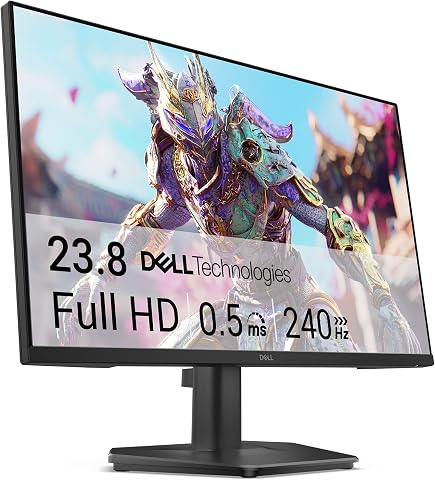 Dell 24 240Hz Gaming Monitor – SE2426HG – 23.8-inch FHD (1920×1080) 240Hz Dis…View on Amazon →
Match Monitor Speed to Your PC
The comparison matters because a monitor’s refresh rate is a capacity, not a promise that a computer will deliver matching frames. A 4K, 320Hz display may appeal to buyers who want both fine detail and high-speed play, but demanding games at 4K can ask much more of a graphics card than they do at 1080p. A display with very high refresh headroom may not deliver its full practical benefit if a PC rarely reaches those frame rates.
Resolution and physical size also affect the experience. The guide argues that QHD can balance detail and rendering demands, while 1080p can suit players prioritizing high frame rates on less powerful hardware. On larger screens, 1080p pixels may be more noticeable at a close desk distance. That makes the choice relevant not just to competitive players, but also to anyone matching a monitor to an existing PC, desk and game library.
Products Worth Considering

Samsung Galaxy Tab A11+ 11-Inch Tablet, 6GB RAM, 128GB Storage, Expandable Storage, Gray

Apple Watch SE 3 GPS 44mm Smartwatch

Sonos Era 300 Wireless Smart Speaker with Dolby Atmos, Black
As an affiliate, we earn on qualifying purchases.
Eight Picks, Different Tradeoffs
The source frames its list around use cases, not a claim that one monitor is best for every buyer. The MSI leads for its stated 4K-and-320Hz combination; the AOC QHD model is positioned as a more approachable balance of resolution and speed; and the Samsung is distinguished by its QD-OLED panel. The 1080p choices favor lower rendering demands, while the larger curved and ultrawide models put more emphasis on format and immersion.
The guide also notes that refresh rates above 240Hz can have diminishing practical value for some buyers: the difference between 240Hz, 260Hz and 320Hz depends in part on whether a system can produce very high, stable frame rates. Adaptive-sync support may help when frame rates vary, but the source says buyers should check which products include it and whether a setting must be enabled. It does not supply a complete feature-by-feature specification table in the material provided.
“I ranked these monitors by how well their refresh rate, resolution, and screen format work together, rather than treating the largest refresh number as an automatic win.”
— ThorstenMeyerAI.com buying guide
Prices and Test Results Not Supplied
The source material does not establish current prices, stock, regional availability or warranty terms for the listed monitors. It also does not provide independent benchmark results, measured response times, brightness figures or a complete specification set for every model. Its labels, including “best overall,” should therefore be read as the guide’s recommendations, not as a settled industry ranking.
It is also unclear how each monitor performs across different games, graphics cards and settings. The guide says high frame rates depend on the PC, but it does not include frame-rate testing or specify the hardware used for product comparisons. Buyers should verify current manufacturer specifications and game compatibility before purchasing, particularly for overclocked refresh modes and ultrawide support.
Verify Specs Before Buying
The next step for readers is to compare the guide’s use cases with their own setup: check typical frame rates in the games they play, confirm the monitor’s native and overclocked refresh modes, and verify adaptive-sync and connectivity details with the manufacturer or retailer. For ultrawide models, game support and interface behavior deserve a separate check; for larger 1080p screens, viewing distance and pixel density may determine whether the image looks sufficiently sharp.
Because the supplied material gives no confirmed release or pricing timeline, it is not possible to say when these models will be available or what they will cost in 2027. Buyers should treat the list as a comparison framework and confirm model specifications, pricing and availability close to purchase.
Key Questions
Which monitor does the guide name as its overall pick?
The guide names the MSI MAG 272URDFA E16, citing its combination of 4K resolution and a stated 320Hz refresh rate. It also cautions that reaching high frame rates at 4K requires a capable graphics card.
Is 320Hz automatically better than 240Hz?
No. The source says the practical value of higher refresh depends on whether a PC can produce very high, stable frame rates. It presents 240Hz as a strong baseline and the AOC’s 260Hz overclock as an extra, not the sole reason to buy.
Why choose a 1080p monitor instead of 4K?
1080p is less demanding to render than 4K, which may make higher frame rates easier to reach on a given PC. The guide points to its 24-inch-class 1080p models for players who prioritize responsive competitive play over sharper resolution.
What should buyers check about the ultrawide option?
Check whether the games you play support ultrawide aspect ratios and how they handle the interface. The guide notes that some titles may show side borders or stretch interface elements, so game compatibility matters.
Source: ThorstenMeyerAI.com