Antarctica’s seafloor is now a testing ground for AI-powered research, where advanced technologies help you better understand climate change, ocean flows, and underground ecosystems. Researchers deploy autonomous vehicles, sensors, and remote sensing tools to gather detailed data. AI analyzes large datasets quickly, revealing patterns and changes. This environment pushes tech development forward, offering insights that could impact global climate strategies. Keep exploring further to uncover how this innovative work shapes our understanding of Earth’s future.

Get business pricing on tech for your team
- Business-only prices and quantity discounts
- Tax-exempt purchasing
- Multiple users, one account, clear invoices
Key Takeaways
- Antarctica’s seafloor research employs AI algorithms to analyze vast datasets from sensors, imagery, and remote sensing tools.
- Innovative AI-powered camera systems enhance data collection quality in extreme Antarctic conditions.
- The region serves as a testing ground for AI-driven technologies in geophysical, biological, and chemical seafloor studies.
- Open data sharing and international collaboration accelerate AI development and application in Antarctic seafloor research.
- Insights gained support predictive models for climate change impacts, making Antarctica a natural laboratory for AI innovation.
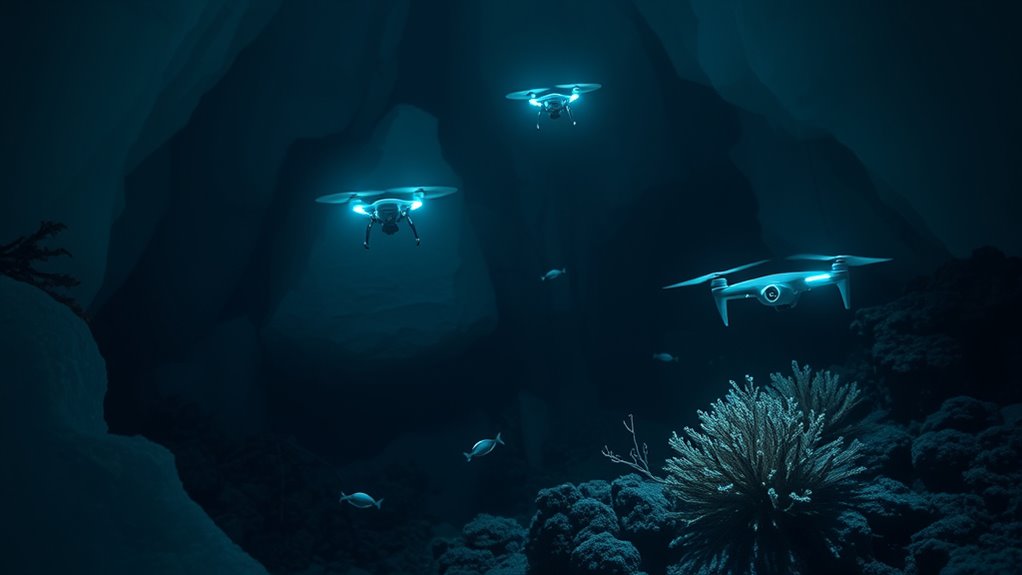
Have you ever wondered what lies beneath Antarctica’s icy surface? You might be surprised to learn that scientists are turning the continent’s seafloor into a pioneering testing ground for AI-powered research. This remote and extreme environment offers a unique opportunity to develop and refine advanced technologies that can handle the challenges of studying the deep ocean. By deploying seafloor cameras, sensors, and autonomous vehicles, researchers gather high-resolution images and data that reveal the hidden geology, biology, and chemical processes occurring beneath the ice. These tools, combined with AI and machine learning, analyze vast datasets efficiently, helping scientists identify patterns and track changes over time. Understanding the processes of ice-shelf thinning and grounding line retreat is essential for predicting future sea level rise. Imagine using AI algorithms to process satellite and passive microwave data for broad-scale monitoring of sea-ice dynamics and ocean circulation. These techniques make it possible to observe remote areas that would otherwise be inaccessible. UAVs, or uncrewed aerial vehicles, further extend observational coverage, especially during the short austral summer when most fieldwork occurs. In addition, innovative camera systems tested in Antarctica’s extreme conditions improve data collection quality, providing clearer insights into seafloor habitats, seeps, and volcanic vents. The deployment of remote sensing technologies enhances data acquisition in these challenging environments and complements onboard sensor systems. All these efforts support an extensive understanding of how seafloor interacts with overlying ice and ocean systems.
The integration of geophysical tools, like gravity, magnetics, and radar, helps create detailed images of the sub-seafloor, revealing sediment dynamics and geological features that influence climate-reactive fluid fluxes. Genomics techniques profile microbial and eukaryotic communities within sediments, uncovering biodiversity that was previously unknown. These insights are crucial for understanding how seafloor ecosystems respond to climate change and how they influence global processes.
Collaborative platforms and open data policies accelerate discoveries, connecting international teams and even non-scientists, such as cruise guests and tourism operators. The combination of technological innovations and global partnerships is making Antarctica’s seafloor an experimental hub for AI-driven research. This work not only deepens our understanding of the Antarctic environment but also enhances our ability to predict and respond to climate change impacts on a planetary scale.
underwater autonomous vehicle for research
As an affiliate, we earn on qualifying purchases.
As an affiliate, we earn on qualifying purchases.
Frequently Asked Questions
How Does AI Improve Data Collection in Antarctica’s Deep-Sea Research?
AI improves data collection in Antarctica’s deep-sea research by analyzing images and videos in real time, drastically reducing analysis time from hours to seconds. You can cover larger areas quickly and accurately, detecting species and mapping habitats more effectively. AI handles vast data volumes, enabling you to identify threats and make informed decisions faster. It also collaborates with you to enhance precision and uncover new discoveries in this extreme environment.
What Challenges Do Researchers Face Deploying AI Technology in Extreme Cold?
You face a harsh reality deploying AI in extreme cold—batteries falter, risking sudden shutdowns, while sensors freeze or get blocked by ice, complicating data collection. The freezing temperatures degrade hardware, demanding rugged, self-sufficient systems. Limited maintenance access means you must rely on highly reliable technology that can operate autonomously for long periods. Power constraints and unpredictable weather threaten continuous operation, making every decision critical in this unforgiving environment.
How Does AI Help Detect New Marine Species in Antarctic Waters?
AI helps you detect new marine species in Antarctic waters by analyzing vast amounts of images and videos quickly, identifying both common and rare animals in real-time. Machine learning models recognize unique features, even of previously unseen species, and validate findings with experts. Acoustic AI detects whale vocalizations, expanding your ability to monitor elusive species. Satellite and onboard AI systems further extend your reach, providing extensive, scalable insights into Antarctica’s diverse marine life.
What Are the Environmental Impacts of Ai-Powered Exploration?
You know what they say, “forewarned is forearmed.” AI-powered exploration minimizes environmental impacts by reducing the need for frequent ship trips, lowering carbon emissions, and decreasing physical disturbance of fragile habitats. It enables real-time monitoring and targeted conservation, helping you detect threats early. However, over-reliance might cause overlooked nuances or over-surveying risks, so balancing AI use with careful oversight guarantees your efforts protect Antarctic ecosystems effectively.
How Will Ai-Driven Research Influence Global Climate Change Understanding?
AI-driven research will transform your understanding of global climate change by revealing complex ice melt and ocean processes, improving prediction accuracy for sea-level rise, and uncovering hidden feedback loops like slush formation. You’ll gain clearer insights into how climate systems respond to warming, enabling more effective policies and adaptation strategies. With real-time data and autonomous monitoring, you’ll be better equipped to track climate shifts and mitigate their impacts worldwide.
high-resolution seafloor camera systems
As an affiliate, we earn on qualifying purchases.
As an affiliate, we earn on qualifying purchases.
Conclusion
As you reflect on Antarctica’s seafloor becoming an AI testing ground, it’s almost poetic how this icy frontier now hosts the future of discovery. Coincidentally, the same technology that unravels hidden secrets beneath the ice also helps us better understand our planet’s fragile balance. In this unexpected convergence, you realize that innovation often emerges from the most remote corners—reminding you that even the coldest places can ignite the warmest ideas.
remote sensing tools for ocean monitoring
As an affiliate, we earn on qualifying purchases.
As an affiliate, we earn on qualifying purchases.
AI-powered ocean data analysis software
As an affiliate, we earn on qualifying purchases.
As an affiliate, we earn on qualifying purchases.
Halloween Picks
halloween
As an affiliate, we earn on qualifying purchases.