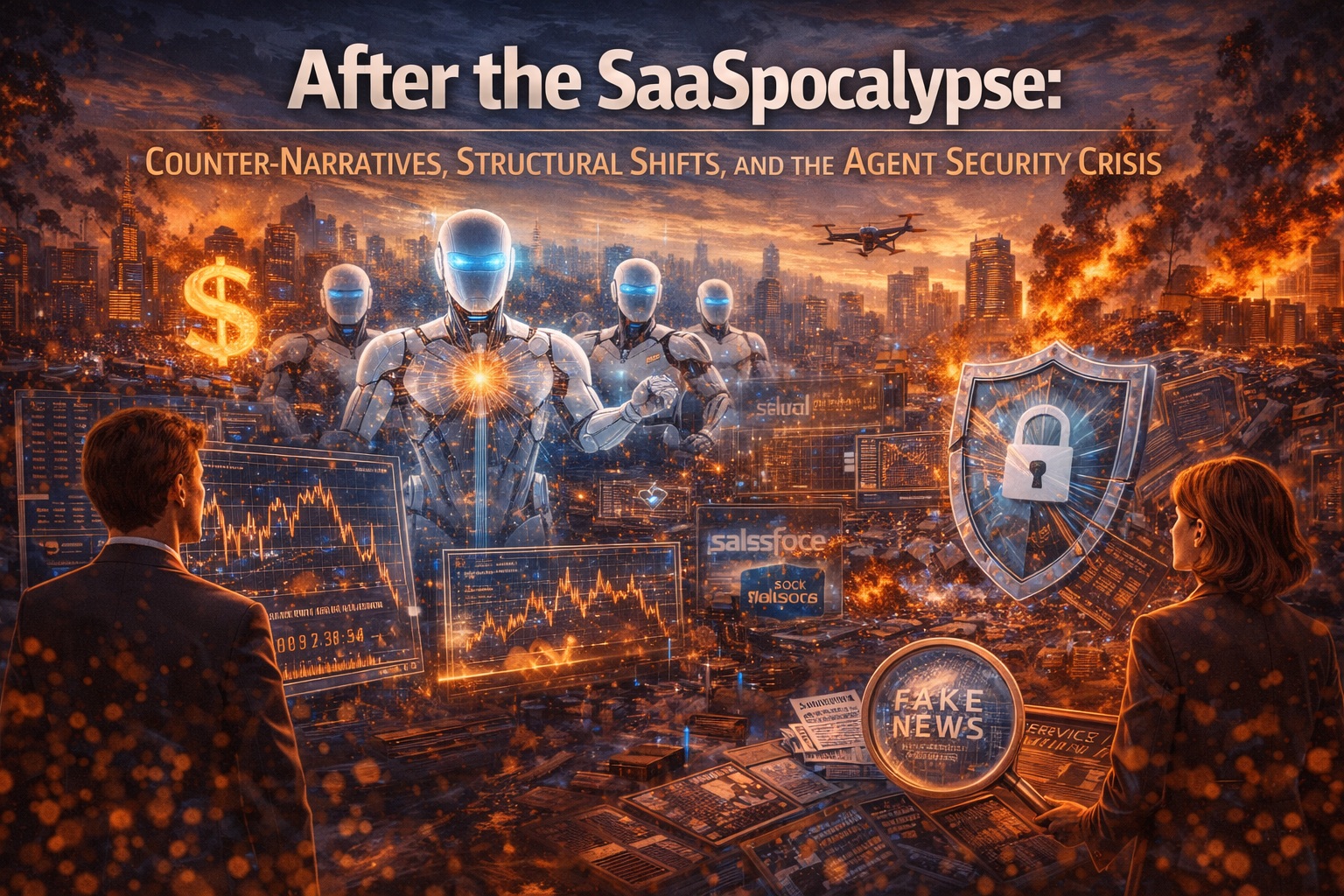

By Thorsten Meyer | ThorstenMeyerAI.com | February 2026
Executive Summary
The SaaSpocalypse wiped $400 billion from software stocks in a week. The response from SaaS CEOs was predictable: “You’re overreacting.” Marc Benioff dismissed the threat — “I don’t understand what the replacement is” — while simultaneously cutting Salesforce’s support staff from 9,000 to 5,000 using Agentforce. Aaron Levie called it a “hybrid future.” Brad Gerstner pulled his money out of high-multiple cloud stocks. Sam Altman told the world that OpenAI is “an API company” — and its API just hit $1 billion ARR in a single month.
Meanwhile, Microsoft — the company that was supposed to win the AI transition — lost $357 billion in market cap after reporting Azure growth of 39%, which the market decided was too slow for a company spending $37.5 billion per quarter on AI infrastructure. And the piece nobody is talking about: AI agents are opening a security attack surface so new that traditional tools can’t even see the traffic. Over 230 malicious extensions appeared on OpenClaw’s marketplace in the first two weeks. MCP protocol vulnerabilities enable remote code execution. Security engineers are now the highest-demand role in tech, with AI security specialists commanding $152,000–$210,000.
This isn’t just a market correction. It’s a structural realignment where the CEOs are saying one thing, the markets are pricing another, and neither side has reckoned with the security crisis that the AI agent transition creates.
| Metric | Value |
|---|---|
| Software market cap lost (Feb 2026 week) | $400B+ |
| Microsoft market cap lost (post-earnings) | $357B |
| Microsoft quarterly AI capex | $37.5B |
| OpenAI API ARR (January 2026) | $1B (single month) |
| Salesforce Agentforce paid deals | 10,000+ |
| Salesforce support staff reduction | 9,000 → 5,000 |
| Malicious OpenClaw extensions (first 2 weeks) | 230+ |
| AI security engineer salary range | $152K–$210K |
| Global cybersecurity talent gap | 4.8M workers |
This article examines the counter-arguments to the SaaSpocalypse, why even the optimistic case reveals structural weakness, what Microsoft’s crisis means for the AI infrastructure bet, and why AI agent security is the unpriced risk that should keep every CISO awake.

AI SOC Mastery: Digital Security Strategy | SOC Workflow Optimization | Cybersecurity AI Tools | AI Threat Intelligence | Advanced Security Automation | Automated Cyber Defense
As an affiliate, we earn on qualifying purchases.
As an affiliate, we earn on qualifying purchases.
1. The Counter-Narrative: SaaS CEOs Push Back
“I Don’t Understand What the Replacement Is”
Within days of the selloff, every major SaaS CEO had a talking point. Marc Benioff told analysts that Agentforce represents a “multi-trillion-dollar TAM” in digital labor. Aaron Levie argued that enterprise data is the moat. Jensen Huang called the idea that software is dead “the most illogical thing in the world.”
The counter-narrative has three pillars:
| Pillar | Argument | CEO Champion |
|---|---|---|
| Data gravity | Customer data creates irreplaceable moats | Levie (Box), Benioff (Salesforce) |
| Hybrid evolution | SaaS + AI agents coexist; software evolves, doesn’t die | Levie, Benioff |
| Digital labor TAM | AI agents expand the market, not just cannibalize it | Benioff (Salesforce) |
Benioff’s specific case: Salesforce’s Agentforce now handles 31,000 support cases per cycle — up from 26,000 — while human-escalated cases dropped from 10,000 to 5,000. The company has racked up over 10,000 paid Agentforce deals since its September 2024 launch. Organic sales growth is projected to accelerate above 10% year-over-year in 2026 thanks to Agentforce.
Levie’s specific case: Enterprise data locked in systems of record creates a defensible position. AI needs data; companies that own the data layer can become the intelligence layer. Box is repositioning from “cloud storage” to “AI-to-content platform.”
What the Counter-Narrative Gets Right
The CEOs aren’t entirely wrong. Enterprise software replacement genuinely is “open-heart surgery” — multi-year contracts, deep integrations, regulatory requirements, and organizational inertia create real barriers to rapid substitution. SAP and Oracle aren’t going anywhere fast.
And the TAM expansion argument has merit: if AI agents create entirely new categories of digital work, the total addressable market for software that orchestrates those agents could exceed the current SaaS market.
What the Counter-Narrative Conveniently Omits
But the counter-narrative has a credibility problem. The same CEOs arguing that SaaS is safe are simultaneously:
- Cutting headcount: Salesforce reduced support from 9,000 to 5,000 using AI. In January 2026, Salesforce laid off nearly 1,000 more employees from Agentforce AI and marketing teams.
- Shifting pricing models: Benioff describes “digital labor” as a pricing concept — outcome-based, not per-seat. This is an implicit admission that the per-seat model is dying.
- Spending to survive: Salesforce is using AI for up to 50% of its own workload — which means it needs 50% fewer seats of its own products internally.
“Marc Benioff says SaaS isn’t dying while cutting 45% of his support staff. Aaron Levie says data is the moat while repositioning his entire product around AI. The counter-narrative isn’t wrong — it’s just describing a company that looks nothing like the one investors originally bought.”

Ghidra Software Reverse-Engineering for Beginners: Master the art of debugging, from understanding code to mitigating threats
As an affiliate, we earn on qualifying purchases.
As an affiliate, we earn on qualifying purchases.
2. The Valuation Thesis: Brad Gerstner Runs the Math
Altimeter’s Position
Brad Gerstner — founder of Altimeter Capital and one of the most vocal cloud investors of the last decade — isn’t buying the counter-narrative. Altimeter has been pulling back from high-valuation cloud names and rebalancing toward companies with durable AI monetization pathways.
The thesis is specific: SaaS companies priced at 5–8x revenue are only fairly valued if they can demonstrate that AI enhances rather than replaces their core revenue streams. Companies that can’t make that case face further compression toward 2–3x — territory previously reserved for legacy enterprise software.
The Valuation Compression Math
| Scenario | Revenue Multiple | Implied Outcome |
|---|---|---|
| SaaS peak (2021) | 18–19x | AI as feature/upsell (proved wrong) |
| Pre-SaaSpocalypse (Dec 2025) | 5.1x | Cautious; priced in slowing growth |
| Post-SaaSpocalypse (Feb 2026) | 3.5–4.5x (est.) | Market pricing substitution risk |
| Bear case: structural disruption | 2–3x | SaaS treated as legacy software |
| Bull case: AI-native pivot | 6–10x | Usage-based model proves durable |
What Gerstner Sees That Benioff Won’t Say
The core insight: revenue quality matters more than revenue level. A SaaS company growing at 15% by hiking prices 9–25% on a shrinking customer base is a fundamentally different business than one growing at 15% by expanding usage across an AI-augmented customer base.
Gerstner’s question for every cloud investment: Is the growth organic or defensive? If up to 72% of forward growth comes from price increases rather than new customers or expansion, that’s a business extracting value from existing relationships — not building new ones.
Callout: Brad Gerstner’s real insight isn’t that SaaS is dying. It’s that the quality of SaaS revenue has deteriorated — and the market is finally pricing quality, not just quantity.
Cybersecurity & Networking Poster – The OSI Model Reference Guide, IT Classroom Decor and Tech Enthusiast Wall Art(Unframed,12X18inch(30X45cm))
- White Margin for Framing: 0.6in (1.5cm) reserved margin
- Durable Canvas Material: Resistant to humidity and environmental damage
- Color Variations: Slight color differences due to monitor settings
As an affiliate, we earn on qualifying purchases.
As an affiliate, we earn on qualifying purchases.
3. The API Company: Sam Altman’s Structural Argument
“Every Company Will Be an API Company”
Sam Altman has been consistent about one thing: OpenAI is an API company. In January 2026, OpenAI’s API hit $1 billion in annual recurring revenue in a single month — a run-rate that doubled in under a year. Enterprise is Altman’s stated top priority for 2026.
The structural argument is more radical than the SaaSpocalypse suggests. Altman isn’t just saying AI replaces SaaS. He’s arguing that the entire application layer becomes thin — that the future of software is API-first experiences where AI does the work and the interface is minimal.
What “API Company” Actually Means for SaaS
| Traditional Stack | AI-Native Stack |
|---|---|
| Application (UI) → thick, proprietary | Application → thin, often AI-generated |
| Business logic → custom code | Business logic → model inference + prompts |
| Data layer → database | Data layer → vector store + context window |
| Integration → point-to-point APIs | Integration → agent-to-agent protocols |
| Pricing → per seat | Pricing → per API call / per outcome |
The implication: if Altman is right, the value migrates from the application layer (where SaaS lives) to the model layer (where OpenAI, Anthropic, and Google live) and the data layer (where enterprises own the defensible asset). The application layer — currently a $600B+ market — gets compressed between the two.
The Counter-Counter: Why the API Vision Has Limits
The API-first model has genuine constraints:
- Reliability: Enterprise workflows require >99.9% uptime. API-dependent architectures introduce single points of failure that SaaS applications internalize.
- Compliance: Regulated industries need audit trails, data residency guarantees, and explainability that API-first architectures don’t natively provide.
- Switching costs: Ironically, heavy API integration creates its own lock-in — not to a SaaS vendor, but to a model provider. Trading one dependency for another.
“Sam Altman says every company will be an API company. The question is whether ‘API company’ just means the model provider captures the margin that used to go to the SaaS vendor. Meet the new boss — probably the same as the old boss, except this one runs on GPUs.”

AI and Third-Party Risk: Solutions for Assessing and Managing Your AI Vendors and Systems
As an affiliate, we earn on qualifying purchases.
As an affiliate, we earn on qualifying purchases.
4. Microsoft’s Dual Crisis: Too Big to Pivot, Too Invested to Stop
The Numbers Nobody Expected
Microsoft was supposed to be the bridge between old software and new AI. Instead, it became a case study in how even the best-positioned company can get caught between worlds.
After Q2 FY2026 earnings, Microsoft lost $357 billion in market cap — the largest single-day loss for any company in the AI era. Azure grew 39%, which sounds impressive until you realize the market expected more from a company spending $37.5 billion per quarter on AI infrastructure.
| Microsoft Metric | Value | Context |
|---|---|---|
| Market cap lost (post-earnings) | $357B | Largest single-day loss in AI era |
| Azure growth | 39% | Below consensus; market punished |
| Quarterly AI capex | $37.5B | $150B annualized infrastructure spend |
| RPO tied to OpenAI | ~45% | Revenue concentration risk |
| Copilot enterprise seats | Growing but unspecified | Adoption slower than projected |
The Capex Trap
Microsoft’s problem is structural: it needs to spend $150 billion per year on AI infrastructure to stay competitive, but it can’t yet demonstrate that the spend generates proportional revenue. The market’s math: Azure AI revenue needs to grow at 50%+ sustained to justify the capex. At 39%, the gap between investment and return is widening.
Meanwhile, ~45% of Microsoft’s remaining performance obligations (RPO) are tied to OpenAI agreements — creating a revenue concentration risk that makes the company’s AI future dependent on a single partnership that it doesn’t control.
The Security Pivot
Microsoft’s most significant move isn’t a product launch — it’s a strategic pivot toward AI agent security and compliance. As enterprises deploy millions of AI agents across their infrastructure, the identity, access, and governance layer becomes critical. Microsoft is positioning Azure Active Directory, Purview, and Defender as the trust layer for agentic workloads.
This pivot reveals something the SaaSpocalypse narrative misses: the biggest near-term opportunity isn’t in building AI agents. It’s in securing them.
5. The Agent Security Crisis: The Risk Nobody Priced
The Attack Surface That Didn’t Exist Six Months Ago
While investors debated SaaS valuations, AI agents quietly opened the most significant new attack surface in enterprise computing since the move to cloud. The problem: AI agents are autonomous, tool-using systems that operate with user-level or system-level permissions across enterprise infrastructure. Traditional security tools were built for human-initiated requests, not autonomous agent operations.
OpenClaw’s Claw Hub: A Case Study in AI Supply Chain Risk
OpenClaw’s marketplace — the largest open-source registry for AI agent extensions — became ground zero for AI supply chain attacks. Within the first two weeks of a coordinated campaign starting January 27, 2026, security researchers identified over 230 malicious extensions (sometimes reported as ~400 including variants) that:
- Exfiltrated sensitive data through seemingly benign tool integrations
- Injected persistent backdoors into agent memory and context
- Escalated privileges by exploiting agent-to-tool trust boundaries
- Poisoned training data by manipulating agent feedback loops
The attack vector is novel: malicious actors don’t need to compromise the AI model itself. They compromise the extensions, tools, and skills that agents use — the equivalent of a supply chain attack, but for AI agent capabilities rather than software libraries.
MCP Protocol Vulnerabilities: The Architecture Is the Attack Surface
The Model Context Protocol (MCP) — the emerging standard for agent-to-tool communication — has revealed fundamental security flaws:
| Vulnerability Class | Description | Impact |
|---|---|---|
| Remote code execution | MCP server CVEs allow arbitrary code execution on host systems | Full system compromise |
| Confused deputy | Agents act on manipulated context, using legitimate permissions for malicious purposes | Privilege escalation without credential theft |
| Memory injection | Malicious content persists in agent memory across sessions, influencing future decisions | Persistent compromise that survives restarts |
| Prompt injection | Adversarial inputs in tool outputs redirect agent behavior | Agent performs unintended actions with full permissions |
| Tool shadowing | Malicious tools register under names that mimic legitimate tools | Agents invoke attacker-controlled code unknowingly |
The fundamental issue: agents make autonomous decisions about which tools to invoke, what data to access, and what actions to take. Traditional security models assume a human in the loop. AI agents remove that assumption.
Why Traditional Security Can’t See Agent Traffic
Existing enterprise security tools — SIEMs, EDRs, CASBs, identity providers — were designed to monitor human-initiated requests flowing through known network paths. AI agent traffic is different:
- Agent-to-agent communication bypasses traditional network monitoring
- Dynamic tool invocation creates unpredictable access patterns
- Context-window reasoning means the “decision” to access a resource happens inside the model, invisible to external monitoring
- Chained operations mean a single agent action can trigger cascading tool calls across multiple systems
One security researcher summarized it: “We built our entire security stack to watch humans click buttons. Agents don’t click buttons. They invoke APIs at machine speed, and our tools can’t tell the difference between a legitimate workflow and an exfiltration campaign.”
The Demand Signal: Security Engineers Are the New Bottleneck
The market response is already visible in hiring:
| Role | Salary Range (2026) | Demand Signal |
|---|---|---|
| AI Security Engineer | $152K–$210K | Highest demand in cybersecurity |
| AI Agent Governance Specialist | $140K–$190K | Emerging role; limited supply |
| MCP/Agent Protocol Auditor | $130K–$175K | Net-new category; near-zero supply |
| AI Red Team Lead | $160K–$220K | Premium over traditional red team |
The global cybersecurity workforce gap is 4.8 million workers. AI agent security adds an entirely new dimension to that gap — requiring expertise that combines AI/ML knowledge, protocol security, supply chain risk management, and enterprise identity governance. The talent doesn’t exist at scale.
Callout: The SaaSpocalypse is a market repricing. The agent security crisis is an operational risk. One wipes out paper wealth. The other wipes out data, trust, and institutional integrity. Guess which one gets more coverage.
6. The Emerging Equilibrium: What the Next 12 Months Look Like
Three Scenarios
| Scenario | Probability | Key Driver | Market Outcome |
|---|---|---|---|
| Managed transition | 40% | SaaS incumbents successfully integrate AI; pricing evolves gradually | Multiples stabilize at 4–6x; security spending accelerates |
| Accelerated disruption | 35% | AI agent capabilities advance faster than incumbent adaptation; major security incident | Further compression to 2–3x; security becomes board-level priority |
| Counter-reformation | 25% | Regulation, security concerns, or AI reliability failures slow agent adoption | Partial recovery to 5–7x; incumbent moats prove deeper than feared |
The Variables That Matter
For SaaS valuations:
- Q1 2026 earnings: net seat count trends (not revenue, which lags)
- Pricing model pivots: who moves to usage-based first?
- Agentforce, Copilot, and Claude Cowork enterprise adoption rates
For Microsoft’s AI bet:
- Azure AI revenue growth trajectory vs. $150B annual capex
- OpenAI partnership stability and RPO concentration
- Security product adoption as enterprise agent governance standard
For AI agent security:
- First major enterprise breach attributed to agent compromise
- Regulatory response to MCP/agent protocol vulnerabilities
- Insurance industry response to agent-related risk exposure
7. Strategic Implications and Actions
For Enterprise Leaders
1. Don’t wait for the breach. Audit your current AI agent deployments for supply chain risk. Review every extension, plugin, and skill your agents use. If you’re using OpenClaw or similar marketplaces, implement verification before the next malicious campaign.
2. Build an agent security architecture now. Traditional security tools cannot govern autonomous agents. You need agent-specific monitoring: tool invocation logs, context-window auditing, privilege boundary enforcement, and agent-to-agent communication visibility.
3. Evaluate the counter-narrative critically. When SaaS vendors tell you AI enhances their product, ask: does it enhance the product, or does it eventually replace the need for the product? If Salesforce’s Agentforce handles 31,000 support cases that previously required human seats running Salesforce software, what does that do to your own seat count?
4. Plan for the API-first transition. Whether Altman is right about timeline or not, the direction is clear: application layers are thinning. Build internal capability to orchestrate AI agents through APIs rather than through per-seat SaaS applications.
For Investors
5. Price security into every AI investment thesis. Every company deploying AI agents needs agent security. Every company selling AI agent platforms needs to demonstrate security maturity. This is the overlooked adjacency that produces the next wave of enterprise spending.
6. Distinguish revenue quality, not just quantity. Growth from price hikes on a shrinking customer base is fundamentally different from growth through AI-native expansion. Gerstner’s framework — organic vs. defensive growth — is the right lens.
7. Watch Microsoft’s capex-to-revenue ratio. If Azure AI revenue doesn’t accelerate to 50%+ growth within two quarters, the $150B annual capex creates a widening gap between investment and return. The market will reprice again.
For Policymakers
8. Regulate the agent supply chain. AI agent extension marketplaces are the new software supply chain. The OpenClaw incident demonstrates that existing supply chain security frameworks (SBOM, SLSA) don’t cover agent-specific attack vectors. New standards are needed.
9. Establish agent identity and audit requirements. If AI agents operate with user-level permissions in critical infrastructure, they need identity, authentication, and audit trail requirements equivalent to human operators. Current regulatory frameworks have no concept of “agent identity.”
10. Fund the security talent pipeline. A 4.8-million-worker cybersecurity gap was already critical. AI agent security adds requirements for an entirely new skill set that the current education and certification pipeline doesn’t produce.
What to Watch Next
- First major enterprise breach attributed to AI agent compromise — the “SolarWinds moment” for agent security
- Q1 2026 SaaS earnings — net seat count and revenue quality indicators
- Microsoft Q3 FY2026 earnings — Azure AI revenue vs. capex trajectory
- MCP protocol security standards — whether the industry self-regulates before regulators force it
- Salesforce Agentforce adoption vs. seat count — the real test of whether “digital labor” expands or cannibalizes the TAM
- Insurance industry response — when cyber insurers begin pricing agent-specific risk, enterprise behavior changes fast
The Bottom Line
The SaaSpocalypse triggered a market repricing. The counter-narratives from SaaS CEOs are partially valid — enterprise replacement is slow, data moats are real, and the TAM for AI-augmented software may genuinely be larger than the current SaaS market. But the counter-arguments have a fatal weakness: the CEOs making them are simultaneously proving the bear case by cutting their own headcount, shifting their own pricing, and automating their own operations using exactly the technology they claim doesn’t threaten their business model.
Microsoft’s $357 billion loss reveals a different dimension: even the company best positioned to bridge old software and new AI is struggling to demonstrate that the math works at scale. When you spend $150 billion a year on AI infrastructure and the market still says “not enough return,” the problem isn’t execution — it’s that the transition is more expensive and uncertain than anyone modeled.
And the piece that neither bulls nor bears have priced: AI agent security is a crisis in formation. Over 230 malicious extensions in two weeks. Protocol vulnerabilities that enable remote code execution. A security stack built for humans, deployed against autonomous agents. The first major agent-attributed breach hasn’t happened yet — but the attack surface is wide open, the tools don’t exist, and the talent to build them is four million workers short.
The SaaSpocalypse asked whether AI kills SaaS. The better question: who secures the AI agents that are supposed to replace it? Because right now, the answer is nobody.
The market repriced software. It hasn’t started pricing the security cost of what comes next.
Thorsten Meyer is an AI strategy advisor who notes that “the replacement for per-seat software” might just be “per-breach insurance premiums” — which, for the record, also price by the seat. More at ThorstenMeyerAI.com.
Sources:
- Axios: AI Wiped Out $400 Billion This Week — February 2026
- Computing.co.uk: Salesforce CEO Benioff Dismisses Threat to SaaS from Agentic AI — February 2026
- Fortune: Salesforce CEO Marc Benioff on AI Agents at Dreamforce — October 2025
- CIO Dive: Salesforce Banks on AI Deals as Customers Move Past Pilot Stage — 2026
- Fox Business: Salesforce Reduces Customer Support Workforce from 9,000 to 5,000 Using AI — 2026
- Latestly: Salesforce Lays Off Nearly 1,000 from Agentforce and Marketing Teams — January 2026
- CNBC: AI Fears Pummel Software Stocks — February 2026
- Bloomberg: What’s Behind the ‘SaaSpocalypse’ Plunge — February 2026
- HBR / Palo Alto Networks: 6 Cybersecurity Predictions for the AI Economy in 2026 — December 2025
- Practical DevSecOps: Top 10 Emerging AI Security Roles 2026 — 2026
- Practical DevSecOps: AI Security Engineer Roadmap 2026 — 2026
- Microsoft Cloud Blog: Adapting Identity and Network Security to AI Agents — January 2026
- Black Duck: AI Security Trends 2026 — 2026
- Daniel Miessler: Cybersecurity Changes Expected in 2026 — 2026
- ClearanceJobs: From AI Hype to AI Risk — 2026 Forecast — January 2026
- CNBC: Dario Amodei Warns AI May Cause ‘Unusually Painful’ Disruption — January 2026
- Fast Company: Salesforce Using AI for Up to 50% of Workload — 2025
- Cloud Wars: Benioff on Agentic AI ‘Thrilling Customers’ — 2026