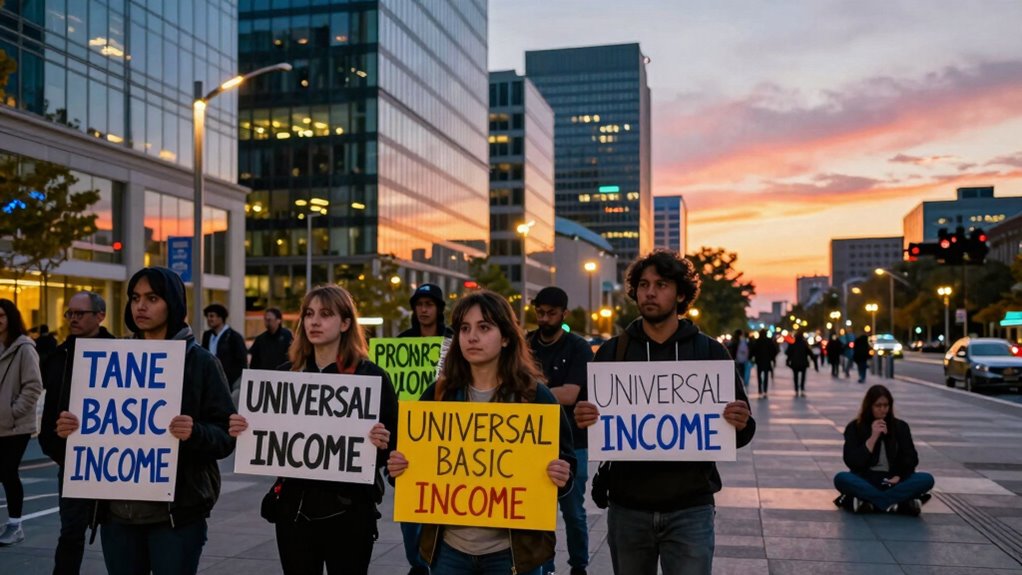
The strongest critique of UBI is that it might discourage people from working, undermining economic growth and social mobility. As a supporter, you need to show how UBI can be structured to maintain motivation through phased implementation or conditional support. Addressing these concerns effectively will help build trust and demonstrate UBI’s long-term sustainability. Keep exploring how these strategies can make UBI both practical and beneficial for everyone.

Get business pricing on tech for your team
- Business-only prices and quantity discounts
- Tax-exempt purchasing
- Multiple users, one account, clear invoices
Key Takeaways
- The primary critique is that UBI may discourage work, risking reduced labor participation and economic productivity.
- Supporters must demonstrate how UBI can be structured to maintain work incentives effectively.
- Addressing funding sustainability is crucial to prevent inflation and fiscal strain that could undermine UBI’s viability.
- Policy design should incorporate targeted incentives or conditional support to counteract potential disincentives.
- Transparent economic analysis and innovative financing are essential to convince skeptics of UBI’s long-term sustainability.

Is universal basic income (UBI) truly the answer to economic inequality and job displacement? That question cuts to the heart of the most significant critique of UBI: its potential to undermine work incentives and threaten economic sustainability. Supporters often highlight how UBI can provide a safety net, but the concern remains that offering a guaranteed income without conditions might reduce people’s motivation to work. If enough individuals decide that earning less becomes less appealing than receiving a basic income, the labor market could suffer, leading to decreased productivity and economic growth. This risk raises the question: Can UBI maintain enough work incentives to keep the economy thriving?
Many skeptics argue that, without some form of conditionality or work requirement, UBI might create a disincentive for employment. When people receive money regardless of whether they work or not, some may choose to work less, or not at all, especially if the basic income is sufficient to meet their needs. This could lead to a decline in the overall labor force participation rate, which in turn might slow down economic progress and reduce the crucial vitality of markets. Such a scenario threatens the core goal of UBI—reducing inequality—if it inadvertently discourages the very employment that generates income and social mobility.
Beyond work incentives, there’s the challenge of ensuring economic sustainability. Funding a universal cash transfer for everyone requires vast resources, often implying higher taxes or reallocation from other essential programs. Supporters need to answer how UBI can be financed without creating excessive fiscal burdens or inflationary pressures. If the costs are unsustainable, the entire concept risks collapsing under its own weight, leaving taxpayers burdened or public services underfunded. The economic sustainability of UBI hinges on balancing these costs with the benefits, and many question if this balance is achievable in the long term. Additionally, innovative financing methods such as technology-driven tax reforms could play a crucial role in making UBI more feasible. Furthermore, understanding the cost-benefit analysis of UBI can help determine whether its long-term economic impacts justify the initial expenditures. A comprehensive approach to economic modeling can provide clearer insights into potential outcomes and adjustments needed for success.
Supporters must consequently address both issues head-on. They need to demonstrate how UBI can be structured to preserve work incentives—perhaps through phased implementation, income thresholds, or additional employment support programs—while ensuring it remains financially viable. Without clear solutions, the strongest critique stands: UBI might inadvertently weaken the very economic foundations it aims to support. To win broader acceptance, proponents must convincingly show that UBI can sustain motivation to work and the economy’s health without sacrificing fiscal responsibility. Only then can UBI move beyond its criticisms and become a truly effective policy tool.
As an affiliate, we earn on qualifying purchases.
Frequently Asked Questions
How Does UBI Impact Inflation in the Long Term?
UBI can lead to long-term price inflation if it’s funded by increased money supply, as more money chases the same goods. You might see inflation rise if monetary policy isn’t adjusted accordingly, causing prices to spike over time. Supporters argue that well-designed policies can mitigate this effect, but you should watch for how central banks manage inflation while implementing UBI, ensuring it doesn’t destabilize the economy.
Can UBI Effectively Reduce Poverty Without Discouraging Work?
Imagine it’s the 21st century, and you’re wondering if UBI can cut poverty without killing work incentives. It can, if designed thoughtfully. UBI provides essential income for poverty alleviation, encouraging work rather than discouraging it. By setting adequate levels and maintaining employment opportunities, you guarantee people are motivated to work while benefiting from financial security. Properly implemented, UBI balances poverty reduction with continued work participation.
What Are Alternative Solutions to UBI for Economic Inequality?
You can explore targeted assistance programs that focus on the most vulnerable groups, ensuring resources go where they’re needed most. Expanding universal healthcare reduces medical costs, easing financial strain and narrowing economic gaps. Combining these approaches helps address inequality directly, without the broad reach of UBI. This way, you support those in greatest need while promoting fairness, economic stability, and access to essential services for everyone.
How Would UBI Affect Government Budgets and Debt Levels?
UBI would substantially impact your government’s fiscal implications, increasing spending and potentially raising debt levels. You’d need to carefully manage budget balancing, possibly through higher taxes or reallocating existing funds. While UBI aims to reduce inequality, it could strain public finances if not implemented with sustainable measures. You must consider these economic trade-offs to guarantee fiscal stability while achieving the social benefits UBI promises.
Is UBI Sustainable With Aging Populations and Shrinking Workforces?
You might find UBI challenging to sustain amid demographic shifts and declining workforce participation. As populations age, fewer workers contribute to funding UBI programs, increasing financial strain. To counteract this, you’ll need policies encouraging higher workforce participation, like retraining programs or incentives. Without addressing these demographic and participation changes, UBI risks becoming unsustainable, requiring significant adjustments to funding sources or benefit levels to remain viable long-term.
conditional cash transfer systems
As an affiliate, we earn on qualifying purchases.
As an affiliate, we earn on qualifying purchases.
Conclusion
So, as you consider the arguments against UBI, remember this: the strongest critique isn’t just about the money or the economy—it’s about what it might cost us in values and societal cohesion. Are we ready to face that truth? The question remains, and the answer could shape the future in ways you never expected. Think carefully—because the next move you make could change everything. Are you prepared for what’s coming?
UBI funding and financing solutions
As an affiliate, we earn on qualifying purchases.
As an affiliate, we earn on qualifying purchases.
economic modeling software for policy analysis
As an affiliate, we earn on qualifying purchases.
As an affiliate, we earn on qualifying purchases.
Halloween Picks
halloween
As an affiliate, we earn on qualifying purchases.