
TL;DR
A research team using the Webb telescope has produced the most detailed map to date of the cosmic web, connecting galaxies and dark matter across cosmic time. This breakthrough allows for new insights into the universe’s large-scale structure.
The James Webb Space Telescope has produced the most detailed map to date of the cosmic web, revealing its structure when the universe was only a few hundred million years old. This achievement allows scientists to study the universe’s large-scale architecture with unprecedented clarity, providing new insights into cosmic evolution.
The research team, led by Bahram Mobasher of the University of California, Riverside, utilized Webb’s advanced imaging capabilities to observe the cosmic web—the vast network of dark matter, gas, and filaments that connect galaxies and galaxy clusters. The new map significantly surpasses previous observations in depth and resolution, enabling astronomers to see details that were previously smoothed out or hidden.
Lead author Hossein Hatamnia, a graduate student at UCR and Carnegie Observatories, stated that this map allows for the study of galaxy evolution within these structures across cosmic time, from when the universe was about one billion years old up to the present day. The findings were published in The Astrophysical Journal.
Why It Matters
This development enhances understanding of the universe’s large-scale structure, offering new data to inform models of galaxy formation and dark matter distribution. It provides a basis for further studies into the evolution of cosmic structures over billions of years.
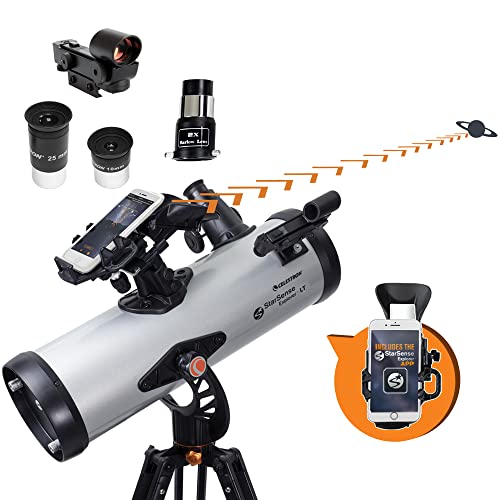
Celestron StarSense Explorer LT 114AZ App-Enabled Telescope – 114mm Newtonian Reflector with Smartphone Dock & StarSense App – iPhone & Android Compatible – Easy-to-Use for Beginners
SMARTPHONE-POWERED SKY TOUR: No experience needed! Just dock your phone, launch the StarSense Explorer app, and follow the…
As an affiliate, we earn on qualifying purchases.
As an affiliate, we earn on qualifying purchases.
Background
The cosmic web is a fundamental component of cosmological models, but detailed observations of its early stages have been limited. Previous surveys lacked the resolution or depth to observe these structures at such an early epoch. The James Webb Space Telescope, launched in late 2021, has expanded observational capabilities, enabling more detailed studies of the distant universe. This study represents a step forward in utilizing Webb’s potential for large-scale structure mapping.
“The increase in depth and resolution allows us to observe the cosmic web at a time when the universe was only a few hundred million years old. Details that were previously indistinct are now observable.”
— Bahram Mobasher, UCR professor
“This map enables the study of galaxy evolution within cluster and filamentary structures across cosmic time, from when the universe was approximately one billion years old to the present.”
— Hossein Hatamnia, lead author
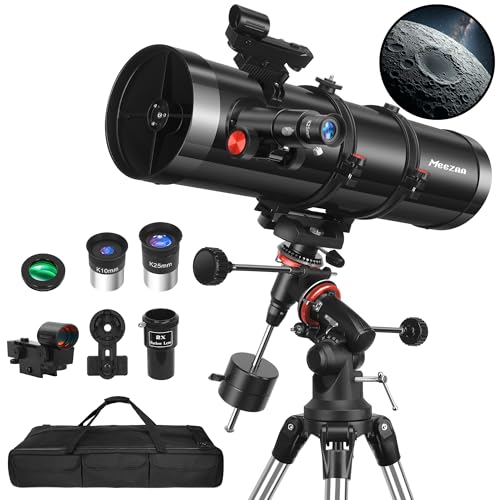
MEEZAA Telescope, 150EQ Newtonian Reflector Telescope for Adults Astronomy Beginners, Professional Astronomical Telescopes with Equatorial Mount, Phone Adapter, Tripod, Moon Filter and Large Carry Bag
150mm Large Aperture: This astronomical reflector telescope for adults features a 650mm focal length and 150mm aperture, delivering…
As an affiliate, we earn on qualifying purchases.
As an affiliate, we earn on qualifying purchases.
What Remains Unclear
Further analysis is required to understand how these detailed structures will influence existing models of dark matter distribution and galaxy formation. Additional observations are planned to expand the survey and refine interpretations of the data.

FIBONAX Telescope Camera 4K, 8MP USB Astronomy Camera, 1.25 Inch Electronic Eyepiece with Removable IR Cut Filter, ASCOM Driver Support, UVC Plug and Play for Lunar Planetary Imaging
✅Entry Level Telescope Camera: 8MP sensor supports up to 4K video and 1080P high frame rate capture, helping…
As an affiliate, we earn on qualifying purchases.
As an affiliate, we earn on qualifying purchases.
What’s Next
Future efforts will focus on analyzing the detailed structures revealed by the map to improve understanding of galaxy formation processes. Researchers also plan to extend the survey to additional regions of the universe and compare the observations with simulations to refine cosmological models.

Scientific Astrophotography: How Amateurs Can Generate and Use Professional Imaging Data (The Patrick Moore Practical Astronomy Series)
Used Book in Good Condition
As an affiliate, we earn on qualifying purchases.
As an affiliate, we earn on qualifying purchases.
Key Questions
How does this map differ from previous cosmic web observations?
This map provides higher resolution and greater depth, enabling the observation of the cosmic web at earlier cosmic times than previous surveys, thanks to Webb’s advanced imaging capabilities.
Why is mapping the cosmic web important?
The cosmic web underpins the large-scale structure of the universe and influences galaxy formation and evolution. Studying its early development helps test theories related to dark matter, dark energy, and the overall history of the universe.
What are the scientific implications of this discovery?
This detailed map supports further research into galaxy clusters and filaments across cosmic time, contributing to a better understanding of the processes shaping the universe’s structure and providing data to test cosmological models.