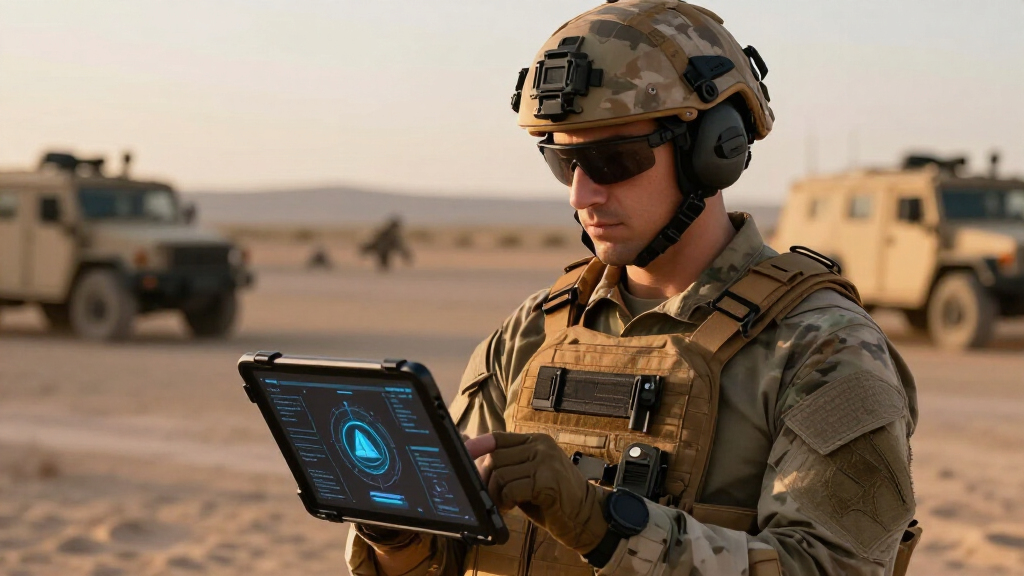

📊 Full opportunity report: What AI Means For NATO's Security And The Threat Of Friendly Fire on ThorstenMeyerAI.com — validation score, market gap, and execution plan.

Get business pricing on tech for your team
- Business-only prices and quantity discounts
- Tax-exempt purchasing
- Multiple users, one account, clear invoices
TL;DR
NATO’s critical communication and sensor networks depend on Chinese equipment, creating potential security risks. Experts warn this could lead to AI-enabled friendly fire incidents during conflicts.
NATO’s military communication and sensor networks are heavily reliant on Chinese equipment, raising concerns about potential vulnerabilities and risks of AI-enabled friendly fire incidents amid rising geopolitical tensions. This reliance, combined with China’s legal obligations to assist its intelligence services, creates a security challenge for the alliance.
Recent analyses highlight that much of NATO’s critical infrastructure, including mobile communications used by forces across Europe, depends on Chinese technology. For example, approximately 60% of Germany’s 5G network is built with Huawei equipment, which is legally obliged under Chinese law to cooperate with Beijing’s intelligence operations. Similar dependencies exist in Belgium, Poland, and Romania, where Chinese gear remains in use despite ongoing efforts to replace it.
These dependencies are significant because, under China’s National Intelligence Law of 2017, Chinese companies like Huawei and DJI are required to assist intelligence work upon request, with no legal or judicial safeguards. While no documented breach has yet been publicly confirmed, experts warn that this legal framework presents a structural risk—potentially exploitable during conflicts, such as a crisis involving Taiwan or Russia—by activating vulnerabilities or backdoors embedded in the hardware or software.
Additionally, NATO’s sensor and drone systems, which are critical for targeting and defense, also incorporate Chinese components. These include counter-drone systems and surveillance platforms that rely on Chinese-made hardware, creating further points of potential compromise. The reliance on such technology raises questions about the integrity of AI-driven targeting decisions, especially in high-stakes scenarios where friendly fire could occur.
Friendly fire at alliance scale: what Chinese equipment in NATO networks actually means
Yesterday: Ukraine may have turned a Russian unit’s identification layer against its own jet. Today’s question doesn’t require that to be true. It requires only that the concept be plausible — and then asks what it means when NATO’s own identification layer is built on equipment from a country whose law compels its companies to cooperate with intelligence on demand.
Any Chinese entity — any company, any employee, anywhere — must assist national intelligence work when asked. No carve-out for foreign deployments. No judicial review. No refusal option. When Beijing asks Huawei for access, Huawei must provide it. The law doesn’t distinguish between Shenzhen and Stuttgart. It doesn’t distinguish between civilian and NATO. This is not theoretical. It is operational law.
Requires no reconnaissance. The companies manufactured and installed the equipment. They have the source code, firmware, manufacturing tolerances, and update pipeline — the reconnaissance was completed before the adversary was even identified as one. A stronger position than what InformNapalm claims Ukraine achieved.
The question isn’t whether China will use this access. It’s whether NATO can afford to assume it won’t. Three things follow. Replacement is genuinely hard — banning without building the supply chain produces capability gaps, not security. The identification layer is where the exposure is sharpest — a Chinese motor is a supply-chain risk; a Chinese sensor or processor in an IFF system is an identification-layer risk, the same class the BARS Moscow story made visible. And the open-weight argument applies here — but stops short: open weights give you visibility into the classification model; they don’t give you visibility into the silicon it runs on. NATO has thirty-two members, each with its own procurement history. Together they’ve built an identification layer with distributed, unaudited, legally-accessible dependencies on a potential adversary. BARS Moscow required weeks of reconnaissance. The reconnaissance for NATO’s version was completed in the factory.
Implications of Chinese Tech Dependence for NATO’s Combat Readiness
The heavy reliance on Chinese technology within NATO’s infrastructure introduces significant security vulnerabilities. If adversaries exploit these dependencies—either through legal mandates or cyber intrusion—they could manipulate sensor data or disable communications, increasing the risk of misidentification and friendly fire during military operations. This situation complicates NATO’s strategic planning and underscores the importance of diversifying and securing critical networks to prevent potential exploitation during conflicts.
AI-powered military communication systems
As an affiliate, we earn on qualifying purchases.
As an affiliate, we earn on qualifying purchases.
NATO’s Ongoing Efforts to Replace Chinese Equipment
Since 2022, NATO allies have recognized the risks associated with Chinese hardware and begun efforts to phase out Huawei and similar vendors from their networks. Germany, which hosts the largest NATO troop concentration in Europe, has set a 2026 deadline to remove Huawei from its 5G networks. Major operators have sought technical solutions to replace Huawei equipment without disrupting service, but complete removal remains costly and complex. Despite these efforts, many eastern European countries still rely on Chinese gear, leaving vulnerabilities in place as tensions escalate.
The legal framework that compels Chinese companies to cooperate with Beijing’s intelligence services remains a foundational concern. Although no confirmed breaches have been publicly reported, experts warn that the structural dependence on Chinese hardware creates an inherent risk—one that could be exploited in future conflicts.
As an affiliate, we earn on qualifying purchases.
Unproven Exploitation of Chinese Tech in NATO Networks
There is currently no publicly confirmed incident of Chinese hardware being exploited to manipulate NATO’s military systems or cause friendly fire. While the legal framework and dependencies are clear, actual breaches or malicious activations remain unproven and are the subject of ongoing intelligence assessments. The real risk is structural and legal, not yet demonstrated through specific operational failures.
As an affiliate, we earn on qualifying purchases.
NATO’s Strategies for Reducing Dependence and Securing Networks
NATO is expected to accelerate efforts to replace Chinese equipment across member states, with deadlines set for 2026 and beyond. The alliance will likely increase investments in secure, domestically produced technology and develop protocols to detect and mitigate potential cyber manipulations. Monitoring and intelligence sharing will remain critical as NATO works to close vulnerabilities before they can be exploited during crises or conflicts.
As an affiliate, we earn on qualifying purchases.
Key Questions
Could Chinese hardware be used to cause friendly fire incidents in NATO operations?
While no confirmed incidents have occurred, the legal obligations of Chinese companies and dependencies in NATO networks create a theoretical risk that hardware or software could be manipulated to influence targeting decisions, potentially leading to friendly fire if exploited.
What steps is NATO taking to address these vulnerabilities?
NATO is working to replace Chinese equipment with trusted alternatives, improve network security, and develop protocols to detect potential manipulations. Member states are also coordinating efforts to phase out vulnerable hardware by 2026.
Has there been any confirmed breach involving Chinese technology in NATO systems?
No publicly confirmed breaches have been reported. The concerns are based on legal dependencies and structural vulnerabilities that could be exploited in future conflicts.
How costly and disruptive is removing Chinese equipment from NATO networks?
Replacing Huawei and similar vendors involves significant costs and logistical challenges. For example, Deutsche Bahn estimates costs over €400 million and delays of five to six years for complete removal from its network.
Source: ThorstenMeyerAI.com
Fall Picks
fall essentials
As an affiliate, we earn on qualifying purchases.