
TL;DR
Meta launched Muse in the UK on November 23, 2026, making its personal AI agent available to adults through iOS, Android, the web and WhatsApp. Meta says Muse can shop across connected services but must get approval before buying; those safeguards have not been independently tested.
Meta launched its Muse personal AI agent in the UK on November 23, opening it to adults aged 18 and over through iOS, Android, the web and WhatsApp. The service is designed to carry out online tasks, including shopping through connected retailers, bringing questions about user approval and access to personal accounts into practical focus, as explored in how Meta’s AI agent accesses messages. Meta says Muse waits for approval before making a purchase; its safety and privacy claims have not been independently tested in the source material.

Get business pricing on tech for your team
- Business-only prices and quantity discounts
- Tax-exempt purchasing
- Multiple users, one account, clear invoices
Muse is available free, with optional paid plans, according to the launch material. Meta lists UK retailers and travel companies among its partners, including Marks & Spencer, Currys, Sainsbury’s, easyJet and Trainline. The service can also work across apps and websites a user connects, though the source does not specify which tasks are available with each partner or whether access differs by plan.
Meta describes Muse as a personal AI agent that converts a goal into a sequence of actions. For a shopping task, it may use information from a saved recipe to make a list, browse a retailer, fill in forms and prepare an order. Meta says a separate security agent checks actions against granted permissions, and Muse presents the proposed purchase for the user to approve before it pays. The company says checkout can use Onelink by Stripe or Shop Pay at supported stores.
Meta says each Muse runs in a separate virtual computer in the cloud, with its own browser, and that it cannot see users’ passwords, a design related to Meta’s work on local, agentic AI. The company also says it records actions and planned next steps, and that users can remove connected accounts. These descriptions come from Meta; the source material reports no independent assessment of the system’s security, privacy or shopping performance.
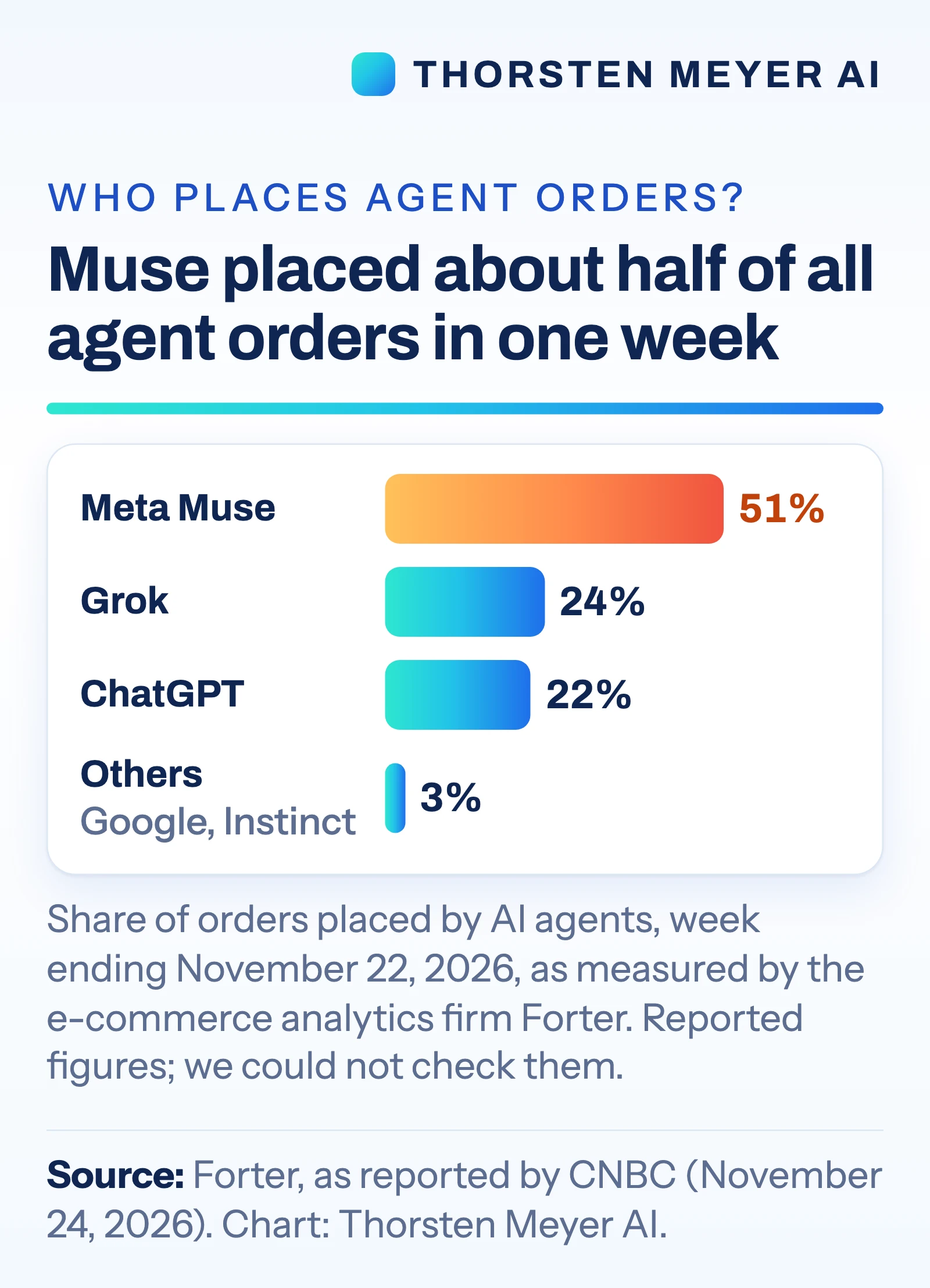
When Software Becomes the Shopper
The UK launch puts an AI agent in a position to act as a customer, rather than simply recommend products. That could change how people use online stores: a user may delegate searches, form-filling and repeat orders, while the agent navigates sites and accounts on their behalf. The practical consequence is that permissions and purchase approval become central to whether people are comfortable delegating transactions.
Businesses also face a new kind of visitor. Retailers and travel firms named by Meta are participating as partners, while other services may encounter agents acting through their websites. The source notes that United Airlines has taken steps to keep agents out, illustrating that companies may choose different approaches. It does not give details of that policy or establish how widely businesses are adapting their systems.
For users, the promised convenience comes with access to connected services and personal information. Meta says users choose the connections and can remove them, and that purchases require approval. Those are company statements, not verified findings. Whether the safeguards work reliably in ordinary use, including when an agent encounters an unexpected page or an incorrect item, remains unanswered by the launch material.
Products Worth Considering

Bose Home Speaker 500 Smart Bluetooth Speaker, Black

Amazon Kindle Paperwhite (2024, 16 GB) – 7-inch Display, Black

Apple Watch Series 12 GPS 42mm Smartwatch
As an affiliate, we earn on qualifying purchases.
From US Debut to UK Access
Meta first introduced Muse in the United States in September 2026, according to the supplied source. The UK launch followed on November 23, with Meta updating its announcement the next day. The UK release extends the service to a market where Meta says it has partnerships with local retailers and travel providers.
The distinction between a chatbot and an agent is relevant to the launch. A chatbot typically responds with information or suggestions; an agent is intended to carry out steps toward a goal. Meta says Muse can continue working on longer tasks after a user closes the app and return when circumstances change or it needs permission. The source describes this capability but does not provide independent demonstrations or measured performance results.
Meta says chats may be used to improve its AI and that this setting is enabled by default. Users can turn it off in Settings under Data controls, according to the source. This is a separate consideration from granting access to retailer or other accounts, which Meta says users can choose and revoke.
““Every Muse gets its own virtual computer in the cloud, like a laptop that’s just for you.””
— Meta
Safeguards Await Independent Testing
The launch material does not establish how accurately Muse completes shopping tasks, how often it makes mistakes, or how the approval step behaves when a purchase changes after review. It also provides no independent test of Meta’s claims about password access, cloud isolation, security checks or data handling. Those protections remain company-described safeguards in the available source.
Other details are also unspecified, including the full range of UK tasks and partner integrations, the limits of free and paid plans, and how refunds or disputes are handled when an agent acts. The source does not report user numbers, transaction volumes or results from a UK trial. Meta’s statement that chats may be used for AI improvement, with the setting on by default, is described in the source, but the extent of that use is not detailed.
UK Use Will Test the Claims
The next evidence will come from how the service performs for UK users and whether Meta provides further detail about integrations, permissions and safeguards. Users considering Muse can review each requested connection and inspect the order details before approving a purchase. The source also says they can disable chat use for AI improvement in Data controls.
Retailers and travel companies will need to decide how to handle agents visiting their services, whether through partnerships, restrictions or other policies. No further rollout date, independent audit or performance report is specified in the source material. Until such evidence is available, claims about Muse’s safety and reliability should be treated as Meta’s descriptions rather than independently confirmed results.
Key Questions
What is Meta Muse?
Muse is Meta’s personal AI agent, designed to plan and carry out online tasks across apps and websites a user connects, including shopping tasks.
Who can use Muse in the UK?
Meta says the service is open to adults aged 18 and over through iOS, Android, muse.ai and WhatsApp. It is free, with optional paid plans.
Can Muse buy something without approval?
Meta says Muse shows the proposed purchase and waits for the user’s approval before buying. The source provides no independent test confirming how this safeguard works in practice.
Which UK businesses work with Muse?
Meta names Marks & Spencer, Currys, Sainsbury’s, easyJet and Trainline among UK partners. The source does not detail the tasks available with each business.
Has Muse’s security been independently tested?
The supplied source reports no independent test of Meta’s safety and privacy claims, including its statements about passwords, cloud separation and purchase approval.
Source: Thorsten Meyer AI