
A new photonic chip replaces traditional electronic circuits with light, allowing AI systems to perform computations faster and more efficiently. By manipulating photons directly on silicon, these chips operate at light speed, drastically reducing latency and energy use—up to 100 times better than electronic counterparts. This breakthrough supports real-time, high-bandwidth tasks like autonomous driving and robotics. Curious about how this technology could transform AI? Keep exploring to discover the full potential.

Get tech for your team delivered free — and shop member deals
- Fast, free delivery on millions of items
- Access to Prime Big Deal Days deals on October 6–7
- Prime Video, Amazon Music and more included
Key Takeaways
- Photonic AI chips process data at the speed of light, significantly increasing computational efficiency and reducing latency.
- Light-based components enable faster, parallel data handling, boosting AI performance beyond electronic circuit limits.
- These chips consume near-zero energy during calculations, drastically lowering power costs and heat generation.
- Advances in photonic fabrication allow scalable, cost-effective production for widespread AI deployment.
- Overall, photon-based chips deliver up to 100 times better performance, revolutionizing AI efficiency and real-time processing.
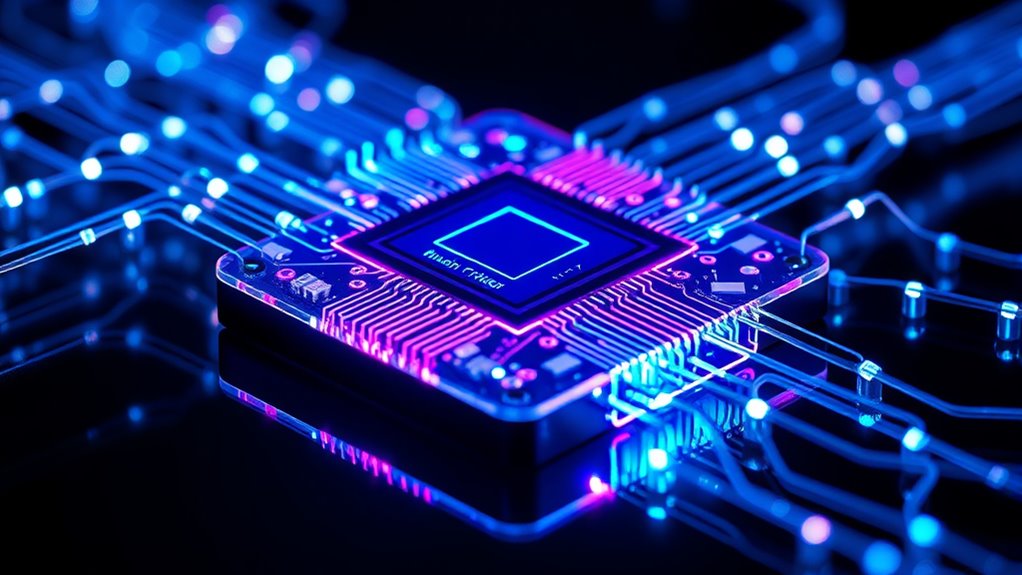
A breakthrough in AI hardware is redefining the limits of speed and energy efficiency by replacing traditional electronic circuits with photonic integrated circuits that use light instead of electricity. This shift enables AI systems to perform complex computations much faster and more efficiently. Instead of relying on electrons flowing through wires, these chips manipulate photons—particles of light—directly on a silicon chip, dramatically reducing latency. Because light travels at the speed of light, your AI applications experience near-instantaneous responses, making real-time processing more feasible than ever. Photonic components operate at light speed, vastly outperforming electronic circuits. Imagine micro-scale Fresnel lenses etched onto the chip surface, precisely directing laser light to perform convolution operations essential for pattern recognition. These lenses handle complex tasks like image analysis by manipulating light beams, which results in faster and more energy-efficient processing. Multiple wavelengths of light, or colors, can be used simultaneously to process different data streams in parallel. This multi-wavelength approach boosts throughput, allowing you to handle vast amounts of data without slowing down. The built-in feedback mechanisms keep quantum light generation stable, ensuring the system runs reliably in real time without bulky external equipment. In addition, the photonic fabrication process has seen significant advancements, enabling more scalable and cost-effective production of these chips. In terms of energy efficiency, photonic AI chips outperform traditional electronic counterparts by up to 100 times for certain tasks. They perform machine learning calculations with near-zero energy consumption, markedly cutting power costs. Optical components minimize energy loss during data transmission and computation, leading to less heat generation. This reduction allows for denser chip packing and longer hardware lifespan, making large-scale AI deployments more sustainable and economical. As your AI models grow more complex, the energy savings become even more pronounced, addressing the increasing power demands of modern AI. When it comes to performance, these chips operate at the speed of light, far surpassing the clock speed limits of electronic circuits. Prototype devices reach classification accuracies comparable to top electronic systems, but with much lower latency. Parallel processing of multiple data streams enables real-time, high-bandwidth operations, essential for applications like autonomous vehicles and advanced robotics. Integrating photonic and electronic components on a single chip optimizes both control and speed, bringing cutting-edge AI hardware closer to commercial reality. This technology promises a future where AI is faster, greener, and more scalable than ever before.
As an affiliate, we earn on qualifying purchases.
Frequently Asked Questions
How Do Photon-Based Chips Compare in Cost to Traditional Electron Chips?
Photon-based chips are currently more expensive than traditional electron chips due to lower manufacturing volumes, higher material costs, and limited production infrastructure. You’ll find PICs costlier per unit since they’re in early development stages, with fewer scalable manufacturing options. However, their remarkable energy efficiency can offset higher initial costs over time, especially in large-scale AI deployments where reduced energy expenses and cooling needs provide significant savings.
What Industries Stand to Benefit Most From This Technological Advance?
You’ll see the biggest benefits in data centers, telecommunications, and scientific research. Photonic chips boost AI processing, making data centers faster, more energy-efficient, and scalable. In telecom, they improve network speed and capacity while cutting power costs. Scientific fields like astronomy and physics gain from ultrafast data analysis and energy savings. These industries will experience significant advancements, driving innovation and reducing operational expenses with this breakthrough technology.
Are Photon Chips Compatible With Existing AI Hardware Systems?
Yes, photon chips are compatible with existing AI hardware systems. They’re designed as drop-in solutions, meaning you can integrate them into your current setups without changing your code. They work alongside CPUs and GPUs using standardized architectures like x86 and common OSes like Linux. This compatibility makes adopting photonic processors easier, allowing you to enhance performance while maintaining your existing infrastructure and software workflows.
What Are the Potential Environmental Impacts of Photon-Based Computing?
You’ll find that photon-based computing can substantially reduce environmental impacts by lowering energy consumption and cooling needs. Operating at room temperature, these chips cut greenhouse gas emissions associated with data center cooling. They also lessen reliance on toxic materials and rare elements, though manufacturing still raises concerns like water use and waste. Overall, adopting photon tech helps you reduce pollution, minimize resource depletion, and supports sustainable growth in AI infrastructure.
How Soon Could Photon Chip Technology Become Commercially Available?
You won’t need a crystal ball to see when photon chips hit the market. Experts say full-scale production could start within this decade, thanks to ongoing investments and breakthroughs. However, don’t pack your bags just yet—manufacturing hurdles, material issues, and costs mean it’ll be a gradual rollout. So, keep an eye out; photon-powered tech might just become your new best friend before you know it, but don’t hold your breath.
As an affiliate, we earn on qualifying purchases.
Conclusion
This breakthrough ignites a new dawn in AI, where photons dance through circuits like shimmering threads woven into a luminous tapestry. As you witness this quantum leap, imagine a future where information flows as swiftly as light itself, transforming the digital landscape into a radiant symphony of innovation. With every photon’s whisper, the horizon of possibility expands, promising a world where speed and efficiency shine brighter than ever before—guiding us toward a horizon painted in the vivid colors of progress.
As an affiliate, we earn on qualifying purchases.
high-speed optical computing device
As an affiliate, we earn on qualifying purchases.
As an affiliate, we earn on qualifying purchases.
Halloween Picks
halloween
As an affiliate, we earn on qualifying purchases.