

You might not realize how quickly AI-native teams are forming and evolving within organizations. These teams focus on agility, rapid experimentation, and collaboration across disciplines, shifting away from traditional hierarchies. They emphasize shared ownership, continuous learning, and innovative data privacy approaches. As organizational cultures adapt to support this new way of working, success hinges on understanding team dynamics and decision-making. Keep exploring further to uncover how these changes could shape your company’s future.
Key Takeaways
- AI-native teams operate with agility, emphasizing rapid experimentation and short project cycles, enabling faster emergence.
- Organizational shifts toward flatter hierarchies and shared ownership accelerate AI team formation and integration.
- Cross-disciplinary collaboration and flexible roles facilitate swift adaptation to AI project needs.
- Privacy-first approaches and data governance embedded from the start streamline AI development timelines.
- Leadership styles focusing on facilitation and empowerment promote quicker AI team development and scalability.
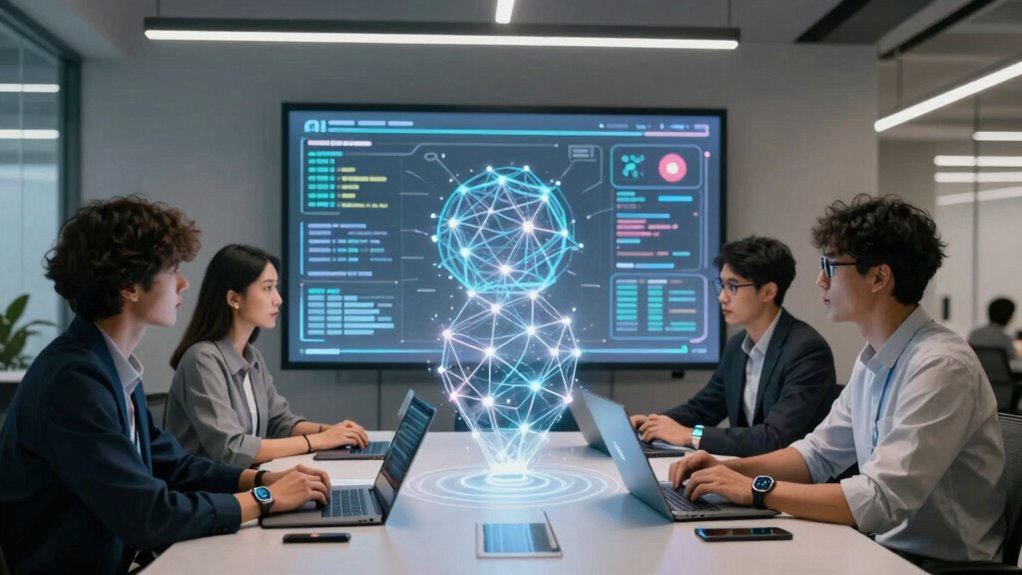
Many companies are underestimating just how quickly AI-native teams are forming, often because these teams operate differently from traditional units. Unlike conventional groups that rely on established hierarchies, AI-native teams are agile, cross-disciplinary, and built around rapid experimentation. They’re often composed of data scientists, machine learning engineers, and domain experts who work closely together, blurring the lines between roles. This fluidity accelerates project timelines but also challenges traditional notions of team dynamics. As these teams evolve, they prioritize adaptability and continuous learning, which can create friction if organizational culture isn’t aligned. You might find that collaboration becomes more about shared goals and less about rigid reporting structures.
AI-native teams are agile, cross-disciplinary, and driven by rapid experimentation, transforming traditional organizational dynamics and collaboration.
One of the biggest shifts you’ll notice with AI-native teams is how they handle data privacy. Since AI projects often require access to sensitive information, maintaining data privacy isn’t just a compliance checkbox — it’s embedded into the development process. These teams tend to adopt privacy-first approaches, integrating data governance and security protocols from the outset. They’re also leveraging techniques like anonymization, federated learning, and differential privacy to guarantee data remains secure while still enabling meaningful insights. This proactive stance on data privacy isn’t just about avoiding legal issues; it builds trust with stakeholders and users alike. Additionally, data privacy is increasingly viewed as a competitive advantage, emphasizing transparency and responsibility. Recognizing the importance of data governance helps ensure ethical AI development and safeguards organizational integrity.
At the same time, team dynamics in AI-native units are fundamentally different from traditional teams. Instead of long-term roles, members often come together temporarily for specific projects, then move on to new challenges. This creates a culture of rapid iteration, where feedback loops are short and learning happens on the fly. You, as someone involved in these teams, need to be comfortable with ambiguity and quick pivots. Flexibility becomes essential because projects can change direction overnight based on new data or technological breakthroughs. The focus shifts from fixed responsibilities to shared ownership of outcomes, fostering a sense of collective responsibility and innovation. Recognizing these team structures is key to adapting organizational strategies effectively, especially as organizations increasingly adopt agile methodologies in AI development.
Moreover, because AI-native teams operate outside the typical corporate hierarchy, leadership often takes a more facilitative role rather than a directive one. This flattening of authority empowers team members to contribute ideas freely, boosting creativity and engagement. However, it can also lead to challenges in decision-making and accountability if roles aren’t clearly defined. As you observe these shifts, it’s clear that understanding the nuances of team dynamics and data privacy isn’t just beneficial — it’s crucial for successfully navigating the fast-paced world of AI-native teams. The organizations that recognize and adapt to these changes will be better positioned to harness AI’s full potential. Adapting to new team structures is essential as organizations embrace this rapid evolution.

AI for Agile and Scrum Teams: How to Use Artificial Intelligence to Accelerate Sprints, Improve Collaboration, and Deliver Better Software Faster
As an affiliate, we earn on qualifying purchases.
As an affiliate, we earn on qualifying purchases.
Frequently Asked Questions
How Do Ai-Native Teams Differ From Traditional Tech Teams?
AI-native teams differ from traditional tech teams because they prioritize AI integration from the start, shaping team dynamics around AI capabilities. You’ll find these teams use AI tools actively in daily workflows, fostering rapid innovation and adaptability. They’re more collaborative, leveraging AI to enhance problem-solving. Unlike traditional teams, they view AI as a core part of their strategy, which accelerates growth and keeps them ahead in the evolving tech landscape.
What Skills Are Essential for Ai-Native Team Members?
You need a mix of technical and soft skills for AI-native team members. Strong AI collaboration skills help you work seamlessly across disciplines, while understanding ethical frameworks guarantees responsible AI use. Coding, data analysis, and machine learning expertise are essential, but so are communication and problem-solving abilities. Staying adaptable and enthusiastic to learn keeps you ahead in this fast-evolving field. Prioritize these skills to thrive in AI-native teams.
How Quickly Can Companies Implement Ai-Native Team Structures?
How quickly can you build an AI-native team? It depends on your company’s agility and focus on AI ethics. You can start integrating AI-native structures within months, emphasizing team collaboration, cross-disciplinary skills, and ethical guidelines. Prioritize training, clear communication, and fostering innovation. With a proactive approach, your organization can rapidly adapt, forming a cohesive team that leverages AI effectively while maintaining ethical standards and encouraging seamless collaboration.
What Challenges Do Organizations Face When Transitioning to Ai-Native Teams?
When shifting to AI-native teams, you face challenges like steering ethical considerations and managing cultural shifts. You need to guarantee your team understands AI ethics to prevent biases and misuse, which can be complex. Additionally, adapting your organizational culture to embrace rapid technological change requires clear communication and training. These hurdles demand proactive leadership and a commitment to fostering an environment that values innovation while addressing ethical and cultural concerns.
How Do Ai-Native Teams Impact Overall Business Agility?
You’ll find that AI-native teams boost your business agility by enabling AI-driven decision making and seamless automation integration. This accelerates your ability to adapt quickly to market changes, optimize processes, and innovate faster. With AI embedded in your team, you can respond more effectively to customer needs, reduce manual tasks, and stay ahead of competitors. Overall, AI-native teams transform your agility by making your operations smarter and more responsive.

McAfee+ Premium Unlimited Devices | AntiVirus Software 2026 for Windows PC & Mac, AI Scam Detection, VPN, Data Removal, Identity Monitoring |1-Year Subscription with Auto-Renewal | Download
ALL-IN-ONE PROTECTION – award-winning antivirus, total online protection, works across compatible devices, Identity Monitoring, Secure VPN
As an affiliate, we earn on qualifying purchases.
As an affiliate, we earn on qualifying purchases.
Conclusion
If you think AI-native teams are just a distant future, think again. They’re already here, shaping industries faster than most realize. Like a silent tide, their emergence is unstoppable, transforming how work gets done. You can’t ignore this wave—either ride it or be left behind. Embrace the change now, or risk drowning in obsolescence. The future belongs to those who adapt, so ask yourself: are you ready to catch this rising tide?

Model Optimization Methods for Efficient and Edge AI: Federated Learning Architectures, Frameworks and Applications
As an affiliate, we earn on qualifying purchases.
As an affiliate, we earn on qualifying purchases.

Agile Project Management with Scrum (Developer Best Practices)
Used Book in Good Condition
As an affiliate, we earn on qualifying purchases.
As an affiliate, we earn on qualifying purchases.