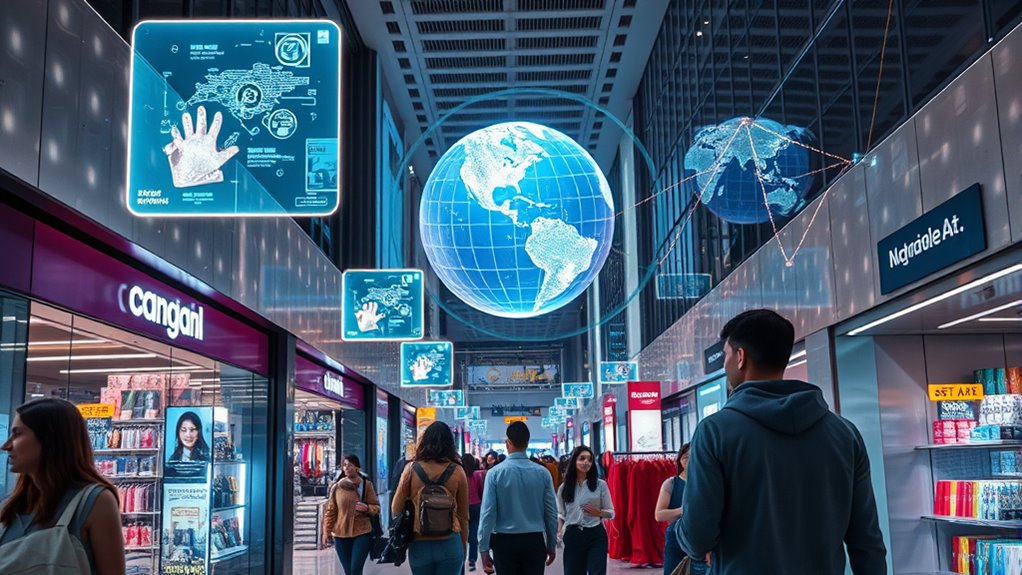

AI is transforming retail into a seamless global economy by enabling integrated operations, personalized experiences, and smarter supply chains across borders. With over 85% of retail leaders adopting AI, you can expect increased efficiency, better customer engagement, and real-time demand forecasting worldwide. Technologies like machine learning and automation make this movement possible, connecting markets like North America, Europe, and Asia. To discover how AI is reshaping this global retail landscape, keep exploring its evolving role.
Key Takeaways
- AI enables seamless cross-border retail operations through integrated data and automation.
- Advanced AI analytics facilitate real-time global demand forecasting and inventory management.
- AI-driven solutions support hyper-personalization, creating consistent customer experiences worldwide.
- Automated supply chains powered by AI connect global suppliers and retailers efficiently.
- AI accelerates the development of an interconnected retail economy by breaking geographical and operational barriers.

Artificial intelligence is transforming retail into a unified, seamless global economy by enabling companies to integrate data, streamline operations, and personalize customer experiences across borders. As of 2025, 85% of retail executives have developed AI capabilities, with 60% actively expanding them, highlighting widespread commitment. Virtually no retail leader remains untouched by AI, with only 1% having neither adopted nor evaluated these solutions. Many plan further investments, with over half intending to increase AI spending in the coming years and 89% investing or planning to do so within one to two years, emphasizing a clear sense of urgency. This adoption spans major markets worldwide, including the US, Europe, India, Brazil, and the Middle East, creating a truly global AI-driven retail landscape. The adoption of AI across these diverse markets underscores its pivotal role in shaping a cohesive global retail environment. The AI market in retail is booming, reaching around USD 11.61 billion in 2024 and expected to grow to USD 14.49 billion in 2025. Projections show a compound annual growth rate of 23% from 2025 to 2030, with the market size surging to USD 40.74 billion by 2030. North America, led by the US, dominates with a 33.4% market share, while investments in AI solutions account for over 62% of the retail AI revenue in 2024. Machine learning is leading the charge, powering various applications from demand forecasting to personalized marketing. AI has shifted from experimental to essential, impacting core operations like hyper-personalization and supply chain management by 2025. It enhances customer engagement through tailored experiences and automates backend processes to boost competitiveness. Predictive analytics help forecast demand, optimize inventory, and increase supply chain resilience, reducing costs and delays. Retailers see a strong return on investment, with 55% reporting ROI above 10% and 21% exceeding 30%. AI drives productivity, cuts costs, and fosters innovation across product development, marketing, and customer service. Key technologies like generative AI, predictive analytics, and robotic process automation are now standard. Autonomous AI systems improve operational efficiencies and enable deeper consumer insights. Although data integration remains a challenge, fully automated workflows are emerging. Additionally, data integration is crucial for maximizing AI effectiveness and achieving a truly seamless retail operation. Ultimately, AI makes retail more interconnected, allowing companies to operate seamlessly across borders, creating a truly integrated global retail economy.
AI-powered demand forecasting software
As an affiliate, we earn on qualifying purchases.
As an affiliate, we earn on qualifying purchases.
Frequently Asked Questions
How Does AI Ensure Data Privacy Across Borders?
AI guarantees data privacy across borders by automating complex data flow mapping, making sure your company complies with regional regulations. It analyzes and categorizes PII, encrypts sensitive data through anonymization, and monitors for unauthorized access. AI’s governance frameworks enforce consistent data handling policies worldwide, while real-time compliance monitoring detects risks promptly. This proactive approach helps you maintain privacy standards, even when managing cross-border data transfers and diverse legal requirements.
What Are the Environmental Impacts of Ai-Driven Retail?
Imagine your favorite store’s AI system as a busy highway, constantly fueling traffic. AI-driven retail consumes massive energy, mainly from data centers, increasing greenhouse gases. By 2030, data centers could use more power than Japan, releasing CO₂ equal to millions of cars. While AI reduces waste and improves efficiency, it also risks harming ecosystems through mining, land use, and water consumption, making environmental impact a critical concern.
How Will AI Affect Employment in Retail Sectors Globally?
AI will substantially impact retail employment globally by automating routine tasks like cashiering and customer service, leading to job displacement in these areas. You’ll see higher unemployment in roles involving manual and cognitive routines, but also wage growth in sectors where AI skills are valued. To stay relevant, you’ll need to reskill and adapt to new AI-driven tools, which can open opportunities in more specialized or technical retail roles.
What Are the Risks of Monopolies in Ai-Powered Retail?
You face risks from monopolies in AI-powered retail because dominant firms control critical resources like data and infrastructure, making it hard for new competitors to emerge. This market concentration can stifle innovation, reduce choices, and lead to unfair practices such as higher fees or price manipulation. It also risks increasing economic inequality and limiting consumer benefits, as monopolists prioritize profits over fairness, transparency, and societal well-being.
How Can Small Retailers Compete in an Ai-Enabled Global Economy?
You can dominate the AI-powered retail world like a small boat outrunning a giant ship. By leveraging affordable AI tools, you personalize experiences, optimize inventory, and automate customer support, creating seamless shopping journeys. Use data-driven insights to target the right customers and adjust prices dynamically. Embrace cloud-based AI platforms to scale efficiently, compete with larger players, and grow rapidly—turning your small business into a formidable force in the global market.
retail inventory management automation tools
As an affiliate, we earn on qualifying purchases.
As an affiliate, we earn on qualifying purchases.
Conclusion
As AI weaves retail into a single, seamless global economy, you’re like a traveler crossing borders effortlessly. It breaks down barriers, making shopping feel as easy as a stroll through your neighborhood. With AI guiding the way, you’ll experience a world where stories and products flow freely across borders, creating a tapestry of interconnected markets. Embrace this wave of change—you’re riding a tide that’s transforming retail into a truly global, unified marketplace.
personalized customer experience AI solutions
As an affiliate, we earn on qualifying purchases.
As an affiliate, we earn on qualifying purchases.
As an affiliate, we earn on qualifying purchases.