

TL;DR
A team of researchers has created an artificial intelligence system that condenses the collective knowledge of human cooking into a 2-megabyte file. This development demonstrates advanced data compression techniques and could impact culinary data management, but its practical applications remain uncertain.
Researchers have developed a new AI model called Epicure that compresses the entire corpus of human cooking knowledge into a 2-megabyte file, a feat that challenges existing notions of data storage and culinary data management.
The Epicure project, detailed in an arXiv paper, involved aggregating 4.14 million recipes from 11 sources across seven languages, including English, Chinese, Russian, and others. The raw ingredient data was normalized to 1,790 canonical entries using an AI-augmented pipeline. The team trained three variants of skip-gram models—Cooc, Chem, and Core—that encode ingredient relationships based on co-occurrence, chemical properties, or a blend of both.
According to the researchers, the models can represent complex ingredient-ingredient and ingredient-compound relationships within a compact 2MB file. The models are designed to capture the chemistry, cultural context, and recipe-specific information, effectively distilling centuries of culinary evolution into a tiny digital package.
Why It Matters
This development raises questions about the limits of data compression, the preservation of cultural and culinary knowledge, and potential applications in AI-driven recipe creation, culinary education, and food science. If such a compact representation can reliably encode human cooking, it could revolutionize how culinary data is stored, shared, and utilized across platforms.
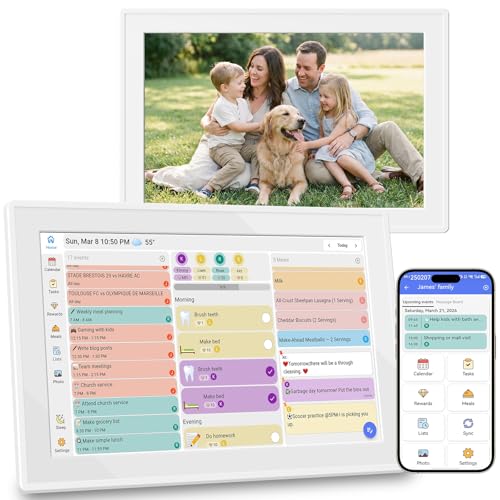
Digital Calendar 10.1" Touchscreen, Smart Electronic Wall Organizer, Chore List, Meal & Family Task Manager, Third-Party Calendar Sync, Picture Frame – Perfect Gifts for Mom & Women
- Family Hub with No Subscription: Syncs Google, iCloud, Outlook in real time
- Interactive Chore List: Assign tasks, monitor progress, motivate kids
- Fun Rewards System: Kids earn stars and unlock rewards
As an affiliate, we earn on qualifying purchases.
As an affiliate, we earn on qualifying purchases.
Background
The project builds on advances in natural language processing and large-scale data normalization, leveraging multilingual recipe datasets and AI techniques to create dense, meaningful embeddings of ingredients and flavors. Prior efforts in culinary AI have focused on recipe generation or ingredient substitution, but this represents a new level of data compression and synthesis. The research was published in May 2026, reflecting ongoing progress in AI’s ability to handle complex, culturally rich datasets.
“Compressing the entire spectrum of human cooking into a 2MB file demonstrates the potential of AI to encode complex cultural knowledge efficiently.”
— Josef Liyanjun Chen, lead researcher
“While the compression is impressive, practical applications for this model are still being explored, especially in real-world culinary settings.”
— AI researcher familiar with the project

Microsoft Power Apps Cookbook: Build user-friendly apps, troubleshoot challenges, and navigate the evolving Power Apps landscape
As an affiliate, we earn on qualifying purchases.
As an affiliate, we earn on qualifying purchases.
What Remains Unclear
It is not yet clear how accurately the compressed model can reproduce or generate new recipes, or how it handles cultural nuances and regional ingredient variations. The practical applications and limitations of this compressed data are still under investigation.

ZICOTO Aesthetic Recipe Book for 100+ Cherished Meals – Spacious 8.25 x 10 Notebook to Write In Your Own Recipes – Beautiful Blank Cookbook for Seamless Homemade Dish Planning
- Create Your Own Recipe Legacy: Document and preserve family recipes
- Stylish Kitchen Companion: Beautiful beige design with gold foil details
- Spacious Recipe Pages: 8.27×10.04 inches for detailed entries
As an affiliate, we earn on qualifying purchases.
As an affiliate, we earn on qualifying purchases.
What’s Next
Future steps include testing the model’s ability to generate authentic recipes, integrating it into culinary tools, and exploring its potential for preserving endangered culinary traditions. Researchers may also work on expanding the dataset or refining the compression techniques.
As an affiliate, we earn on qualifying purchases.
Key Questions
Can this AI model generate new recipes?
It is currently unclear whether the model can reliably create new, authentic recipes, as its primary function is data compression and representation.
What are the potential applications of this technology?
Potential uses include culinary data storage, AI-assisted recipe development, food science research, and preserving traditional cuisines in a compact digital form.
Does this mean all human culinary knowledge can be stored in 2MB?
While the model encodes a vast amount of culinary information, the extent to which it captures the full depth and nuance of human cooking remains to be validated.
Are there ethical or cultural concerns with compressing culinary knowledge?
Yes, concerns include cultural sensitivity, accuracy, and the risk of oversimplification or misrepresentation of diverse culinary traditions.
Source: Hacker News