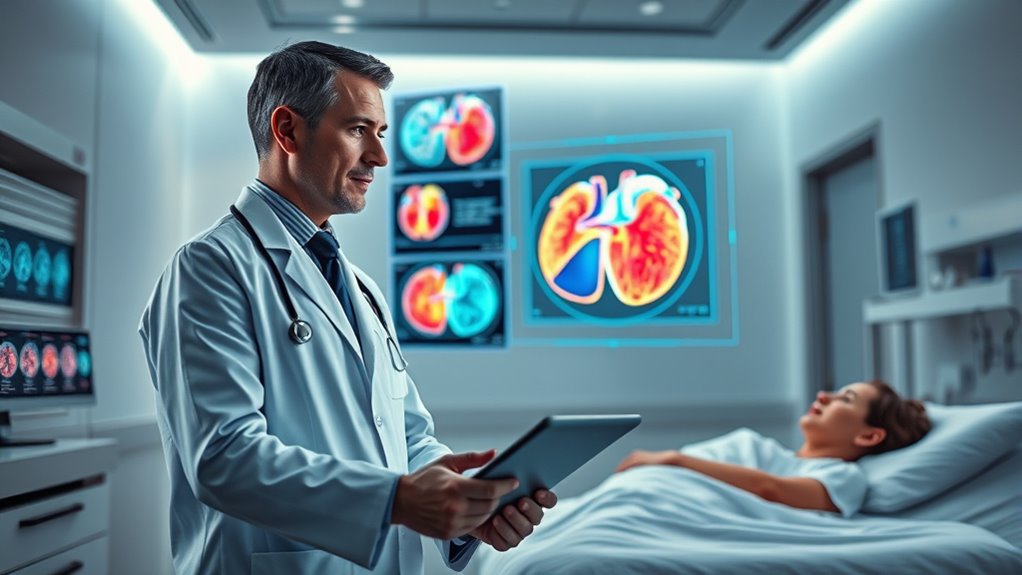

Augmented intelligence empowers physicians to achieve diagnostic accuracy beyond traditional human limits by analyzing vast amounts of data quickly and precisely. AI supports early detection, identifies complex patterns in medical images, and provides real-time decision assistance. This enhances your ability to diagnose conditions more accurately and swiftly. As technology advances, these tools become even smarter, helping you deliver better patient outcomes. Keep exploring how these innovations can transform your diagnostic approach and elevate your practice.

Get business pricing on tech for your team
- Business-only prices and quantity discounts
- Tax-exempt purchasing
- Multiple users, one account, clear invoices
Key Takeaways
- AI analyzes large datasets rapidly, identifying subtle patterns beyond human detection capabilities.
- Machine learning algorithms improve diagnostic accuracy and speed, supporting clinicians with precise insights.
- AI-enhanced medical imaging surpasses human performance in detecting complex or early disease signs.
- Real-time decision support guides physicians, integrating ongoing patient data for more accurate diagnoses.
- Advances in interpretability and regulatory standards increase trust in AI-driven diagnostics, approaching or exceeding human precision.
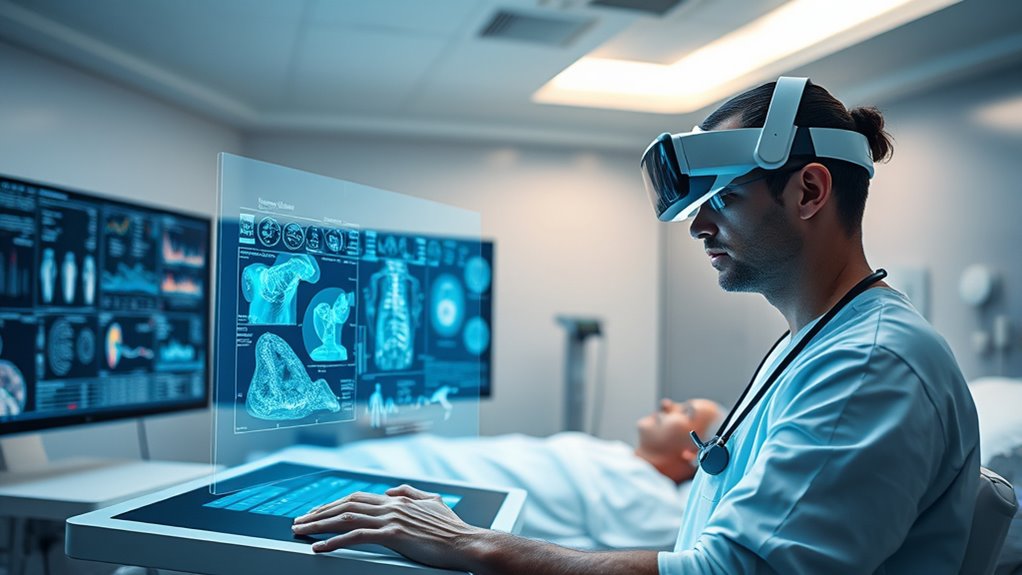
Augmented intelligence is revolutionizing healthcare by empowering doctors with advanced tools that enhance their diagnostic and decision-making capabilities. You now have access to technologies like machine learning algorithms, data analytics, and automation that support your clinical judgment. These tools analyze vast datasets quickly, providing insights that were previously impossible to obtain, improving both speed and accuracy in diagnosing diseases. In medical imaging, AI has demonstrated high precision, often outperforming human clinicians in identifying complex patterns. While it’s not yet a substitute for your expertise, AI helps you catch subtle signs that might be missed, enabling earlier detection of conditions like cancer or neurological disorders. This early diagnosis can markedly improve patient outcomes, making AI an invaluable partner in clinical practice.
The integration of AI into your workflow streamlines routine tasks such as documentation and research, freeing up more time for patient care. Automated data analysis allows you to interpret test results swiftly and with greater confidence, reducing diagnostic errors and overdiagnosis. Real-time decision support systems analyze ongoing patient data, guiding you toward more informed choices. These systems can predict patient outcomes, helping you tailor treatments more precisely. As AI continues to evolve, future developments promise even more sophisticated decision-making support, making your clinical judgments more accurate and efficient. Recent advancements in AI interpretability are also helping clinicians understand how these systems arrive at their conclusions, increasing trust and usability in clinical settings. The ongoing development of regulatory standards aims to ensure the safe and ethical deployment of AI tools in healthcare, fostering greater acceptance among practitioners. Most physicians recognize the benefits AI brings to patient care, and many feel increasingly enthusiastic about its potential. You understand that AI’s ability to provide rapid, data-driven insights enhances your diagnostic precision, but you also acknowledge the importance of training and ethical oversight. Trust in AI depends on transparent feedback loops, data privacy protections, and ongoing education. While AI offers remarkable advantages, you remain aware of challenges like bias, data quality issues, and the need for regulatory standards to ensure safe and responsible use. Despite these hurdles, AI’s role in diagnostics is set to expand, giving you superhuman capabilities to identify diseases early and improve patient outcomes in ways previously unimaginable.
As an affiliate, we earn on qualifying purchases.
Frequently Asked Questions
How Does Augmented Intelligence Differ From Artificial Intelligence?
You see, augmented intelligence differs from artificial intelligence because it’s designed to assist, not replace, you. While AI aims for full automation and autonomous decision-making, augmented intelligence enhances your abilities by analyzing data and surfacing insights in real time. It keeps you at the center of clinical decisions, supporting your judgment with machine speed and accuracy, ensuring you maintain control and accountability in patient care.
What Are the Main Ethical Concerns With Augmented Diagnostic Tools?
You might think these tools are perfect, but ethical concerns lurk beneath. You’ll worry about bias, as AI can reinforce healthcare disparities if data isn’t diverse enough. Transparency issues can make you feel in the dark, uncertain about diagnoses. Privacy risks threaten patient trust, and accountability becomes tricky when errors happen. Balancing innovation with fairness, transparency, and privacy is essential, so you don’t inadvertently compromise care or patient rights in the process.
How Is Patient Privacy Protected With Ai-Driven Diagnostics?
You can protect patient privacy in AI diagnostics by guaranteeing compliance with HIPAA, implementing strong data security measures, and obtaining explicit informed consent before using PHI. Transparency about AI’s role in diagnostics helps build trust, while limiting data access minimizes risks. Regularly updating security protocols and collaborating with regulators ensure that your AI tools stay within legal boundaries and safeguard sensitive patient information effectively.
Can Augmented Intelligence Replace Human Doctors Entirely?
No, augmented intelligence can’t replace human doctors entirely. You rely on AI to assist with pattern recognition and data analysis, but it lacks the empathy, judgment, and nuanced understanding you bring to patient care. You need human intuition to interpret unstructured information and navigate complex, emotional situations. AI is a powerful tool to enhance your work, but the human element remains essential for holistic, compassionate healthcare.
What Training Is Required for Physicians to Use These Technologies Effectively?
You need to learn AI basics, like understanding different types and how big data shapes insights. You should grasp core machine learning methods and AI subfields to interpret diagnostics confidently. Developing skills to evaluate AI accuracy and ethical considerations is crucial. Operating AI tools, troubleshooting, and integrating them into your workflow are essential. Continuous learning ensures you’re prepared to balance AI recommendations with your clinical judgment, ultimately improving patient care.
augmented intelligence diagnostic tools
As an affiliate, we earn on qualifying purchases.
As an affiliate, we earn on qualifying purchases.
Conclusion
As you harness augmented intelligence, you’re wielding a powerful compass guiding you through complex diagnoses with laser-sharp precision. It’s like having a trusted co-pilot by your side, turning the tide against misdiagnosis and elevating patient care to new heights. Embrace this technological ally, and watch your expertise soar beyond human limits. Together, you’re not just practicing medicine—you’re redefining what’s possible, transforming challenges into opportunities with the clarity of a crystal-clear horizon.
machine learning medical analysis software
As an affiliate, we earn on qualifying purchases.
As an affiliate, we earn on qualifying purchases.
real-time clinical decision support systems
As an affiliate, we earn on qualifying purchases.
As an affiliate, we earn on qualifying purchases.
Fall Picks
fall essentials
As an affiliate, we earn on qualifying purchases.