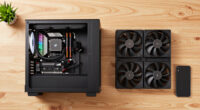
📊 Full opportunity report: Best Quiet Case Fans + the Airflow Setup That Actually Works on ThorstenMeyerAI.com — validation score, market gap, and execution plan.

Get tech for your team delivered free — and shop member deals
- Fast, free delivery on millions of items
- Access to Prime Big Deal Days deals on October 6–7
- Prime Video, Amazon Music and more included
TL;DR
This article identifies the best quiet case fans for 2026 and explains the airflow setup that achieves effective cooling with minimal noise. It emphasizes large, slow-moving fans and proper placement for optimal results.
In 2026, the most effective way to build a quiet yet well-cooled high-performance workstation involves using large, slow-moving fans combined with an optimized airflow setup, according to recent expert reviews and testing.
Leading experts recommend prioritizing 140mm fans over smaller sizes, as they move similar amounts of air at lower RPMs, producing significantly less noise. The Noctua NF-A12x25 and NF-A14 are considered the top performers in terms of engineering, airflow, and noise reduction, albeit at a premium price. For budget-conscious builders, Arctic P12 Pro and P14 fans offer nearly comparable performance at a fraction of the cost, making them the best value options.
For silent operation, be quiet! Silent Wings 4 fans are designed to operate at around 17 dB, providing near-invisible noise levels even at higher RPMs. When cooling radiators, static-pressure fans like the Arctic P12 Pro or Noctua NF-F12 are recommended to push air through dense fin stacks efficiently. The key principle is to use larger fans running at lower RPMs to achieve quiet, effective cooling without sacrificing performance.
Best quiet case fans
+ the airflow that works.
The best fan won’t help if it’s pointed the wrong way. The whole recipe: big fans, running slowly, in a clean front-to-back path, with slightly more intake than exhaust. Build a config in Part 2 and watch the pressure balance respond.
Why Proper Fan Choice and Airflow Setup Matter in 2026
Choosing the right fans and airflow configuration is critical for building quiet, high-performance workstations capable of handling demanding AI workloads. Proper setup reduces noise pollution, enhances component longevity, and ensures consistent thermal performance, which is essential for professional users relying on stable systems. As hardware becomes more powerful and heat generation increases, effective cooling strategies are more important than ever.
As an affiliate, we earn on qualifying purchases.
Advances in Fan Design and Airflow Principles in 2026
Recent developments in fan engineering emphasize larger, slower fans that move equivalent airflow with less noise. The trend toward 140mm fans over 120mm models continues, supported by improved bearing technologies and aerodynamic designs. Additionally, the importance of tailored airflow setups—such as front-to-back exhaust and top-mounted intakes—has been reinforced by recent testing, which shows that a well-structured airflow path significantly enhances cooling efficiency and noise reduction.
Prior to 2026, many builders relied on smaller, high-RPM fans that generated more noise. The shift to larger fans operating at lower speeds represents a major evolution in quiet PC design, especially for high-power workstations used in AI and data processing tasks.
"Moving to larger fans running at lower RPMs is the most effective way to achieve both silence and cooling in high-performance PCs."
— Thorsten Meyer, hardware expert
best airflow setup for high-performance PC
As an affiliate, we earn on qualifying purchases.
As an affiliate, we earn on qualifying purchases.
Remaining Questions About Long-Term Reliability and Compatibility
While current testing supports the effectiveness of large, slow fans and optimized airflow, long-term durability and compatibility across diverse case models remain areas for ongoing observation. Specific performance in extreme ambient temperatures or with future hardware upgrades is still being evaluated, and some users report minor noise variations depending on case design.
As an affiliate, we earn on qualifying purchases.
Next Steps for Building Quiet, High-Performance Workstations in 2026
Manufacturers are expected to release new fan models with improved aerodynamics and quieter operation. Additionally, case designs optimized for larger fans and better airflow management are likely to become standard. Users should monitor updates from leading brands and consider testing different configurations to fine-tune their systems for maximum silence and cooling efficiency.
As an affiliate, we earn on qualifying purchases.
Key Questions
What size fans should I prioritize for a quiet workstation?
Prioritize 140mm fans, as they move similar amounts of air as smaller fans but at lower RPMs, resulting in less noise.
Are budget fans like Arctic P12 Pro reliable for long-term use?
Yes, based on current testing, Arctic P12 Pro fans provide near-equivalent airflow and static pressure performance as premium models, making them suitable for continuous operation in high-performance setups.
Should I use static-pressure fans for radiators and airflow fans for case intake?
Exactly. Use static-pressure fans like Noctua NF-F12 or Arctic P12 Pro on radiators and dense heatsinks, and airflow fans like Noctua NF-A12x25 or Arctic P12 for case intake and exhaust to optimize cooling and noise levels.
How can I optimize airflow for maximum silence?
Arrange fans in a front-to-back, top-to-bottom configuration, use larger fans running at lower RPMs, and ensure minimal obstructions to create a smooth, continuous airflow path through the case.
Source: ThorstenMeyerAI.com
Fall Picks
fall essentials
As an affiliate, we earn on qualifying purchases.