
TL;DR
Anthropic’s $65 billion raise at a $965 billion valuation signals a shift from traditional funding to a focus on securing massive compute capacity. The company’s rapid revenue growth and strategic chip partnerships make this a bet on the infrastructure fueling AI’s next leap.
When a startup hits a $965 billion valuation, most people think it’s about the money. But behind the headlines, this round is really about something much bigger: compute capacity. Anthropic’s latest funding isn’t just a cash injection; it’s a strategic move to lock in the hardware, energy, and cloud resources needed to power AI’s future—faster, bigger, and more securely than ever before.
In this article, you’ll see how a valuation climb becomes a power play for control over the infrastructure that will shape AI’s next era. We’ll break down the numbers, the strategic partnerships, and what this all means for the industry—and for you.
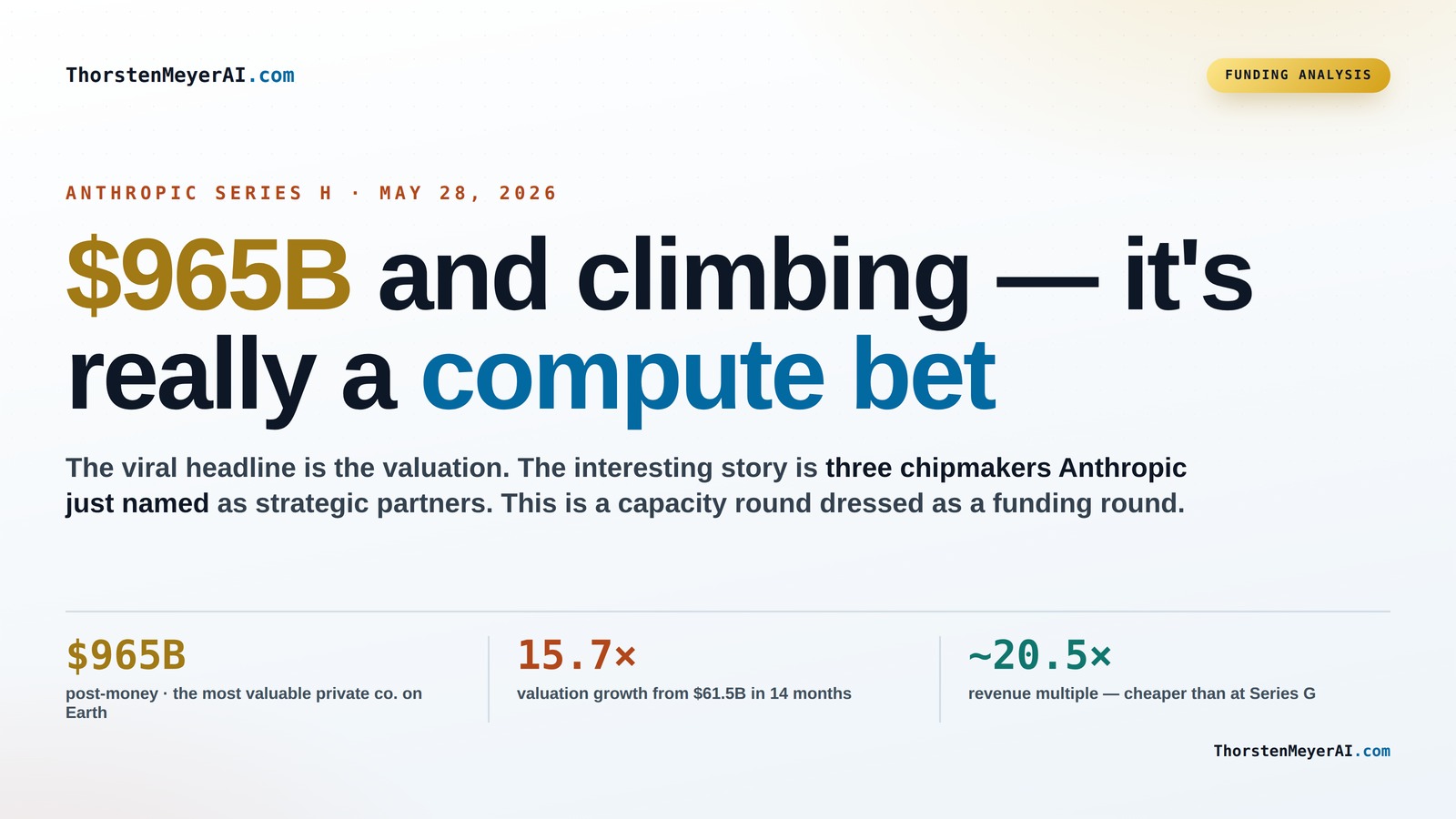
$965B and climbing — it’s really a compute bet
The viral headline is the valuation. The interesting story is in the press release’s middle paragraphs — and in three chipmakers Anthropic just named as strategic partners. This is a capacity round dressed as a funding round.
The numbers nobody can quite parse in sequence
Read together they describe a trajectory with no precedent in enterprise software. Read individually, each looks like a typo.
From $61.5B to $965B in fourteen months
Salesforce took roughly two decades to reach revenue numbers Anthropic just blew past. The sequence below is the part most coverage skips — it’s not the size, it’s the shape.
Anthropic’s valuation ladder · Mar 2025 → May 2026
Five rounds, fourteen months. Bar height is the valuation; the climb itself is the story. Tap any milestone for context.
The multiple actually got cheaper
Bubbles look like multiples expanding while revenue lags. Anthropic’s pattern is the inverse — the valuation tripled, but revenue grew faster, and the multiple compressed.
Revenue-to-valuation multiple · Series G → Series H
Same company, three months apart. The denominator (revenue) is outrunning the numerator (valuation) — exactly the opposite of what a bubble narrative predicts.
10+ gigawatts and three chipmakers
When you name Micron, Samsung & SK hynix alongside your equity backers, you’re saying the binding constraint isn’t demand or model quality — it’s the physical supply of memory chips. The Series H is a capacity round.
Compute commitments backing Anthropic’s capacity bet
$200B+ in announced compute spend across multi-year contracts. The $65B Series H raise has to be read against that bill, not against operating losses.
A genuinely durable bet — or a structural exposure?
Both readings can be true at once. The answer arrives over the next 18–24 months as the gigawatts come online and either fill with paying demand or don’t.
Revenue growth has no precedent in B2B software ($1B → $47B in 17 months). The multiple is compressing, not expanding. Claude is the only frontier model on all 3 major clouds. Enterprise AI spend share went from ~10% to >65% in a year. Compute commitments are tied to specific contracts with capacity dates.
20× revenue is not cheap by any historical software-investing standard. Revenue is reported gross of cloud-reseller pass-throughs, which inflates the top line. Profitability is 2 years out. Amodei’s own warning: a 12-month delay in AI progress “would make him bankrupt” — the compute commitments are a structural exposure to demand persistence.
The valuation race — and the IPO context
Anthropic shipped Opus 4.8 the same morning as Series H — not a coincidence. One week after OpenAI filed confidentially for IPO. The late-2026 frame is set: two frontier AI companies racing to public markets, each pitching durability.
Key Takeaways
- Anthropic’s $65B Series H is mainly about securing AI compute infrastructure—not just raising money.
- Rapid revenue growth has actually decreased their valuation multiple, showing real business traction.
- Strategic partnerships with chipmakers and hyperscalers make Anthropic’s infrastructure the new competitive battleground.
- The focus on long-term power and hardware supply signals AI is becoming a capital-heavy industry.
- Supply chain, geopolitical risks, and energy costs will be key factors affecting Anthropic’s future growth.
AI compute infrastructure hardware
As an affiliate, we earn on qualifying purchases.
As an affiliate, we earn on qualifying purchases.
Why Anthropic’s $65B Raise Is Really a Capacity Play
The core of Anthropic’s Series H isn’t just about raising money—it’s about securing the compute and energy needed to grow AI models at scale. Leading chipmakers like Micron, Samsung, and SK hynix are now key partners, supplying the memory and chips that run Claude’s massive models.
At least $15B of the $65B comes from existing commitments by hyperscalers like Amazon. These aren’t just investments—they’re long‑term contracts for GPU clusters, data centers, and power infrastructure. Think of it as buying a stake in the entire supply chain for AI hardware.
This move shifts the game from “building models” to owning the infrastructure that makes models possible. For you, it’s like the difference between designing a car and owning the roads it travels on—control over the roads means control over the entire industry.
Why this matters: owning infrastructure reduces reliance on third-party providers, which can lead to faster deployment, lower costs, and greater security. However, it also means high upfront investments and increased exposure to supply chain risks and geopolitical tensions. The tradeoff is clear—control versus flexibility—highlighting a strategic shift that could reshape how AI companies scale and compete in the future.

cloud computing servers for AI training
As an affiliate, we earn on qualifying purchases.
As an affiliate, we earn on qualifying purchases.
The Numbers Show a Surprising Shift in Valuation and Revenue Growth
Anthropic’s valuation jumped from $380 billion in February to $965 billion today—an incredible leap. But here’s the twist: its revenue grew from about $9 billion at the end of 2025 to over $47 billion now. That’s a 5.4× increase in just 14 weeks.
And despite tripling the valuation, the multiple—valuation divided by revenue—actually shrank from roughly 27× to 20.5×. This indicates that revenue is growing faster than valuation, which is a sign of improving efficiency and a move away from speculative bubbles. It suggests that investors are starting to value companies based on actual business fundamentals rather than hype, especially as revenue growth validates the infrastructure investments.
Compared to OpenAI, which trades at about 65× revenue, Anthropic’s multiple is significantly lower. This lower multiple could be an indicator of the company’s emphasis on infrastructure over short-term profits, positioning it as a long-term player. The implication: revenue growth is becoming a critical metric for valuation, and infrastructure investments are enabling more sustainable scaling—though they also come with risks like high capital expenditure and dependency on hardware supply chains.

high performance GPUs for AI development
As an affiliate, we earn on qualifying purchases.
As an affiliate, we earn on qualifying purchases.
How the Big Chip and Cloud Partners Power Anthropic’s Future
Anthropic’s strategic partners aren’t just backers—they’re essential suppliers of the hardware and cloud capacity needed to run Claude. Major chipmakers like Micron, Samsung, and SK hynix supply the memory chips that keep large models running smoothly.
Amazon, Google, and Microsoft are also involved—committed to providing the cloud infrastructure that hosts and scales these models.
Imagine this as building a custom highway system for AI—control over the chips and data centers means control over the speed and scale of deployment. For AI developers and users, it’s about faster, cheaper, more reliable access to AI at the scale needed for enterprise and consumer applications.
Why this matters: these partnerships are not just about current supply but also about shaping future hardware standards and infrastructure evolution. The more control Anthropic and its partners have over physical resources, the more they can influence AI’s development trajectory—potentially setting barriers for competitors and creating a moat that’s difficult to breach. This strategic infrastructure dominance could determine who leads in AI innovation and deployment in the coming years.


NVIDIA Tesla A100 Ampere 40 GB Graphics Processor Accelerator – PCIe 4.0 x16 – Dual Slot
- Memory Capacity: 40 GB GDDR6 memory
- Host Interface: PCIe 4.0 x16
- Cooling Type: Passive cooling
As an affiliate, we earn on qualifying purchases.
As an affiliate, we earn on qualifying purchases.
Where Is All the Money Going? It’s Not Just Model Training
The $65B isn’t just for training Claude; it’s a long-term infrastructure investment. Much of the funds are allocated to increasing compute capacity—more GPUs, memory, and power lines.
Beyond hardware, Anthropic is investing in scaling its safety, interpretability, and product teams. They’re also planning for large‑scale data centers and energy contracts—think of it as building a city’s power grid specifically for AI’s needs.
This approach reflects a strategic understanding that AI’s growth depends heavily on the physical infrastructure—hardware, power, and safety measures—rather than just algorithmic improvements. By prioritizing these areas, Anthropic aims to create a resilient ecosystem that can adapt to future demands and mitigate risks like supply shortages or energy price spikes. The tradeoff: substantial capital expenditure now for long-term dominance, which could be challenged by unforeseen geopolitical or supply chain disruptions.

What Does This Mean in the Context of AI Giants and Industry Power Plays?
Anthropic’s rapid valuation leap and focus on infrastructure put it ahead of many rivals, including OpenAI. While OpenAI remains a household name, Anthropic’s recent moves suggest it’s gearing up to control a larger slice of AI’s future pie.
Compared to tech giants like Google and Meta, Anthropic’s independence and aggressive infrastructure push could reshape competitive dynamics—especially as AI becomes more capital-intensive. This shift signals that the industry is moving toward a model where ownership of physical assets—hardware, data centers, energy sources—becomes as important as algorithmic breakthroughs. The more companies like Anthropic invest in infrastructure, the more they can dictate terms, set standards, and potentially create barriers for new entrants. This strategy could lead to a concentration of power among a few well-capitalized players, fundamentally altering the landscape of AI development.
In essence, control over physical resources is becoming a key determinant of industry leadership, with infrastructure investments serving as the new frontier of competitive advantage.

Risks, Nuances, and What to Watch Next
While the numbers look impressive, they come with caveats. The valuation is based on private negotiations, not public markets. Revenue figures are impressive but may be inflated due to how revenue is reported from cloud resellers.
Most importantly, AI’s future depends heavily on the supply of chips, power, and energy—factors outside Anthropic’s direct control. Geopolitical tensions and chip shortages could slow down their growth, potentially leading to delays or increased costs that undermine their infrastructure strategy. Additionally, heavy capital investments pose risks if revenue growth stalls or if market conditions shift unexpectedly.
Keep an eye on: how well Anthropic manages supply chain risks, energy costs, and whether their revenue growth can sustain the valuation multiple. The success of their infrastructure strategy hinges on balancing these external factors with internal execution, making this a critical area for investors and industry watchers alike.

Your Key Questions About This $965B Play, Answered
- Why did Anthropic raise $65B? It’s primarily to lock in compute capacity and hardware supply, not just for company expansion.
- Is this a bubble? No—revenues are growing faster than valuation, and the infrastructure focus suggests a real capacity-driven move.
- How dependent is Anthropic on hardware vendors? Very—chip and memory supply chains are critical, making partnerships with Micron, Samsung, and SK hynix essential.
- What does this mean for AI competition? It signals a shift toward hardware control as a key strategic advantage, potentially reshaping AI industry power dynamics.
Conclusion
This isn’t just about a giant valuation—it’s a sign that controlling AI’s physical backbone is the new power move. As Anthropic pours hundreds of billions into chips, data centers, and power, it’s betting that infrastructure will define who leads in AI’s next chapter.
For the industry, one thing’s clear: future success hinges less on algorithms alone and more on owning the hardware roads that carry AI’s future. Keep an eye on supply chains, energy costs, and how these giants race to dominate the physical layers of intelligence.