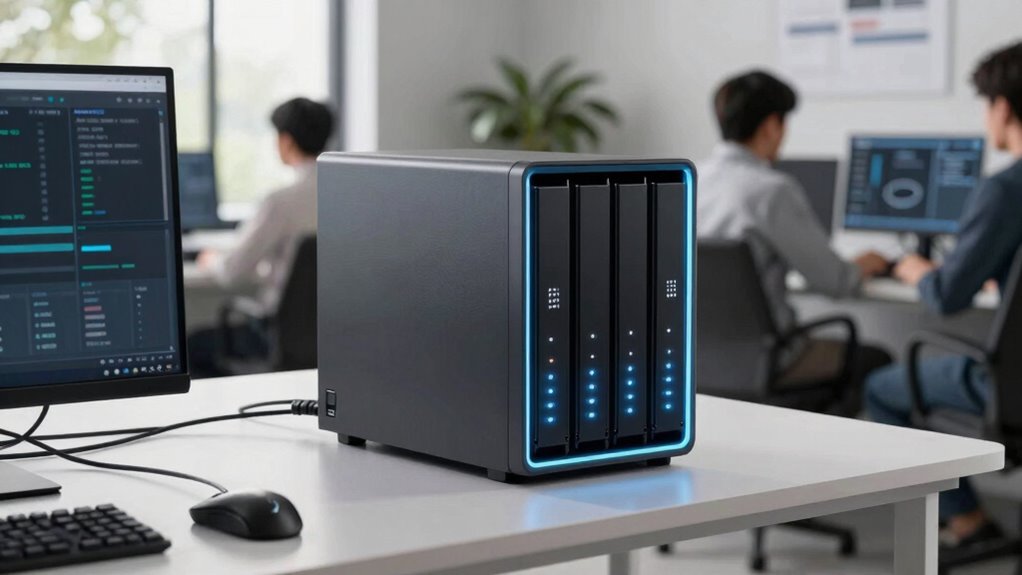

You rely on NAS devices as a core infrastructure because they centralize your files, making data accessible and easy to share across your team. They improve security with encryption and access controls while supporting remote work through cloud integration. Plus, they’re cost-effective and simple to set up, requiring minimal technical skills. As your team grows, NAS devices adapt to your needs, offering a resilient backbone for your digital workflows—discover how they can transform your efficiency.

Get business pricing on tech for your team
- Business-only prices and quantity discounts
- Tax-exempt purchasing
- Multiple users, one account, clear invoices
Key Takeaways
- NAS devices centralize data storage, making files easily accessible and simplifying collaboration for small teams.
- They offer seamless cloud integration, enabling remote access and flexible data management across locations.
- Advanced security features protect sensitive data, ensuring safe storage and compliance.
- Cost-effective and user-friendly, NAS devices require minimal technical expertise and reduce ongoing maintenance costs.
- As reliable core infrastructure, NAS supports scalability and resilience, adapting to evolving team needs.
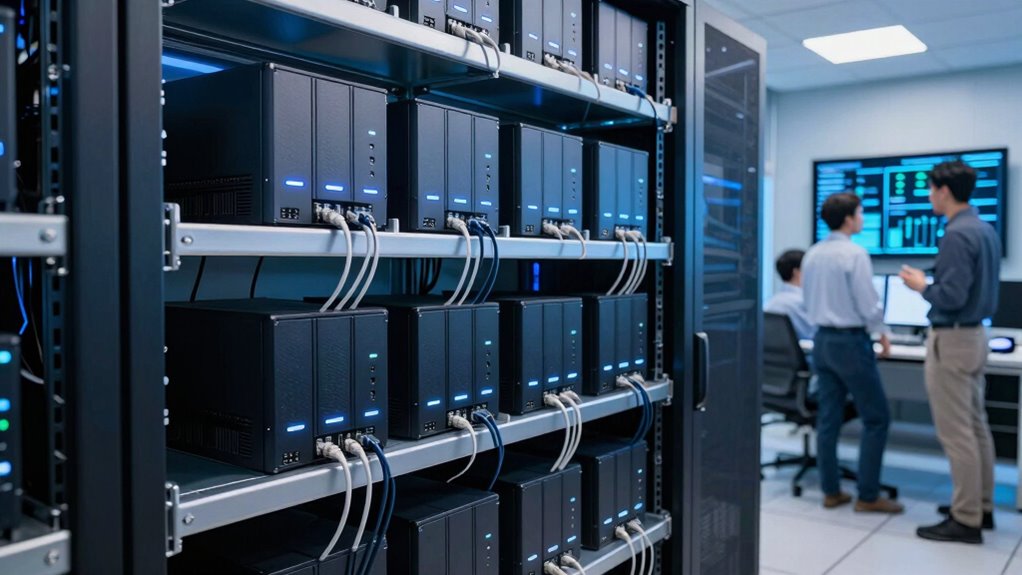
Network Attached Storage (NAS) devices have become fundamental components of modern IT infrastructure, offering a dependable and scalable solution for data management. For small knowledge teams, this means you can centralize all your files, projects, and resources in one accessible location. With NAS, you’re not limited by individual devices or scattered storage solutions. Instead, you gain a unified platform that simplifies collaboration, enhances data accessibility, and provides room for growth as your team expands. One of the key advantages is how seamlessly NAS integrates with cloud services. You can synchronize your local storage with cloud platforms, ensuring your data is backed up off-site and accessible from anywhere. This hybrid approach not only improves flexibility but also allows your team to work remotely or across different locations without losing access to crucial information.
NAS seamlessly integrates with cloud services, enabling remote access, off-site backups, and flexible collaboration for small teams.
Security is a top concern when managing sensitive data, and NAS devices address this with robust data security features. You can implement advanced encryption, multi-factor authentication, and regular backups to safeguard your files. Many NAS solutions also offer extensive access controls, so you determine who can view, edit, or share specific data. This level of security ensures your team’s intellectual property remains protected, reducing the risk of data breaches or accidental loss. Additionally, because NAS devices are designed with data security in mind, they often come with automatic firmware updates and security patches, making it easier for you to maintain a protected environment without extensive technical expertise. Furthermore, NAS devices are often equipped with redundant storage options, which help prevent data loss even if a drive fails. Incorporating automated backup features further enhances data resilience and peace of mind. The integration of data redundancy is critical for maintaining data integrity and minimizing downtime. Moreover, the popularity of NAS devices is further driven by their ability to support energy-efficient operation, reducing operational costs for small teams.
Another reason NAS is becoming a core infrastructure for small teams is its cost-efficiency. Unlike traditional servers, NAS devices are more affordable, easier to set up, and require less maintenance. You don’t need a dedicated IT team to keep the system running smoothly. Plus, their scalability means you can start with a small setup and expand storage as your data needs grow, avoiding large upfront costs. The user-friendly interfaces of modern NAS devices make it straightforward for team members to access files, collaborate on projects, and share resources without complicated configurations. This simplicity reduces downtime and helps keep your team focused on their work instead of troubleshooting technical issues.
In essence, NAS solutions are transforming how small knowledge teams manage data. They combine cloud integration, strong data security measures, scalability, and ease of use into a single, reliable platform. As your team’s needs evolve, your NAS device can adapt, providing a resilient backbone for your digital operations. It’s no longer just an option but a necessity for teams aiming to streamline workflows, protect their data, and stay agile in today’s fast-paced information landscape.
As an affiliate, we earn on qualifying purchases.
Frequently Asked Questions
How Secure Are NAS Devices Against Cyber Threats?
NAS devices can be quite secure against cyber threats if you take proper precautions. They often feature data encryption, which helps protect your sensitive information from unauthorized access. However, you still need to keep firmware updated, use strong passwords, and enable network security features like firewalls. Regularly backing up your data and monitoring for suspicious activity also strengthen your defenses, making your NAS a safer part of your infrastructure.
Can NAS Devices Integrate With Existing Cloud Services?
Imagine your NAS device as a bridge connecting two bustling islands—your local network and cloud services. Yes, NAS devices seamlessly integrate with existing cloud services, acting as a hub for data synchronization. This means you can effortlessly share files, back up data, and access information across platforms. With smooth cloud integration, your team stays connected and productive, turning your NAS into a powerful, synchronized data sanctuary.
What Is the Typical Cost of Deploying a NAS System?
You’ll typically spend between $500 and $2,500 to deploy a NAS system, depending on storage capacity and features. When comparing costs, consider hardware, setup, and maintenance expenses. While NAS devices are generally affordable, deployment challenges like configuration and network integration can add to costs. Doing a thorough cost comparison helps you choose a system that fits your budget and minimizes potential setup hurdles, ensuring smooth integration into your team’s infrastructure.
How Scalable Are NAS Solutions for Growing Teams?
You might think NAS solutions are limited, but they’re surprisingly scalable for growing teams. As your needs expand, you can tackle scalability challenges by upgrading drives, adding expansion units, or integrating cloud backups. These expansion strategies make NAS devices adaptable, so you won’t outgrow them overnight. Ironically, what seems like a simple storage solution can actually evolve with your team, providing a flexible backbone for your knowledge-sharing needs without requiring a complete overhaul.
What Are the Maintenance Requirements for NAS Infrastructure?
You’ll need to regularly perform data backup to protect your NAS data, ensuring that backups are current and stored securely. Hardware upgrades are essential as your team grows or your data demands increase; swapping out drives or adding RAM keeps your system running smoothly. Routine maintenance also includes firmware updates and checking system health to prevent failures. Staying proactive helps maintain reliable access and peak performance for your small knowledge team.
network attached storage with cloud integration
As an affiliate, we earn on qualifying purchases.
As an affiliate, we earn on qualifying purchases.
Conclusion
In the end, embracing NAS devices as your core infrastructure can transform how your team collaborates and shares data. They cut costs, boost efficiency, and simplify management—making your workflow smoother. Remember, “A chain is only as strong as its weakest link,” so investing in reliable storage like NAS guarantees your team’s success isn’t held back. Stay ahead by making smart infrastructure choices today—your future self will thank you.
secure NAS storage with encryption
As an affiliate, we earn on qualifying purchases.
As an affiliate, we earn on qualifying purchases.
As an affiliate, we earn on qualifying purchases.
Halloween Picks
halloween
As an affiliate, we earn on qualifying purchases.