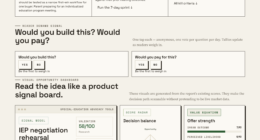
📊 Full opportunity report: Outcome-First Decisions: Keep, Change, or Kill on ThorstenMeyerAI.com — validation score, market gap, and execution plan.

Get business pricing on tech for your team
- Business-only prices and quantity discounts
- Tax-exempt purchasing
- Multiple users, one account, clear invoices
TL;DR
Outcome-First is a decision-making framework that guides organizations to evaluate ongoing projects based on current results, promoting pruning of underperforming initiatives. It emphasizes outcome-based judgments over sunk costs, aiming to improve portfolio health.
A new decision framework called Outcome-First is gaining attention for its approach to portfolio management, emphasizing the importance of evaluating initiatives based solely on current outcomes to decide whether to keep, change, or kill them. Developed as an open-source tool, it aims to address the common problem of organizations continuing projects that no longer produce value, thereby wasting resources.
Outcome-First is built around a core question: what outcome is this initiative producing right now, and is that outcome worth its ongoing cost? Unlike traditional methods that focus on past investments or effort, it reframes decisions forward-looking, making it easier to justify ending projects that are no longer effective. The framework introduces the Worth Filter, which simplifies decision-making by focusing solely on current results, leading to three possible verdicts: keep, change, or kill. It is designed to be provider-agnostic and runs locally, avoiding dependency on specific platforms or models. The framework is open source under the AGPL-3.0 license, ensuring transparency and community involvement.Proponents argue that this approach helps organizations avoid the trap of sunk cost fallacy and emotional attachment, which often lead to unnecessary continuation of underperforming initiatives. By systematically pruning projects that no longer justify their costs, organizations can reclaim capacity and focus resources on more valuable activities. However, critics warn that outcome measurement can be gamed or misapplied, and that the framework cannot replace human judgment or emotional courage needed to kill projects.
Outcome-First Decisions — keep, change, or kill
The hardest decision isn’t what to start — it’s what to stop. Judge every initiative by the outcome it produces now, not the effort already spent.
Independent commentary, produced with AI assistance under human editorial oversight. The views are the author’s own and may change. Outcome-First Decisions is open source under AGPL-3.0, provided “as is” without warranty; see the repository LICENSE. The framework’s verdicts are reasoning aids based on the inputs given and may be wrong — decision support, not decisions; verify independently before acting. Product and company names are trademarks of their respective owners; mention does not imply endorsement.
Why Outcome-First Decisions Impact Portfolio Management
This framework addresses a fundamental challenge in portfolio management: the tendency to continue supporting initiatives based on past investments rather than current value. By making outcome evaluation central, it encourages organizations to be more disciplined in pruning projects that drain resources without delivering results. This can lead to more efficient use of capital, better strategic alignment, and increased agility. The open-source nature promotes transparency and community refinement, potentially influencing best practices across industries.
As an affiliate, we earn on qualifying purchases.
The Role of Outcome-Based Judgments in Project Pruning
Traditional portfolio management often suffers from the ‘continuation bias,’ where organizations keep projects alive due to sunk costs, effort, or emotional attachment. Existing methods tend to focus on past inputs rather than current performance, leading to bloated project lists that consume attention and capital. The Outcome-First framework emerges as a response, emphasizing that the most impactful decisions are about stopping projects that no longer produce valuable results. It builds on ideas from operational discipline and lean management, with an emphasis on local-first, provider-agnostic implementation. The framework was developed recently and is now available on GitHub, signaling a shift toward more disciplined, outcome-focused decision-making.
“Outcome-First is the discipline that helps organizations prune their portfolios by judging initiatives solely on current outcomes, not past efforts.”
— Thorsten Meyer
portfolio management decision software
As an affiliate, we earn on qualifying purchases.
As an affiliate, we earn on qualifying purchases.
Limitations and Risks of Outcome-First Decision Framework
It is still unclear how effectively the framework can be applied in complex, slow-start projects or in environments where outcome measurement is difficult. Critics warn that outcome metrics can be gamed or misinterpreted, leading to premature or inappropriate kills. The framework cannot replace human judgment or emotional courage, which remain critical in making difficult decisions. Additionally, its success depends on honest, accurate outcome measurement, which can be challenging in some contexts. The long-term impact of widespread adoption remains to be seen, and some experts caution against over-reliance on outcome-based judgments without nuanced understanding.
outcome-based decision making frameworks
As an affiliate, we earn on qualifying purchases.
As an affiliate, we earn on qualifying purchases.
Next Steps for Adoption and Refinement of Outcome-First
Organizations interested in implementing Outcome-First are encouraged to review the open-source framework on GitHub and adapt it to their contexts. Further development and case studies are expected to emerge, providing insights into best practices and potential pitfalls. Industry groups may begin to endorse outcome-based pruning as a standard discipline, and integration with existing portfolio management tools could follow. Researchers and practitioners will likely explore how to improve outcome measurement and balance quantitative metrics with qualitative judgment. The framework’s community-driven evolution will shape its future effectiveness and adoption.
As an affiliate, we earn on qualifying purchases.
Key Questions
How does Outcome-First differ from traditional project evaluation methods?
Outcome-First focuses solely on current results to decide whether to keep, change, or kill projects, rather than relying on past investments or effort. It emphasizes outcome-based judgment over sunk costs, promoting more disciplined pruning.
Can Outcome-First be applied in all types of projects?
While designed to be provider-agnostic and flexible, its effectiveness depends on the ability to measure outcomes accurately. Slow-start or qualitative projects may pose challenges, and human judgment remains essential.
Is the framework open for customization?
Yes, it is open source under AGPL-3.0, allowing organizations to adapt it to their specific needs and integrate it with existing decision processes.
What are the main risks of using Outcome-First?
The primary risks include mismeasurement of outcomes, premature killing of valuable projects, and over-reliance on quantitative metrics without considering qualitative factors or organizational context.
What is the future outlook for Outcome-First adoption?
Further case studies, community feedback, and integration efforts are expected to refine the framework. Adoption may grow as organizations seek more disciplined portfolio management practices.
Source: ThorstenMeyerAI.com
Fall Picks
fall essentials
As an affiliate, we earn on qualifying purchases.