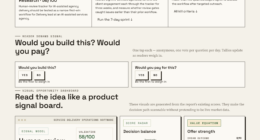

📊 Full opportunity report: The policy menu. There’s no single answer. There’s a menu — and choosing is a values choice in disguise. on ThorstenMeyerAI.com — validation score, market gap, and execution plan.

TL;DR

This article examines the range of policy responses to the economic impacts of AI, emphasizing that there is no single correct answer. Instead, choices reflect different societal values and trade-offs amid ongoing uncertainty.

There is no single answer to how society should respond to the economic shifts driven by AI; instead, policymakers face a menu of options, each aligned with different values and trade-offs, amid ongoing uncertainty about labor market impacts.

This analysis, authored by Thorsten Meyer, synthesizes three dispatches examining the implications of AI-driven economic change. It concludes that responses—ranging from doing nothing to implementing universal basic income (UBI), expanding ownership models, or funding through data dividends—are fundamentally value choices rather than purely technical solutions.

The dispatch emphasizes that each option optimizes for different societal goals such as efficiency, security, agency, or fairness, and each trades off certain benefits and drawbacks. It also highlights that the debate often collapses two axes: what to redistribute (income vs. ownership) and how to fund it (taxing workers vs. taxing common wealth), with the latter being more critical for the feasibility of policies.

Crucially, the dispatch underscores the persistent uncertainty about whether the labor share of income is actually declining—a key premise behind many policy proposals—and notes that this unresolved question complicates decision-making. The analysis advocates for choosing policies based on robustness to error rather than assumptions about the labor market’s future.

The Policy Menu — Thorsten Meyer AI
MENU
● DISPATCH / JUNE 2026
THORSTEN MEYER AI · POST-LABOR · § 03 · CAPSTONE
POST-LABOR · 03
CAPSTONE / MENU
Essay · The Capstone · Distribution Under Uncertainty · 2026-06-12

The policy menu.
There’s no single answer.
There’s a menu — and
choosing is a values
choice in disguise.

Three dispatches brought us to a question. The honest service isn’t to pick a winner — it’s to lay the full menu out fairly.
If value is shifting from labor to capital — even partly, even slowly — what is the response? There are four: do nothing and ease adaptation, redistribute income (UBI), redistribute ownership (UBC), or fund either from common wealth (data dividends, sovereign wealth funds). Each optimizes for a different value — efficiency, security, agency, fairness — and trades away the others. The structural argument: choosing among them is a values choice disguised as a technical one, so the honest service is to present the full menu evenhandedly rather than sell the option I favor. The deepest move: the menu has two axes people collapse — WHAT you redistribute vs HOW you fund it — and the funding axis does more of the real work, because a policy financed by taxing the workers it’s meant to help is self-defeating. And no option resolves whether the shift is even real — so the menu is a set of bets under uncertainty, read not by “which is correct” but “which is robust to being wrong.”
do nothing
Ease adaptation · robust if the
shift isn’t real, catastrophic if it is
UBI
Redistribute income · simple,
dignifying · fiscally heavy, cause-blind
UBC
Redistribute ownership · more
robust · but slow, concentration-prone
common wealth
The funding axis · the question
under the question · funds either
THE POLICY MENU· NO SINGLE ANSWER · A MENU · A VALUES CHOICE IN DISGUISE· DO NOTHING · UBI · UBC · COMMON-WEALTH FUNDING· EACH OPTIMIZES FOR A DIFFERENT VALUE AND TRADES AWAY THE OTHERS· DO-NOTHING · LABOR ALWAYS REALLOCATED · UNTIL MAYBE IT DOESN’T· UBI · ALASKA ~$1,600/YR 40 YEARS, WORK-NEUTRAL· UBC · OWNED STAKE SURVIVES WHAT A TRANSFER DOESN’T· TWO AXES · WHAT YOU REDISTRIBUTE VS HOW YOU FUND IT· TAXING JILL TO PAY JACK IS SELF-DEFEATING· THE FUNDING AXIS DOES MORE OF THE REAL WORK· NO OPTION RESOLVES WHETHER THE SHIFT IS EVEN REAL· CHOOSE FOR ROBUSTNESS, NOT OPTIMIZATION· ANYONE OFFERING ONE ANSWER IS SELLING SOMETHING· THE POLICY MENU· NO SINGLE ANSWER · A MENU · A VALUES CHOICE IN DISGUISE· DO NOTHING · UBI · UBC · COMMON-WEALTH FUNDING· EACH OPTIMIZES FOR A DIFFERENT VALUE AND TRADES AWAY THE OTHERS· DO-NOTHING · LABOR ALWAYS REALLOCATED · UNTIL MAYBE IT DOESN’T· UBI · ALASKA ~$1,600/YR 40 YEARS, WORK-NEUTRAL· UBC · OWNED STAKE SURVIVES WHAT A TRANSFER DOESN’T· TWO AXES · WHAT YOU REDISTRIBUTE VS HOW YOU FUND IT· TAXING JILL TO PAY JACK IS SELF-DEFEATING· THE FUNDING AXIS DOES MORE OF THE REAL WORK· NO OPTION RESOLVES WHETHER THE SHIFT IS EVEN REAL· CHOOSE FOR ROBUSTNESS, NOT OPTIMIZATION· ANYONE OFFERING ONE ANSWER IS SELLING SOMETHING·
FIG. 01 — OPTION ONE · DO NOTHING · EASE THE ADAPTATION
The default, the burden-of-proof holder, the most historically vindicated
Its advocates wouldn’t call it “do nothing” — they’d call it “let markets adapt”
Optimizes for
Efficiency
Mechanism
Wage subsidies · skills · mobility
Robust if
The shift isn’t real
The case for
Labor has always reallocated. 1900: 41% in agriculture; today under 2% — no mass permanent unemployment. Every prior automation panic assumed a fixed lump of labor and was wrong.
Where it’s weakest
It assumes the historical pattern holds on a bearable timeline. If this shift is faster or different, “ease adaptation” is a bet that the past predicts a structurally novel future.
Its sharpest critique of the others: UBI confuses a transition problem with a permanent-income problem. If people need help moving to new work, the cure is targeted wage subsidies that encourage work — not a universal check. Robust if the shift isn’t real; catastrophic if it is.
FIG. 02 — OPTION TWO · UBI · REDISTRIBUTE THE INCOME
The simplest, most immediate, most dignifying — and the most fiscally exposed
A regular cash floor, universal and unconditional
Optimizes for
Security
Mechanism
Unconditional cash floor
Robust if
You need speed
What the evidence shows
Alaska’s dividend (~$1,600/yr, 40 years) is work-neutral; Finland/Germany pilots raised well-being with employment flat; 122+ pilots converge on the same read. Simple, immediate, dignifying.
Where it’s weakest
It’s cause-blind — treats the symptom (no income) not the cause (no asset). And it’s fiscally heavy: a meaningful US UBI runs toward half the federal budget.
The funding trap is the real vulnerability: if a UBI is financed by taxing wages, it is “taxing Jill to pay Jack” — taxing the labor income it’s meant to replace. The evidence kills the “people stop working” objection; it doesn’t kill the “where does the money come from” one. That’s the funding axis (FIG. 05).
FIG. 03 — OPTION THREE · UBC · REDISTRIBUTE THE OWNERSHIP
More robust than income — an owned stake survives what a transfer doesn’t
The Stake’s thesis: broad-based capital ownership, not just income
Optimizes for
Agency
Mechanism
Broad-based capital stakes
Robust if
Capital captures the value
Why more robust than UBI
If value moves to capital, owning capital tracks the shift — the citizen’s stake rises with the returns labor is losing. A transfer must be re-legislated each year; an owned asset is durable.
Where it’s weakest
It’s slow — building meaningful stakes takes years a crisis may not allow — and concentration-prone: without care, the assets pool back to those who already own.
This is the option I favor — which is exactly why it gets the same scrutiny as the rest. UBC is robust across both states of the world (it helps if the shift is real, does little harm if not), but it is too slow to be a crisis response on its own. Ownership alone fails the robustness test that a portfolio passes.
FIG. 04 — THE FUNDING MODEL · WHERE THE MONEY COMES FROM
The question under the question — and it does more work than the redistribution fight
Common wealth, not worker taxes: the funding source can fund either UBI or UBC
Worker-tax funding
Self-undermining
Financing a labor-income replacement by taxing labor income is “taxing Jill to pay Jack.” It fights the very shift it’s responding to — the bad options on the menu.
Common-wealth funding
Robust
A sovereign wealth fund, data royalties, a compute tax, public equity — Varoufakis’s common-wealth principle. Funds the response from the capital gains, not the wages.
The data and compute that power AI are built on common inputs — public data, public research, public infrastructure — so a claim on the returns is a claim on common wealth, not a tax on labor. Common-wealth funding can finance either UBI or UBC, which is why the funding axis is orthogonal to the redistribution one. Its weakness: amount and governance are unresolved, and an AI-valuation bubble could shrink the base.
FIG. 05 — THE TWO AXES & THE ROBUSTNESS TEST · HOW TO READ THE MENU
People collapse two axes into one — and argue about the wrong one
Choose for robustness (least harm if wrong), not optimization (best if right)
Redistribute nothing
Redistribute income
Redistribute ownership
Fund via worker taxes
— (no transfer)
UBI, self-undermining
taxes Jill to pay Jack
Forced buy-in
fights the shift
Fund via common wealth
Do-nothing
robust only if no shift
UBI from a fund
fast floor
UBC from a fund
durable stake
Under irreducible uncertainty about whether the shift is real, choose least-harm-if-wrong, not best-if-right. That favors a common-wealth-funded portfolio — a fast income floor + a slow ownership build + adaptation support — over any pure option. The bad cells are the worker-tax-funded ones; the good cells are the common-wealth ones.
The honest service is the menu itself: here are the options, here is what each optimizes for and trades away, here is the funding axis that matters more than the fight everyone is having. The decision is yours, the tradeoffs are real, and the one thing you should not accept is anyone telling you it’s obvious.
Thorsten Meyer · The Policy Menu · Post-Labor 03 · Capstone

Why Policy Choices Are Values-Driven and Uncertain

The analysis underscores that policy responses to AI-induced economic shifts are fundamentally rooted in societal values, not purely technical calculations. Each option—do-nothing, UBI, ownership redistribution, or data dividends—embodies different priorities such as security, fairness, or efficiency, and involves trade-offs that reflect moral choices.

Furthermore, the uncertainty about whether the decline in labor share is real means policymakers should prioritize robustness—selecting options that do the least harm if their assumptions prove wrong. This perspective shifts the debate from seeking a single ‘correct’ answer to understanding which options are most resilient amid ongoing economic and technological change.

FREEDOM FROM TAXES: Introduction of Automated Payment Transaction Tax and Universal Basic Income (Political Thought)

FREEDOM FROM TAXES: Introduction of Automated Payment Transaction Tax and Universal Basic Income (Political Thought)

As an affiliate, we earn on qualifying purchases.

As an affiliate, we earn on qualifying purchases.

The Evolving Debate on AI and Labor Share

The discussion about how AI impacts labor markets has been ongoing, with some arguing that AI shifts value from labor to capital, prompting calls for redistribution policies like UBI or ownership models. The initial dispatchs in the Post-Labor series laid out the ownership case, tested its premises, and identified signals of labor-share decline. However, recent data remains inconclusive, leaving the core premise uncertain.

This final dispatch synthesizes previous arguments, emphasizing that responses are value-laden choices rather than definitive solutions, especially given the unresolved question of whether the labor share is genuinely shrinking.

“A policy menu is honest only when each option is presented as its strongest advocates would present it and critiqued as its strongest critics would critique.”

— Thorsten Meyer

[1760558206] [9781760558208]Extreme Ownership: How U.S. Navy SEALs Lead and Win-Paperback

[1760558206] [9781760558208]Extreme Ownership: How U.S. Navy SEALs Lead and Win-Paperback

As an affiliate, we earn on qualifying purchases.

As an affiliate, we earn on qualifying purchases.

Unresolved Questions About Labor Share Decline

The core uncertainty remains whether the decline in labor’s share of income is real or a temporary fluctuation. Current data is inconclusive, and this ambiguity complicates choosing the most appropriate policy response. The dispatch emphasizes that this unresolved issue is critical because it influences which options are most robust and least harmful if the premise proves false.

Sharp Calculators EL-243SB 8-Digit Pocket Calculator

Sharp Calculators EL-243SB 8-Digit Pocket Calculator

Hinged, hard cover protects keys and display when stored

As an affiliate, we earn on qualifying purchases.

As an affiliate, we earn on qualifying purchases.

Next Steps in Policy and Research

Policymakers and researchers should focus on improving data collection and analysis to clarify whether the labor share decline is ongoing. Meanwhile, decision-makers are advised to prioritize policies that are resilient to different future scenarios, emphasizing flexibility and adaptability. Public debate should also shift toward understanding values and trade-offs rather than seeking a single ‘correct’ solution.

The AI-Assisted Policy Professional: Practical AI Workflows for Government Consultants, International Organisations, and Development Professionals

The AI-Assisted Policy Professional: Practical AI Workflows for Government Consultants, International Organisations, and Development Professionals

As an affiliate, we earn on qualifying purchases.

As an affiliate, we earn on qualifying purchases.

Key Questions

What are the main policy options discussed for responding to AI-driven economic shifts?

The options include doing nothing, implementing universal basic income (UBI), expanding ownership models (UBC), and funding redistribution through data dividends or sovereign wealth funds.

Why is there no single correct answer to these policy questions?

Because each option aligns with different societal values—efficiency, security, fairness—and involves trade-offs. The best choice depends on which values society prioritizes, especially amid ongoing uncertainty about labor market changes.

What is the key uncertainty affecting policy decisions?

The central unknown is whether the decline in labor’s share of income is real and persistent. Without clarity on this, policies must be evaluated based on their robustness rather than assumptions.

How should policymakers approach choosing among these options?

They should prioritize options that do the least harm if their assumptions are wrong, focusing on resilience and flexibility rather than seeking a single ‘best’ solution.

What is the significance of the funding source in these policy debates?

The funding mechanism—whether taxing workers or common wealth—has a profound impact on the feasibility and fairness of policies, often more than the specific type of redistribution.

Source: ThorstenMeyerAI.com

You May Also Like

Every AI Subscription Is a Ticking Time Bomb for Enterprise

AI providers are subsidizing enterprise subscriptions at a loss, risking costly price corrections that could impact business operations.

Nvidia CEO’s Charitable Foundation Signs GPU Deal With CoreWeave

Nvidia CEO’s charitable foundation has signed a GPU supply agreement with CoreWeave, marking a significant partnership in cloud GPU provisioning.

The AI Zombification of Universities

Universities face a surge in AI use, threatening academic integrity and the core purpose of higher education, as confirmed cases and widespread use escalate.

The New Office Arms Race Is About Judgment, Not Typing Speed

An evolving workplace values judgment over speed, transforming office dynamics—discover why meaningful contribution now defines success and how to stay ahead.