📊 Full opportunity report: Transforming Industrial Gauge Checks Using Phone-Photo Technology on IdeaNavigator AI — validation score, market gap, and execution plan.

Get business pricing on tech for your team
- Business-only prices and quantity discounts
- Tax-exempt purchasing
- Multiple users, one account, clear invoices
TL;DR
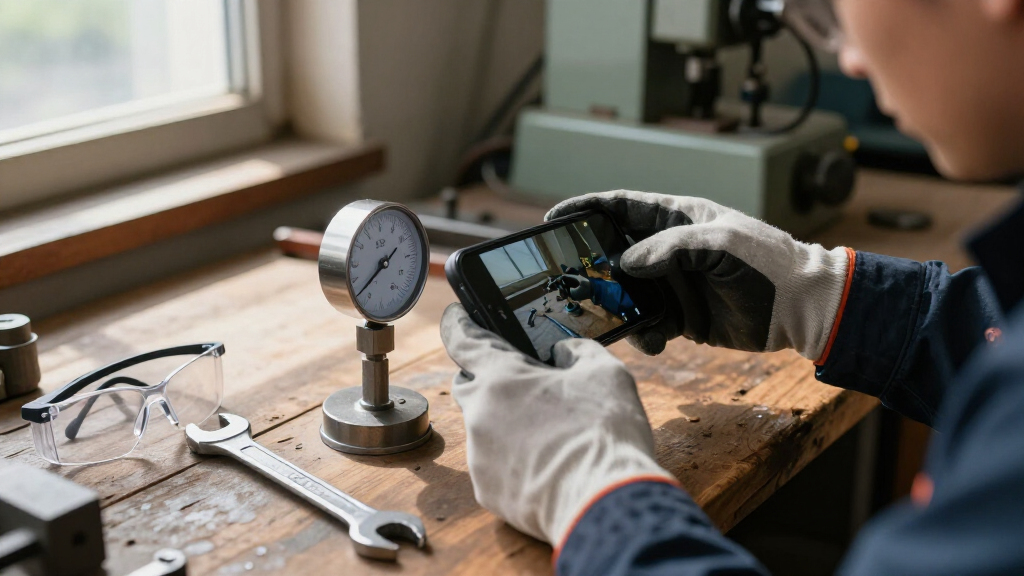
A new approach uses phone photos to read and log analog gauges in industrial settings, promising to reduce errors and enable better trend analysis without costly sensor upgrades. Pilot tests are underway at three facilities to validate effectiveness.
Industrial facilities are beginning to test a phone-photo-based system for reading analog gauges, which could replace traditional clipboard rounds and manual transcription. This innovation aims to improve measurement accuracy, enable trend analysis, and reduce costs associated with retrofitting legacy equipment, making it a significant development for operations management.
The new system involves technicians photographing gauges during their routine rounds using a dedicated app. The app employs vision models to accurately read the gauge values from the photos, compare them against expected ranges, and log the data with timestamps and location markers. It also flags anomalies immediately, allowing for quicker maintenance responses.
This approach is being tested at three facilities over a one-month period, where it will run parallel to existing clipboard-based rounds. The goal is to compare error rates, early detection of issues, and overall data quality between the two methods. The system is designed to be a low-cost, scalable solution that leverages existing phone hardware without requiring expensive IoT sensors.
According to an anonymous researcher, the technology has matured enough to reliably read analog dials, sight glasses, and counters from simple phone images, creating a new data source for legacy equipment without physical alterations.
Potential Impact on Industrial Maintenance Data Collection
This development could significantly improve operational efficiency by reducing transcription errors that often hide developing failures in legacy systems. Better data accuracy and trend analysis can lead to more predictive maintenance, reducing downtime and maintenance costs. Additionally, the low-cost nature of the solution makes it accessible for facilities that cannot afford extensive sensor retrofits, potentially transforming how industrial data is collected and used across sectors.
digital gauge reading app for industrial gauges
As an affiliate, we earn on qualifying purchases.
As an affiliate, we earn on qualifying purchases.
Legacy Equipment and the Need for Better Monitoring
Many industrial facilities rely on analog gauges for critical measurements, but traditional methods involve manual transcription onto paper, which is prone to errors and rarely used for ongoing analysis. Retrofitting these systems with IoT sensors is often prohibitively expensive, especially on legacy equipment. As a result, facilities lack continuous, reliable data streams necessary for predictive maintenance and operational optimization.
Recent advances in computer vision have demonstrated that modern models can accurately interpret visual data from ordinary phone photos. This has opened the door for a low-cost, scalable solution that turns existing gauges into data sources without hardware upgrades. Pilot programs are now testing this approach to evaluate its effectiveness and potential for wider adoption.
As an affiliate, we earn on qualifying purchases.
Uncertainties Around Accuracy and Adoption Speed
It is not yet clear how the system’s accuracy compares to traditional methods over longer periods or across different types of gauges. The pilot tests will provide initial data, but broader validation is still needed. Additionally, factors such as user training, integration with existing maintenance workflows, and acceptance by technicians remain to be seen. The cost-effectiveness of scaling beyond pilot sites also requires further assessment.
As an affiliate, we earn on qualifying purchases.
Next Steps in Validation and Potential Rollout
Following the initial one-month pilot, the participating facilities will analyze error rates, anomaly detection effectiveness, and overall data quality. If results are positive, broader deployment could be considered, along with further development of the app’s features. Industry stakeholders will watch for published findings to determine whether this approach becomes a standard practice for legacy gauge monitoring.
industrial gauge monitoring system
As an affiliate, we earn on qualifying purchases.
As an affiliate, we earn on qualifying purchases.
Key Questions
How accurate are phone photos for reading gauges compared to manual transcription?
Initial tests suggest high reliability, with vision models accurately reading gauge values from photos. The pilot program will compare error rates directly with manual transcription to confirm accuracy levels.
Can this system replace all types of gauges in industrial settings?
The system is designed primarily for analog gauges, sight glasses, and counters that are visually accessible. Its effectiveness on complex digital or specialized gauges remains to be evaluated.
What are the cost implications of adopting this phone-photo system?
Because it leverages existing smartphones and a dedicated app, the system is expected to be low-cost, with a subscription model based on gauge count. It aims to be more affordable than retrofitting with IoT sensors.
Will technicians need special training to use the app?
Technicians will likely need minimal training to photograph gauges correctly and use the app, which is designed to be simple and intuitive. The pilot will assess usability and training needs.
When could this technology be widely adopted across industries?
If pilot results are positive, broader adoption could follow within a year, depending on validation outcomes, industry acceptance, and integration with existing maintenance systems.
Source: IdeaNavigator AI
Fall Picks
fall essentials
As an affiliate, we earn on qualifying purchases.