
🔍 Read the full analysis: What Anthropic's Hardware Standard Means For AI Industry Leaders on ThorstenMeyerAI.com
TL;DR
Anthropic introduced a limited research preview of its Model Hardware Standard (MHS) on August 27, 2026, designed to enable AI agents to connect with and control physical devices through shared drivers. While early results are promising, the standard is still under development, and its safety and performance are not yet fully validated across diverse environments.
Anthropic has launched a limited research preview of its Model Hardware Standard (MHS) on August 27, 2026, opening early access to selected laboratories and manufacturers. For more details, see the original analysis. The standard aims to enable AI agents to discover, monitor, and operate physical equipment through shared software drivers, potentially transforming automation in research labs, factories, and other settings. While initial partner projects show promising results, the safety, reliability, and broad applicability of MHS are still under evaluation.
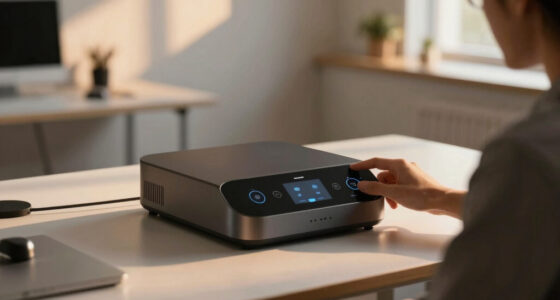
The Model Hardware Standard developed by Anthropic provides a common interface for connecting AI systems with physical devices such as microscopes, robotic arms, and laser systems. This initiative is discussed in more detail in our coverage on AI automation features. The standard introduces a software driver layer that describes device capabilities, enforces safety limits, and allows AI agents to perform operations like reading temperatures or adjusting settings. This approach aims to reduce the time and effort involved in integrating diverse hardware, which traditionally requires custom engineering for each device.
Early projects under the preview include collaborations with Genentech for protein assay automation, Janelia Research Campus for microscope control, and QuEra for laser stabilization. These efforts highlight the potential of standardized hardware interfaces, as detailed in the original analysis. In these pilot tests, AI agents have successfully coordinated multiple instruments and recovered from operational errors, such as laser lock failures, with reported high success rates. However, these results are preliminary, and independent validation or peer-reviewed studies are not yet available.
Anthropic emphasizes that MHS could significantly cut down integration times—from weeks or months to hours or minutes—by providing a standardized control layer across devices from different vendors. Yet, safety remains a concern, as the current implementations depend on expert supervision, and the system’s ability to handle complex physical phenomena or unexpected failures has not been fully demonstrated.
Potential Industry-Wide Impact of Hardware Standardization
If successfully adopted and validated, MHS could revolutionize automation across research, manufacturing, and quantum computing sectors by simplifying device integration and enabling more flexible, scalable AI-driven workflows. It could reduce costs and development times, foster interoperability among diverse hardware vendors, and accelerate the deployment of autonomous systems. However, the risks associated with giving AI direct control over physical equipment—such as safety hazards, equipment damage, or sample contamination—mean that rigorous validation, safety standards, and oversight are essential before widespread adoption.
As an affiliate, we earn on qualifying purchases.
Origins and Development of the Model Hardware Standard
The Model Hardware Standard originated from collaborative work between Anthropic and the Howard Hughes Medical Institute’s Janelia Research Campus, focusing on replacing complex point-to-point connections with a unified interface for experimental rigs. The goal was to facilitate seamless control and data sharing among lasers, cameras, and motorized components from different vendors. Following initial success, Anthropic expanded testing to include partners in biotech, robotics, and quantum computing, with companies like AWS, Doosan Robotics, Tecan, and Universal Robots participating. Companies like Hugging Face and Raspberry Pi are also working on integrating MHS support into their platforms.
While the concept addresses a longstanding interoperability challenge, the current implementation remains in early stages, with ongoing development and limited deployment. The approach is inspired by the need for safer, more reproducible automation, especially as AI systems become more capable of direct physical interaction.
“The Model Hardware Standard aims to create a shared language for AI to safely and efficiently control physical devices across industries.”
— Thorsten Meyer, Anthropic
As an affiliate, we earn on qualifying purchases.
Unverified Safety and Performance Across Diverse Environments
While early pilot projects demonstrate potential, independent validation of MHS’s safety, reliability, and effectiveness across a wide range of hardware, failure modes, and operational conditions is lacking. It is unclear how well the standard will perform in complex, real-world environments with unpredictable physical phenomena or hardware malfunctions. The system’s ability to prevent safety incidents or hardware damage during autonomous operation remains unproven outside controlled tests.
As an affiliate, we earn on qualifying purchases.
Next Steps for Validation and Broader Adoption
Anthropic is currently accepting applications from research and industry organizations to participate in the limited preview, which will focus on testing additional devices, developing safety evaluations, and establishing deployment best practices. The company plans to publish a detailed safety roadmap and share findings from ongoing tests. The critical next milestones include independent, multi-site evaluations, incident reporting, and benchmarks for safety and robustness. A wider open-source release of the standard is anticipated once sufficient validation and safety assessments are completed.
As an affiliate, we earn on qualifying purchases.
Key Questions
What is the Model Hardware Standard (MHS)?
MHS is a shared specification developed by Anthropic to enable AI systems to connect with and control physical devices through standardized software drivers, aiming to streamline integration and improve safety.
When will MHS be publicly available?
Anthropic has not announced a specific release date. The current focus is on testing the standard with selected partners and developing safety and deployment guidelines before a broader release.
What are the safety concerns associated with MHS?
Safety concerns include the risk of hardware damage, unsafe sample handling, or operational failures if AI agents are given autonomous control without adequate safeguards. The system’s safety performance is still under evaluation.
Which industries could benefit most from MHS?
Research laboratories, biotech companies, manufacturing facilities, and quantum computing labs could benefit from easier device integration, faster automation, and more flexible workflows.
What are the main challenges for widespread adoption?
Challenges include ensuring safety and reliability across diverse hardware, establishing industry-wide standards, and developing comprehensive validation and incident reporting processes.
Primary source: Anthropic · via ThorstenMeyerAI.com