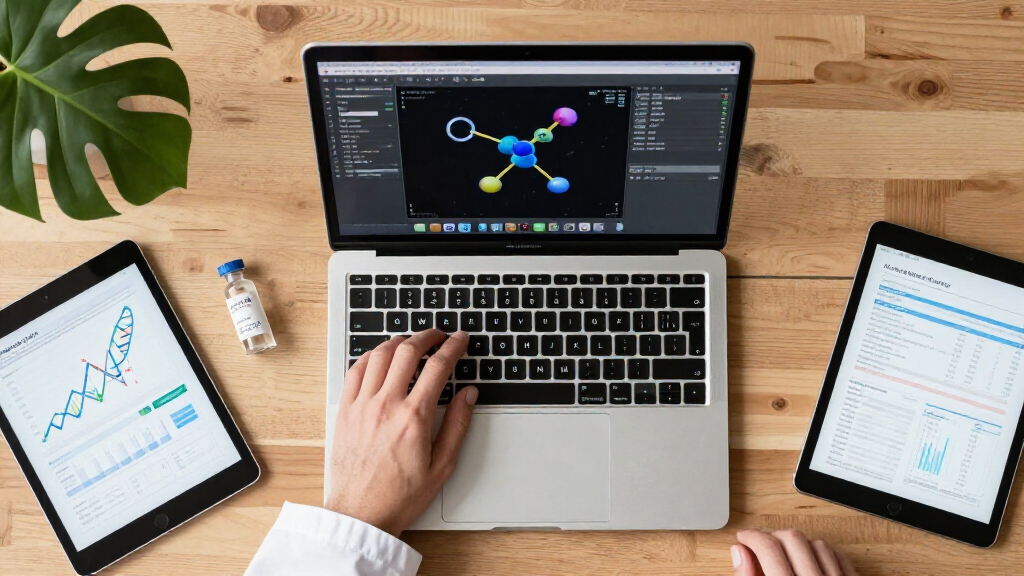

🔍 Read the full analysis: What Makes Claude A Leader In AI-Driven Biomolecular Modeling? on ThorstenMeyerAI.com

Get business pricing on tech for your team
- Business-only prices and quantity discounts
- Tax-exempt purchasing
- Multiple users, one account, clear invoices
TL;DR
Anthropic reports that its Claude AI model supports biomolecular modeling workflows, including code generation, literature synthesis, and data interpretation as detailed in the original analysis. While promising, these claims are from the company itself, with independent validation still needed.
Anthropic has announced that its Claude AI models are being actively used by researchers in biomolecular modeling, supporting tasks such as code writing, literature review, and data interpretation. The company claims these applications help accelerate research workflows, potentially shortening drug discovery and structural biology cycles see how ByteDance’s AI model compares. This account highlights a growing trend of AI tools integrating into laboratory-adjacent scientific activities, though independent validation remains forthcoming.
According to Anthropic, researchers deploying Claude in biomolecular workflows are leveraging its capabilities for generating and debugging scientific code, digesting large volumes of scientific literature, and structuring complex molecular data. The company emphasizes that Claude acts as an auxiliary tool, streamlining intermediate steps that traditionally require significant manual effort, such as scripting and data analysis. These claims are based on Anthropic’s own reports and specific use cases shared publicly, but detailed independent verification or peer-reviewed studies are not yet available.
Anthropic’s account underscores that the primary value of Claude lies in enhancing productivity rather than making novel scientific predictions. For example, the model is said to assist in writing scripts for molecular dynamics simulations, explaining complex structural data, and synthesizing literature across thousands of papers. These applications aim to reduce the time researchers spend on tedious tasks, allowing them to focus more on hypothesis-driven science. The company also notes that Claude’s language understanding facilitates reasoning about protein structures and binding sites in conversational formats, making complex data more accessible.
While these claims are promising, they are primarily vendor assertions. No specific laboratories, quantitative benchmarks, or peer-reviewed results have been published to substantiate the extent of productivity gains or error rates. It remains unclear how widespread these applications are among the broader scientific community or whether they outperform traditional workflows in controlled studies. The current evidence base is limited to Anthropic’s own descriptions and early user reports.
Implications for Scientific Research Acceleration
The potential impact of Claude’s integration into biomolecular modeling is significant, as it could shorten research cycles in drug discovery, enzyme engineering, and structural biology. AI-assisted coding and literature synthesis can reduce manual effort, improve data handling, and facilitate faster hypothesis testing. For the biotech and pharmaceutical sectors, such efficiencies could translate into faster development timelines and cost savings. However, the actual effectiveness depends on independent validation and the reliability of AI-generated outputs, which are still under assessment.
As an affiliate, we earn on qualifying purchases.
Biomolecular Modeling and AI Advances
Biomolecular modeling has been transformed by AI, notably with AlphaFold’s breakthrough in protein structure prediction, which earned the 2024 Nobel Prize in Chemistry. These systems demonstrated that machine learning could approach experimental accuracy in predicting molecular structures, shifting the focus to integrating AI into broader research workflows. Unlike AlphaFold’s specialized predictive role, Anthropic positions Claude as a general-purpose assistant that complements existing tools by handling ancillary tasks like scripting, data analysis, and literature review. This approach aims to streamline the entire research pipeline rather than replace specific predictive models.
Anthropic’s claims align with a broader trend of AI tools entering laboratory-adjacent activities, where they support researchers rather than replace core experimental methods. The emphasis is on workflow acceleration, which could enhance productivity without fundamentally altering the scientific process itself. Nonetheless, the reliance on vendor-reported benefits highlights the need for independent studies to confirm these advantages in real-world settings.
“Anthropic’s description of Claude supporting biomolecular workflows aligns with ongoing efforts to integrate AI into scientific research, but validation is still needed.”
— Thorsten Meyer, AI researcher
scientific coding tools for research
As an affiliate, we earn on qualifying purchases.
As an affiliate, we earn on qualifying purchases.
Lack of Independent Validation and Benchmark Data
At present, the claims about Claude’s effectiveness in biomolecular modeling are solely from Anthropic’s own reports. No peer-reviewed studies, independent benchmarks, or detailed user case studies have been published to confirm these benefits. It is unclear how much time or accuracy improvements Claude provides compared to traditional methods, or whether these applications are widespread among the scientific community. The reliability of AI-generated code and summaries in high-stakes research remains an open question.
literature review software for scientists
As an affiliate, we earn on qualifying purchases.
As an affiliate, we earn on qualifying purchases.
Awaiting Peer-Reviewed Evidence and Broader Adoption
Future developments will depend on independent validation of Claude’s utility in biomolecular research, including peer-reviewed studies and detailed case reports from laboratories. Watching how biotech and pharmaceutical companies incorporate Claude into their workflows will also be informative. Additionally, upcoming versions of Claude may improve its scientific reasoning and code generation capabilities, potentially increasing its impact. Researchers and industry stakeholders will likely monitor these developments closely to assess whether AI-assisted workflows become standard practice.
As an affiliate, we earn on qualifying purchases.
Key Questions
Can Claude replace specialized biomolecular prediction tools?
Currently, Claude is positioned as a support tool for tasks like coding, data interpretation, and literature review, not as a replacement for specialized prediction models like AlphaFold. Its role is to streamline workflow steps rather than generate primary structural predictions.
What specific tasks does Claude assist with in biomolecular research?
Claude is reported to help with writing and debugging research code, synthesizing scientific literature, structuring molecular data, and reasoning about protein structures and binding sites in conversational formats.
Has Claude been tested in independent scientific studies?
No, as of now, all claims are from Anthropic’s own reports. Independent validation, peer-reviewed research, and benchmarking are still pending.
How might AI tools like Claude impact the future of biological research?
If validated, AI assistants could significantly shorten research cycles, reduce manual effort, and improve data handling, especially in complex fields like drug discovery and structural biology.
What are the risks of relying on AI in scientific workflows?
Risks include potential errors in AI-generated code or interpretations, over-reliance on automated tools without proper validation, and the need for careful oversight to ensure scientific accuracy.
Primary source: Anthropic · via ThorstenMeyerAI.com
Fall Picks
fall essentials
As an affiliate, we earn on qualifying purchases.