
TL;DR
Anthropic announced Claude Meetings on November 12, 2026, a beta that lets eligible Team and Enterprise users add Claude to Google Meet calls for live notes, answers and shared documents. The feature stores transcripts, summaries and screen descriptions, but Anthropic says it does not save audio; retention terms and post-beta artifact pricing remain unclear.
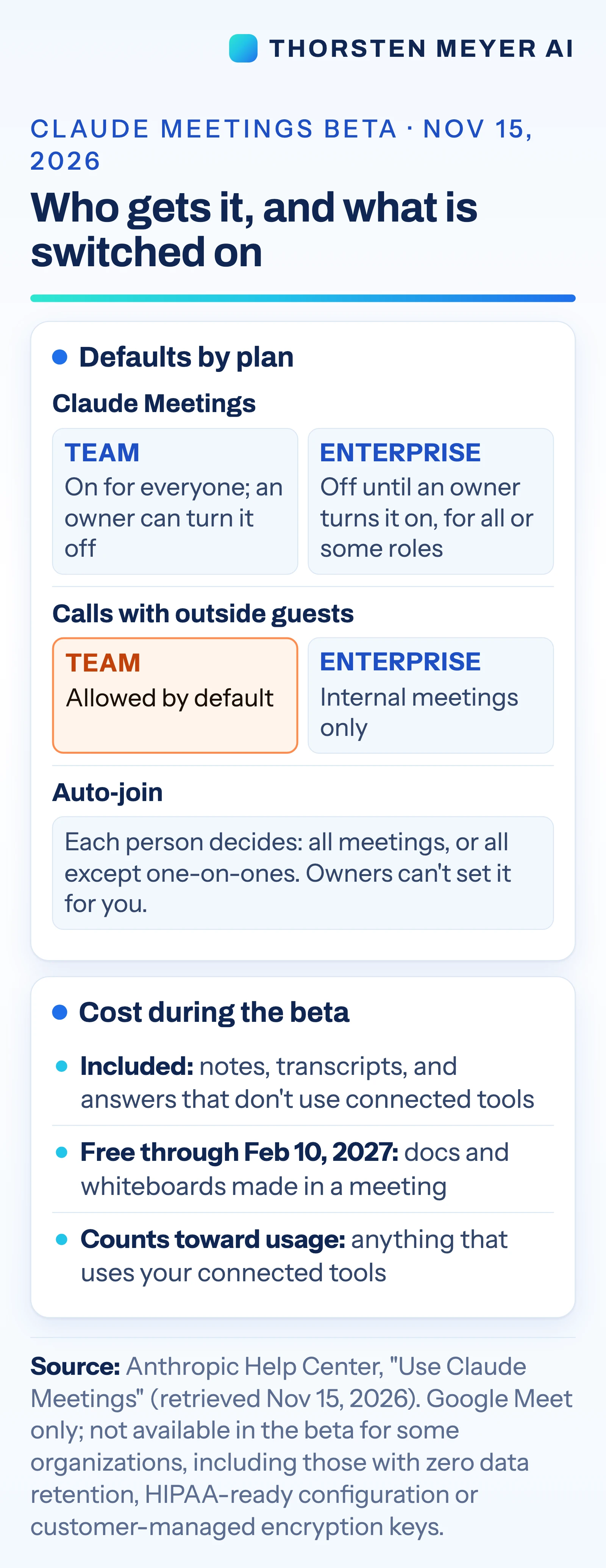
Claude joins when a participant adds it from a meeting selected through a connected Google Calendar, or when that user has enabled auto-join. An organization owner must first enable Google Calendar. Anthropic says auto-join is a personal setting, with options for all meetings or all except one-on-ones; owners cannot turn it on for individual users. Claude typically joins without asking, though a host may be asked to admit it. If the host declines, Anthropic says it will not try again for that call unless someone adds it.

Get business pricing on tech for your team
- Business-only prices and quantity discounts
- Tax-exempt purchasing
- Multiple users, one account, clear invoices
During a call, participants can address Claude aloud or type a request in Google Meet chat. Its written answers in chat are visible to everyone on the call. Claude also maintains a live transcript on a meeting page and can create documents, whiteboards and slides there. Anthropic says the meeting page holds the transcript, summary and screen descriptions, but not audio recordings. Afterward, colleagues on the invitation receive a recap email; outside guests do not. A meeting page remains available for up to eight hours, according to the supplied product details.
Availability and defaults vary by plan. On Team, the feature is on by default and calls with outside guests are allowed by default. On Enterprise, it is off until an owner enables it and is limited to internal meetings by default. The beta is unavailable to some organizations, including those configured for zero data retention, HIPAA readiness or customer-managed encryption keys. Notes, transcripts and answers are included in the plans, while documents and whiteboards created in meetings are free through February 10, 2027. Connected-tool use counts toward usage; Anthropic’s example includes asking permission before sending a Slack message.
AI Notes Become Meeting Participants
Claude Meetings brings an AI system into the shared space where workplace decisions are discussed. Participants can see its presence and a notice appears in the call chat, but Anthropic leaves it to the person adding Claude to make sure everyone is comfortable being transcribed. That makes notice and consent a meeting-level responsibility, even when an organization has enabled the feature.
The feature also expands beyond note-taking. Claude can answer questions in front of the group, create shared work during the call and, with permission, use connected tools. Those capabilities could reduce follow-up work, but they also make it important for teams to understand whose permissions are used, where artifacts are stored and who can access them. The plan defaults matter: a Team workspace may allow external guests by default, while Enterprise requires an owner to enable the feature and starts with internal-only meetings.
For organizations with strict data-handling requirements, the listed exclusions may determine whether the beta is available at all. The stated absence of saved audio does not answer every records question: a transcript and screen descriptions can still capture sensitive discussion. Teams may need to review meeting practices and applicable policies before enabling the tool.
Products Worth Considering

Samsung 37-inch Odyssey G7 4K UHD Curved Gaming Monitor

Kindle Paperwhite 16GB (2024 Model) – Graphite

Logitech MX Keys S Combo Wireless Keyboard and Mouse, Graphite
As an affiliate, we earn on qualifying purchases.
From Calendar Invite to Recap
Anthropic’s announcement describes a workflow that starts with a Google Calendar connection. A participant selects a meeting and adds Claude, or relies on personal auto-join settings. During the call, Claude can respond in Meet chat and build artifacts on a meeting page. When the call ends, the page contains meeting materials and invited colleagues receive a recap email.
The product is currently a Google Meet-only beta. Anthropic says support for other platforms is coming, but has not provided a date in the supplied material. AI meeting transcription is an established product category; a Gartner report quoted by Computerworld characterized Claude Meetings as “a beta entrant in a mature market.” Anthropic’s stated distinction is its combination of live answers, document creation and connected-tool actions alongside transcription.
Anthropic’s customer-event example illustrates the intended use: a team asks Claude to draft a plan during the call, requests a previous event cost, and receives a document and whiteboard on the meeting page afterward. This is an example from the company, not independent evidence of performance.
““It takes the notes, answers questions, and builds artifacts, such as docs, whiteboards, and slides, live during the call.””
— Anthropic Help Center, “Use Claude Meetings”
Retention and Future Pricing Undisclosed
The supplied Anthropic materials do not specify how long meeting records are retained or what documents and whiteboards will cost after February 10, 2027. They also give no launch date for support beyond Google Meet. The feature’s absence from certain organization configurations is stated, but the material does not list every eligibility condition.
Anthropic says it saves text rather than audio, including transcripts, summaries and screen descriptions. The available details do not fully explain how long each record persists after the meeting page’s stated eight-hour availability, how deletion works, or precisely which people can access each artifact. Those points should be checked against current product settings and policy documentation as the beta develops.
Watch for Beta Policy Updates
Anthropic says support for other meeting platforms is coming, but has not announced timing. Organizations considering the beta can check their plan’s defaults and eligibility, have an owner review Enterprise settings, and tell participants when Claude will join and what it records. They should also review connected-tool permissions before using actions such as sending messages.
Before relying on meeting artifacts for records or compliance purposes, teams will need clearer retention and deletion terms. Pricing for documents and whiteboards after February 10, 2027, and any changes to availability or plan behavior, remain open product details to watch as Anthropic updates the beta.
Key Questions
Who can use Claude Meetings?
Anthropic lists the beta for Team and Enterprise plans in Claude and Claude Desktop. Some organizations, including those with zero data retention, HIPAA-ready configuration or customer-managed encryption keys, are excluded.
Does Claude record meeting audio?
Anthropic says Claude keeps a transcript, summary and screen descriptions, not audio. The supplied materials do not state how long meeting records are retained.
Will everyone in the call know Claude joined?
Claude appears as a visible participant and posts a notice in the call chat. Anthropic says the person who adds it is responsible for making sure participants are okay with transcription.
What does Claude Meetings cost?
Notes, transcripts and answers are included in Team and Enterprise plans. Meeting documents and whiteboards are free through February 10, 2027; Anthropic has not specified their price afterward. Use of connected tools counts toward usage.
Can Claude join calls with outside guests?
On Team plans, outside guests are allowed by default. On Enterprise, meetings are limited to internal participants by default. If outside guests are not allowed and one joins, the supplied product description says Claude leaves; if they are allowed, Claude takes notes but does not reply in chat.
Source: Thorsten Meyer AI