
AI and robotics are reshaping employment in unique ways. AI focuses on software that analyzes data and makes decisions, impacting roles in decision-making, customer service, and data processing. Robotics involves physical machines performing manual tasks, like assembly or delivery. Together, they accelerate automation, but affect jobs differently. Understanding these paths helps you see how industries evolve. Keep exploring to learn how these technologies will influence your future workplace and opportunities.
Key Takeaways
- AI mainly automates cognitive tasks like data analysis and decision-making, impacting jobs in management, finance, and customer service.
- Robotics focuses on physical task automation, replacing manual labor in manufacturing, logistics, and construction industries.
- The integration of AI with robotics accelerates comprehensive automation, leading to broader job displacement across sectors.
- Ethical and economic considerations influence how AI and robotics affect employment, including job creation, displacement, and inequality.
- Balancing innovation with responsible management is essential to ensure automation benefits society broadly rather than a select few.
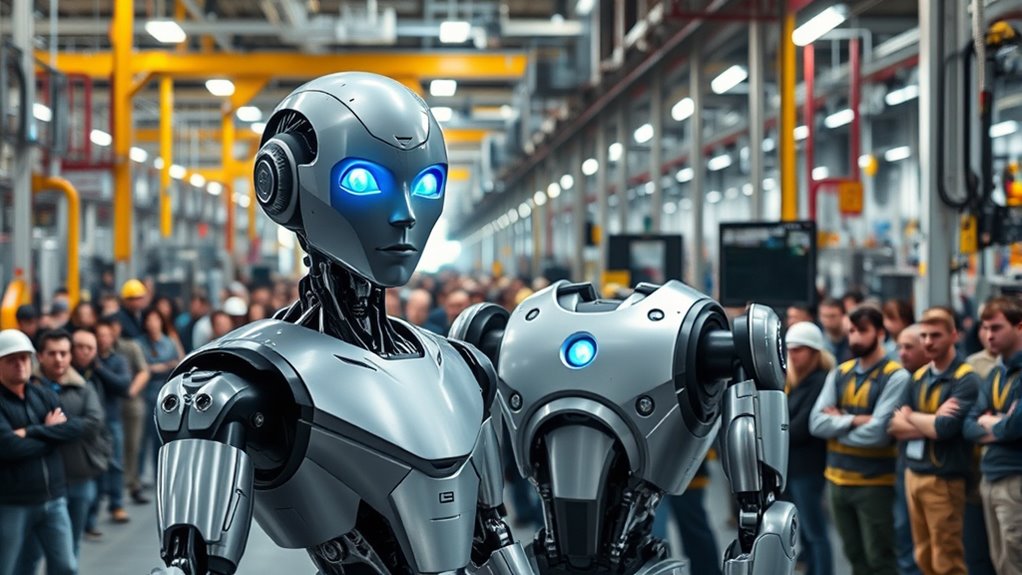
Have you ever wondered how artificial intelligence and robotics differ, yet complement each other in today’s technology landscape? These two fields are often intertwined, but they serve distinct roles in automation’s evolution. AI refers to software systems that simulate human intelligence, enabling machines to analyze data, learn from patterns, and make decisions. Robotics, on the other hand, involves physical machines designed to perform tasks, often incorporating AI to enhance their capabilities. While AI can exist independently as algorithms or software, robotics combines mechanical components with intelligent systems to execute tangible actions.
AI simulates human intelligence, while robotics combines mechanical parts with intelligent systems to perform physical tasks.
Understanding their differences helps clarify how each impacts jobs. AI’s influence primarily pertains to decision-making, data processing, and automation of cognitive tasks. It can optimize supply chains, manage customer service via chatbots, or analyze medical records for diagnoses. Robotics directly alters the physical labor force by replacing or augmenting manual tasks—think of assembly line robots, autonomous vehicles, or drone delivery systems. Together, AI and robotics accelerate automation, but their effects on employment depend on how they’re integrated into various industries. Additionally, the integration of private placement strategies can facilitate investments in innovative automation technologies, shaping their development and adoption.
Ethical considerations come into play as AI and robotics reshape workplaces. You should be aware of concerns regarding job displacement, privacy, and decision accountability. For example, as AI systems make critical choices—like approving loans or diagnosing patients—questions about transparency and bias emerge. Meanwhile, robotics replacing human workers on factory floors trigger debates about economic inequality and workers’ rights. The automation wave can boost productivity but also leads to fears of widespread unemployment if not managed carefully. Balancing innovation with ethical responsibility becomes essential to ensure societal benefits without marginalizing vulnerable groups.
The economic implications are equally significant. You might see increased efficiency and reduced costs as companies adopt AI-driven software and robotic automation. This can lead to higher profits but also to job losses in certain sectors, especially those reliant on repetitive manual labor. Conversely, new jobs may arise in technology development, maintenance, and oversight. Governments and organizations must consider how to support displaced workers and invest in retraining programs. The long-term economic impact hinges on how well society manages this transition—whether it fosters inclusive growth or exacerbates inequality.
In essence, AI and robotics are distinct yet interconnected forces shaping the future of work. AI enhances decision-making and cognitive functions, while robotics physically implements tasks. Both bring profound ethical and economic challenges that demand careful attention. As you observe industries adopt these technologies, recognize that their true potential depends on balancing innovation with responsibility, ensuring that automation benefits everyone rather than just a select few.

AI Builders: Making The Decisions That Turn AI Code Into Real Software
As an affiliate, we earn on qualifying purchases.
As an affiliate, we earn on qualifying purchases.
Frequently Asked Questions
How Do AI and Robotics Influence Different Industries Uniquely?
AI and robotics influence industries uniquely through industry-specific automation and technological adaptability. You’ll find AI excels in data analysis, customer service, and decision-making, transforming sectors like finance and healthcare. Robotics, on the other hand, enhances manufacturing, logistics, and construction with physical tasks. Your industry benefits most when integrating both, leveraging AI’s adaptability for complex tasks and robotics’ precision for physical work, ultimately boosting efficiency and innovation across different sectors.
What Ethical Concerns Arise With AI and Robotics Automation?
You should consider that AI and robotics raise significant ethical concerns, like privacy issues and moral dilemmas. As these technologies collect and analyze data, you might worry about how your personal information is used or protected. Additionally, moral dilemmas emerge when automating decisions that affect people’s lives, such as in healthcare or justice, making it vital to develop ethical guidelines. Staying informed helps you understand and navigate these complex issues responsibly.
How Will AI and Robotics Reshape Future Workforce Skills?
AI and robotics will reshape your future workforce skills by emphasizing creative collaboration and skill adaptation. You’ll need to work alongside machines, leveraging your creativity to solve complex problems and innovate. As technology advances, you’ll adapt by learning new digital tools and developing versatile skills. Embracing these changes means becoming flexible, continuously upgrading your abilities, and fostering teamwork with AI systems to stay competitive and thrive in the evolving job landscape.
What Are the Economic Implications of AI Versus Robotics Adoption?
You’ll see AI and robotics adoption substantially reshape the labor market, potentially boosting productivity but also widening income inequality. AI tends to displace white-collar jobs, risking higher income gaps, while robotics often replace manual roles, affecting employment levels. Economically, this shift may lead to increased polarization, requiring policies that support workforce reskilling. Balancing automation’s benefits with social equity becomes essential to ensure economic stability and inclusivity.
How Can Policymakers Balance Innovation With Job Security?
You can steer the ship between innovation and job security by embracing policies like Universal Basic Income and Workforce Retraining programs. Think of it as planting seeds for a resilient future, ensuring no one’s left behind as automation advances. By investing in lifelong learning and providing safety nets, you help workers navigate the waves of change, turning technological progress into an engine for inclusive growth rather than a storm of uncertainty.

wlkata Mirobot 6DoF Mini Industrial Robotic Arm Professional Kit Programmable Lightweight Desktop Robotic Arm for K12 or 3D Printer
- Professional Kit Includes: Robot arm, controller, accessories, and more
- Multiple Control Methods: Software, app, and virtual control options
- Versatile Functionality: Laser engraving, drawing, handling, and expansion
As an affiliate, we earn on qualifying purchases.
As an affiliate, we earn on qualifying purchases.
Conclusion
As you consider AI versus robotics, remember that both transform jobs but in different ways. notably, a recent study shows that by 2030, AI could automate up to 45% of tasks in various sectors, while robotics primarily replace manual labor. This highlights how AI’s cognitive abilities may reshape knowledge work, whereas robotics continue to impact physical jobs. Staying adaptable and embracing lifelong learning will be key to thriving amid these technological shifts.

Autonomous Delivery Drone Battery Management: Power System Optimization That Extends Flight Range
As an affiliate, we earn on qualifying purchases.
As an affiliate, we earn on qualifying purchases.

The Operational Excellence Library; Mastering Building a Customer Service Chatbot
As an affiliate, we earn on qualifying purchases.
As an affiliate, we earn on qualifying purchases.