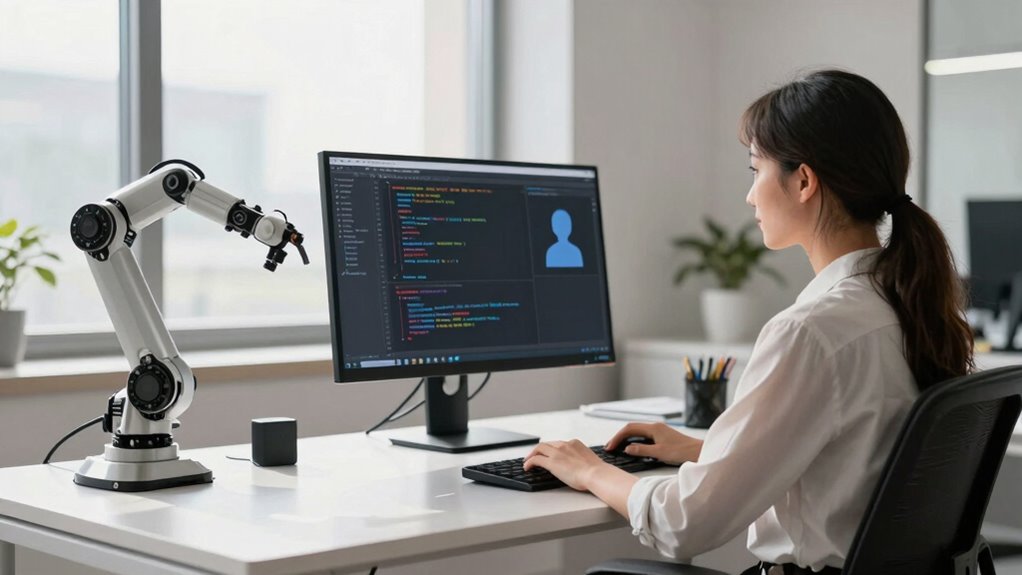

As someone involved in AI, your role as a human in the loop is essential for guiding and overseeing AI systems. You guarantee these systems operate ethically, fair, and aligned with societal values. You review decisions, adjust parameters, and spot biases, preventing errors and unintended consequences. Your presence helps AI better understand context and nuance, maintaining trust and accountability. If you want to discover how your oversight shapes responsible AI, keep exploring the fundamental parts of this key role.
Key Takeaways
- Humans oversee and review AI decisions to ensure accuracy, fairness, and alignment with societal values.
- The role involves adjusting AI parameters and providing feedback to improve system performance.
- Humans serve as ethical safeguards, addressing biases and ensuring responsible AI deployment.
- Continuous monitoring in sensitive areas maintains transparency, accountability, and respect for rights.
- The human-in-the-loop balances automation efficiency with contextual judgment and critical thinking.
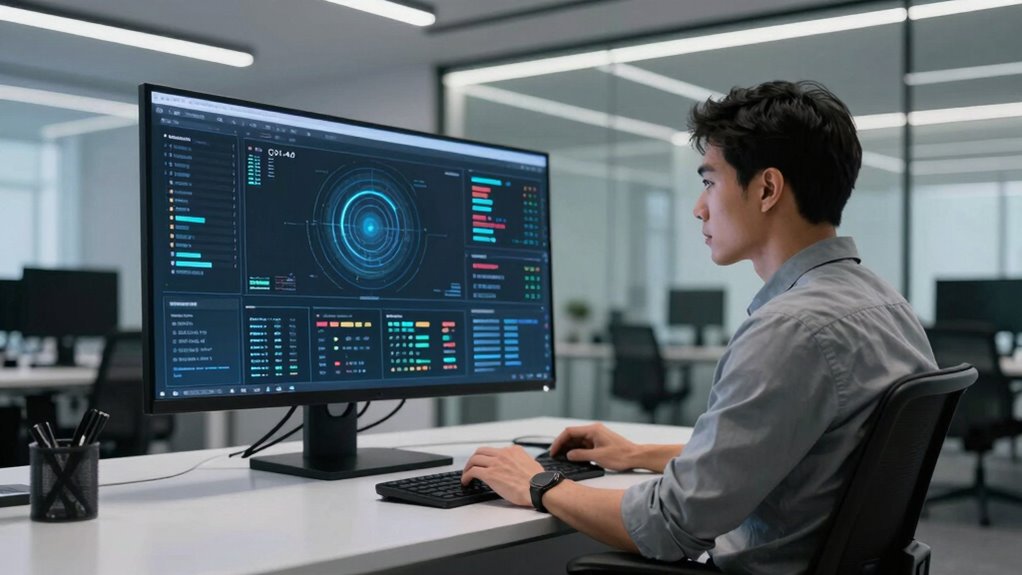
Have you ever wondered how artificial intelligence systems improve their accuracy and reliability? The answer often lies in the evolving role of humans within AI workflows, especially in the context of the “Human in the Loop” approach. This concept emphasizes that, even with advanced automation integration, human oversight remains essential. This collaborative dynamic helps prevent errors, bias, and unintended consequences that purely automated systems might introduce. As AI continues to grow more complex, your role becomes increasingly critical in maintaining trust and accountability. Additionally, integrating human judgment into AI processes ensures that contextual and subtle nuances are appropriately considered, which automated systems might overlook.
Humans in the loop guide, monitor, and correct AI, ensuring trust, ethics, and reliability in complex automation systems.
In this new job landscape, your responsibilities involve continuous interaction with AI systems—reviewing their decisions, providing feedback, and adjusting parameters when necessary. You serve as a safeguard against flaws that might slip through automation, especially in sensitive areas like healthcare, finance, or legal services. Your presence ensures that AI’s suggestions are aligned with human values and societal norms. This blend of automation integration and human judgment fosters a more resilient and trustworthy system, but it also raises important ethical considerations. Balancing efficiency with ethical responsibility becomes your priority. You need to question whether the AI’s suggestions could reinforce biases or unfair practices. Your oversight ensures that decisions are fair, transparent, and respectful of individual rights.
Your role also involves navigating the ethical considerations inherent in AI deployment. You’re tasked with recognizing situations where automation might overlook nuance or context, and where human intuition and moral judgment are necessary. This responsibility demands vigilance, as you must constantly evaluate whether the AI’s actions serve the best interests of users and society. You’re also a key player in shaping policies about data privacy, consent, and accountability, ensuring that AI systems respect legal and ethical boundaries. Your expertise helps organizations develop responsible AI strategies, striking a balance between technological advancement and moral integrity. Recognizing how AI systems can perpetuate or mitigate biases is crucial for maintaining ethical standards.
Furthermore, understanding the importance of bias mitigation and ongoing oversight can significantly influence the success of AI implementation. Continuous human involvement helps identify and correct algorithmic bias, ensuring fairness and equity in automated decisions. Ultimately, your job as the human in the loop isn’t about replacing machines but complementing them. You bring empathy, ethical awareness, and critical thinking to the process, making AI smarter, safer, and more aligned with human values. As automation continues to pervade industries, your role will only grow more vital. You’re the bridge that connects cutting-edge technology with societal good, ensuring that AI serves humanity in a responsible and trustworthy way.

The AI Infused Classroom
As an affiliate, we earn on qualifying purchases.
As an affiliate, we earn on qualifying purchases.
Frequently Asked Questions
How Do I Train Employees to Work Effectively With AI Systems?
To train employees effectively with AI systems, focus on engaging training strategies that emphasize hands-on practice and real-world scenarios. Keep employees involved through interactive workshops and ongoing support. Encourage open communication, address concerns, and highlight AI’s benefits. By fostering a culture of continuous learning and ensuring employees understand how AI complements their work, you boost engagement and build confidence in using these technologies efficiently.
What Industries Are Most Impacted by the Human in the Loop Approach?
You’ll find industries like healthcare, finance, and manufacturing most impacted by the human in the loop approach. AI integration in these fields requires workforce adaptation, as humans collaborate with AI to improve accuracy and decision-making. Your role involves understanding how human oversight enhances AI systems, ensuring ethical standards, and maintaining quality. Embracing this approach helps industries stay competitive while empowering employees to work alongside AI effectively.
How Do Ethical Concerns Influence the Human in the Loop Model?
Ethical concerns act as the compass guiding the human in the loop model, guaranteeing you don’t drift into murky waters. You play a crucial role in bias mitigation by scrutinizing AI outputs, and accountability standards keep your actions transparent. These principles help prevent harm, fostering trust and fairness. By balancing technological efficiency with moral responsibility, you make sure that AI decisions serve humanity’s best interests, not just algorithms’ whims.
What Tools Are Essential for Integrating Humans Into AI Workflows?
To integrate humans into AI workflows effectively, you need essential tools that facilitate AI collaboration and workforce adaptation. Use platforms with intuitive interfaces for seamless interaction, data annotation tools for accurate human oversight, and real-time monitoring dashboards to track AI performance. These tools help you adapt your workforce efficiently, ensuring humans complement AI systems, uphold ethical standards, and enhance overall decision-making accuracy in the loop.
How Does Human Oversight Affect AI Decision-Making Accuracy?
Human oversight considerably improves AI decision-making accuracy by enabling bias mitigation and ensuring accountability frameworks are in place. When you monitor AI outputs, you catch errors or biases that the algorithms might overlook, leading to more reliable results. This active involvement helps refine models continuously, reduces unintended consequences, and builds trust. With human oversight, AI systems become more transparent and responsible, ultimately enhancing their effectiveness and societal acceptance.

Generative AI for Software Development: Building Software Faster and More Effectively
As an affiliate, we earn on qualifying purchases.
As an affiliate, we earn on qualifying purchases.
Conclusion
As you embrace the role of the human in the loop, remember your unique value in refining AI systems. Notably, a recent study found that 80% of AI errors are caught and corrected by human oversight. Your judgment and intuition remain irreplaceable, ensuring technology serves us accurately and ethically. So, stay engaged and proactive—your contributions are essential in shaping reliable, responsible AI. The future of tech depends on your human touch.
human in the loop AI monitoring devices
As an affiliate, we earn on qualifying purchases.
As an affiliate, we earn on qualifying purchases.

Empowering AI for Programmers: The Kristal Framework and Human-Centered Integration
As an affiliate, we earn on qualifying purchases.
As an affiliate, we earn on qualifying purchases.