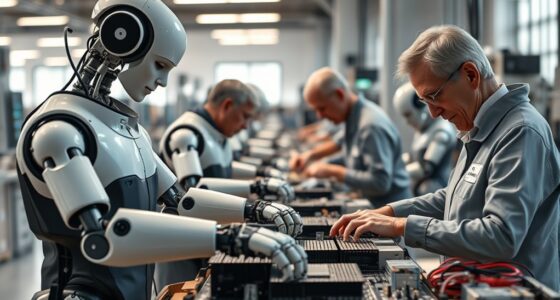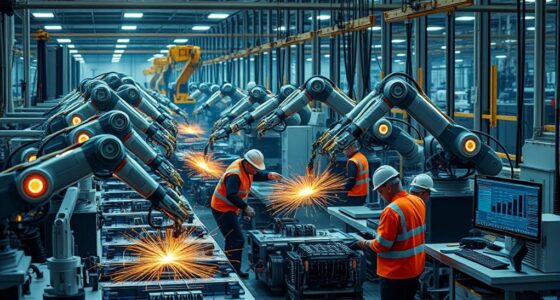
The safest jobs today aren’t the ones people usually expect, like traditional manufacturing or administrative roles. Instead, roles that rely on human qualities, like caregiving, coaching, or counseling, are more resilient because they’re hard to automate. Your focus should shift from job titles to building skills like emotional intelligence, creativity, and adaptability. Staying updated on technological changes and continuously developing your skills can make your career more secure. Keep exploring to discover more ways to future-proof your work.

Get business pricing on tech for your team
- Business-only prices and quantity discounts
- Tax-exempt purchasing
- Multiple users, one account, clear invoices
Key Takeaways
- Safe jobs increasingly rely on human-centric skills like emotional intelligence, caregiving, and complex decision-making, not traditional roles.
- Automation risks are dynamic; roles once considered secure may become vulnerable, emphasizing adaptability over job titles.
- Remote work offers opportunities for skill diversification and developing digital competencies that enhance job resilience.
- Continuous learning and technological adaptability are essential to stay ahead of automation and industry changes.
- Prioritizing uniquely human qualities and flexible skills creates sustainable career paths amid rapid technological evolution.

As technology continues to evolve rapidly, the landscape of employment is shifting toward safer, more sustainable jobs. But what those jobs are might surprise you. Many assume that the safest roles are those shielded from automation risks—positions that machines can’t easily replicate. However, the reality is more complex. Automation risks are constantly changing, and jobs once considered secure are now vulnerable. For example, roles in manufacturing or routine administrative tasks are increasingly automated, pushing workers to seek out new opportunities. The key to securing a safe job now involves adapting to these shifts and developing skills that machines can’t easily replace, like creative problem-solving, emotional intelligence, and complex decision-making.
Meanwhile, remote work challenges add another layer to this evolving landscape. You might think that working from home naturally makes a job safer or more stable, but remote work isn’t without its risks. It brings a unique set of challenges, such as maintaining productivity, staying connected with your team, and managing work-life balance. These challenges can impact job security if not addressed properly. As companies adapt to remote work, they look for employees who can thrive independently and demonstrate strong communication skills. If you’re not prepared for these remote work challenges, you might find yourself at a disadvantage, even in roles that seem safe on paper.
The new safe jobs are less about the position itself and more about your ability to adapt. Roles that emphasize human-centric skills—like caregiving, counseling, or coaching—are becoming more valuable because they’re difficult to automate. Additionally, jobs that require constant learning and flexibility, such as digital marketing or data analysis, tend to be more resilient. You need to stay ahead of automation risks by continuously upgrading your skills. That might mean taking courses, gaining certifications, or learning to work with new technologies. The most secure jobs are those that require nuanced judgment, emotional understanding, and the ability to navigate complex social dynamics—areas where humans still outperform machines. Recognizing the importance of technological adaptability can help you better prepare for future job security. Being aware of how automation risks evolve can also guide you in choosing career paths that remain relevant over time. Developing future-proof skills is essential in an environment where technological change can quickly alter job landscapes. Staying informed about the ongoing technological advancements can give you a competitive edge in adapting to the shifting job market.
Ultimately, the safest jobs in this changing world aren’t always the ones you initially expect. They’re often roles that leverage your uniquely human qualities and adaptability. While remote work might pose challenges, it also offers opportunities to develop new skills and diversify your experience. Staying proactive and open to change will be your best strategy for finding and maintaining a safe, sustainable career in the future.
Products Worth Considering

Jackery Explorer 300 Portable Power Station, 292Wh

Logitech MX Mechanical Wireless Illuminated Keyboard, Tactile Quiet, Graphite

Sony WH-1000XM4C Wireless Noise-Cancelling Headphones, Black
As an affiliate, we earn on qualifying purchases.
Frequently Asked Questions
How Will Technology Impact Job Safety in the Future?
Technology will enhance job safety through AI ethics and automation risks management. You’ll see better safety protocols and predictive maintenance, but also face automation risks that threaten certain jobs. By understanding AI ethics, you can advocate for responsible tech use, ensuring safety standards are prioritized. Overall, technology’s impact on job safety will depend on how well you adapt to these changes and push for ethical, safe innovations.
Are “Safe” Jobs Equally Accessible Worldwide?
Safe jobs aren’t equally accessible worldwide. You’ll find global employment disparities, making it harder for some to access secure roles due to economic or infrastructural factors. Cultural safety perceptions also influence this, as different societies prioritize safety differently. You might face barriers based on your location or cultural context, meaning what’s considered a “safe” job in one country may not be the same elsewhere.
What Skills Are Most Valuable for Future Job Security?
Think of your skills as a toolbox—you’ll need skill adaptability and continuous learning to stay afloat in a shifting job landscape. These skills are your lifeboat, helping you navigate unexpected challenges and new opportunities. Staying curious and flexible allows you to grow alongside technological advancements and market changes. Embrace lifelong learning, and you’ll build a safety net that keeps you secure, no matter how unpredictable the future becomes.
How Do Safety Perceptions Differ Across Industries?
You’ll notice safety perceptions vary across industries due to factors like workplace ergonomics and safety training. In manufacturing, strong safety protocols and ergonomic setups boost confidence, while healthcare emphasizes ongoing safety training to prevent hazards. In tech, safety concerns focus on cybersecurity and ergonomic office setups. Understanding these differences helps you adapt safety practices, making workplaces safer and more comfortable, regardless of industry-specific risks.
Will Remote Work Influence Job Safety Standards?
A stitch in time saves nine, and your remote work policies can shape safety culture. Remote work will likely lead to updated safety standards, emphasizing mental health and ergonomic setups. Clear remote policies help guarantee safety, even outside traditional environments. As you adapt, fostering a strong safety culture becomes essential to protect employees, demonstrating how evolving work arrangements influence safety expectations and standards in modern workplaces.
Conclusion
As you consider the evolving job landscape, remember that the safest roles might not be the ones you initially expect. Instead of sticking to traditional ideas of security, stay adaptable and open to new opportunities. Think of it as steering through uncharted waters—you might find the most stable path isn’t the one most traveled. Embracing change now can set you on a course toward a more secure and fulfilling future, even if it means stepping outside your comfort zone.