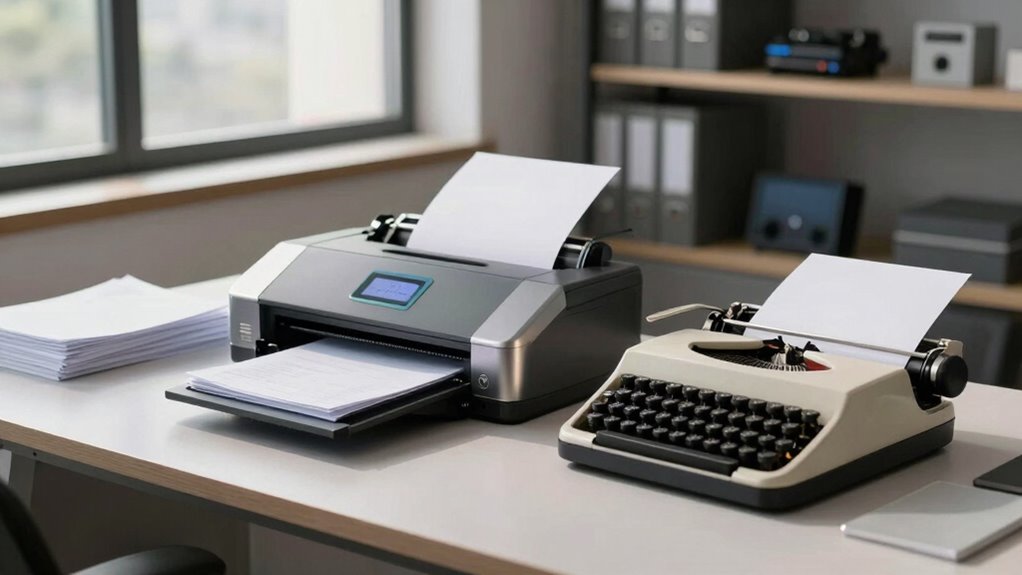

Despite the rise of digital workflows, hardware scanners remain essential for handling large document volumes efficiently and with high quality. They offer unmatched speed, better image clarity, and guarantee data accuracy, reducing errors. Built-in security features protect sensitive information, while seamless cloud integration simplifies access and organization. Investing in reliable hardware also future-proofs your workflow, supporting emerging technologies. If you want to understand why paper-based tasks still rely on dedicated scanners, keep exploring the key benefits they provide.
Key Takeaways
- Hardware scanners provide unmatched speed and quality for processing large volumes of paper documents efficiently.
- Dedicated scanners ensure data integrity and reduce errors compared to lower-quality or manual digital methods.
- Integration with cloud services like Dropbox enhances workflow automation and document accessibility.
- Built-in security features protect sensitive information through encryption and user authentication.
- Investing in reliable hardware future-proofs digital workflows, supporting evolving formats and automation features.
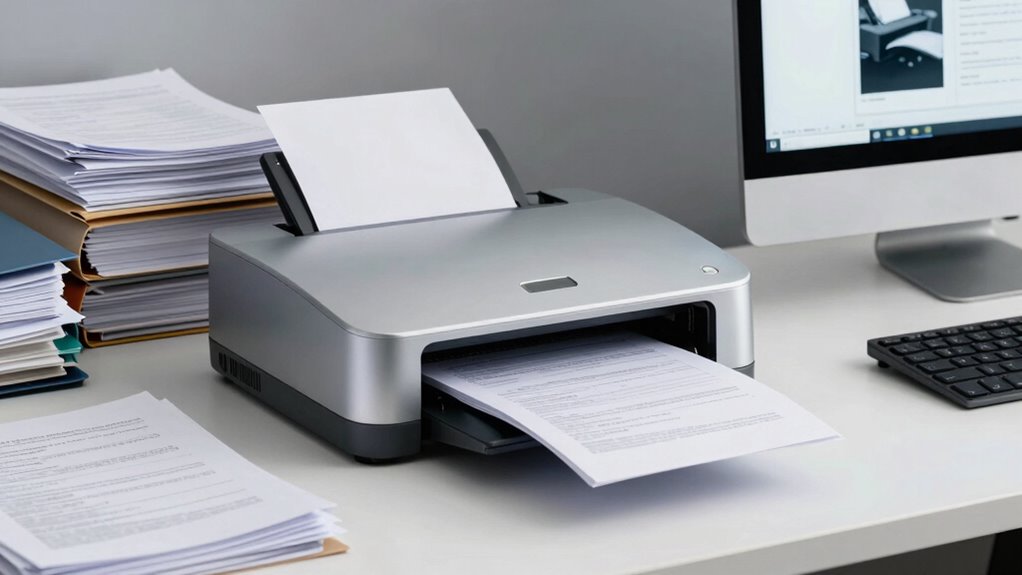
Despite the rise of digital workflows, paper-based tasks still depend heavily on dedicated scanning hardware. You might think that with all the advances in software, cloud services, and mobile apps, scanners are becoming obsolete. However, the reality is quite the opposite. In fact, many organizations find that hardware scanners remain essential for efficient, accurate, and secure document management. As you pursue digital transformation, integrating scanner hardware with cloud solutions ensures seamless workflows, faster data access, and better compliance.
Dedicated scanners are still essential for secure, efficient, and accurate document management in digital transformation efforts.
A dedicated scanner provides the speed and quality that scanning through a mobile device or multifunction printer simply can’t match. When you’re handling large volumes of documents, high-speed scanners allow you to process stacks of papers quickly, saving you valuable time. Plus, the advanced image processing features in dedicated hardware produce clearer, more legible digital copies, which is critical for maintaining data integrity. This level of precision helps avoid costly errors that can occur with lower-quality scans. High-quality hardware also helps streamline your overall document processing.
Moreover, hardware scanners support various file formats and direct integrations with cloud platforms like Dropbox, Google Drive, or proprietary enterprise systems. This is where cloud integration becomes a game-changer. By connecting your scanner directly to cloud services, you eliminate the need for manual uploads or complicated workflows. Your scanned documents are automatically uploaded and organized, ensuring that your team can access the latest versions from anywhere. This seamless connection accelerates digital transformation initiatives, making your paper-based processes more agile and responsive. Incorporating cloud-enabled hardware further enhances the efficiency of your document workflows.
Security is another reason hardware scanners are still crucial. When you scan sensitive documents, you want to ensure they are protected during the entire process. Dedicated scanners often come with built-in encryption and user authentication features, reducing the risk of data breaches. Cloud integration further enhances security by enabling encrypted transfers and controlled access permissions. This combination ensures your documents stay safe, compliant with industry standards, and readily available for authorized personnel.
Finally, investing in reliable scanning hardware means you’re future-proofing your document workflows. As technology evolves, high-quality scanners will continue to support new formats, features, and integrations. They serve as a robust foundation for your digital transformation efforts, allowing you to leverage cloud integration and automation effectively. While digital workflows are on the rise, the need for dedicated scanning hardware remains crucial—it’s the bridge that connects your paper-based tasks with the cutting-edge capabilities of today’s digital landscape. Paper workflows continue to rely on dedicated hardware to maintain efficiency and security.
As an affiliate, we earn on qualifying purchases.
Frequently Asked Questions
How Do Scanners Compare to Mobile Scanning Apps?
Scanners generally outperform mobile scanning apps in digital image quality and scanning speed. You’ll notice sharper, clearer images with dedicated hardware, especially for high-resolution needs. Scanners also process large batches quickly, saving you time, while mobile apps can be slower and less consistent, especially in less ideal lighting. If you need professional-quality scans efficiently, hardware scanners are your best choice for superior image quality and faster throughput.
What Are the Environmental Impacts of Using Scanners?
Using scanners can help reduce paper waste by digitizing documents, but they still consume energy, impacting the environment. You might save trees and lessen landfill clutter, yet energy consumption from operating scanners adds to your carbon footprint. To minimize environmental impacts, choose energy-efficient models and recycle old devices properly. Balancing digital workflows with eco-friendly practices guarantees you reduce paper waste while being mindful of energy use.
Can Cloud-Based Solutions Replace Traditional Scanner Hardware?
Cloud-based solutions can’t fully replace traditional scanner hardware; they’re like trying to replace the roots of a tree with just the leaves. While digital integration evolves, hardware dependency remains indispensable for quality, speed, and security. You need reliable scanners to capture high-resolution images and guarantee seamless workflows. Without dedicated hardware, you risk losing accuracy and efficiency, making it clear that scanners still play a crucial role in your paper-to-digital shift.
How Secure Are Scanned Documents Stored Digitally?
Digital storage of scanned documents is generally secure if you implement proper data encryption and access controls. Encryption protects your files from unauthorized viewing, while access controls restrict who can open or modify them. However, you should also guarantee your storage solutions are regularly updated and monitored for vulnerabilities. By combining these security measures, you considerably reduce the risk of data breaches and keep your digital documents safe.
What Is the Average Lifespan of a Scanner Device?
You can expect a scanner device to last around 5 to 7 years, but maintenance costs and technological obsolescence can shorten its lifespan. Regular maintenance helps keep it functioning smoothly, yet outdated features may push you to upgrade sooner. As technology advances, newer models often offer better efficiency and security, making it wise to plan for replacement within that timeframe to avoid costly repairs and guarantee peak performance.
professional security scanner with encryption
As an affiliate, we earn on qualifying purchases.
As an affiliate, we earn on qualifying purchases.
Conclusion
Despite the rise of digital solutions, paper workflow jobs still rely on hardware, and for good reason. Did you know that 60% of organizations report that scanning hardware considerably boosts productivity? This shows that, while digital tools are crucial, physical scanners remain essential for efficiency and accuracy. So, don’t overlook the value of quality hardware—your workflow depends on it. Embracing this balance keeps you ahead in today’s fast-paced, paper-intensive world.
As an affiliate, we earn on qualifying purchases.
As an affiliate, we earn on qualifying purchases.