
📊 Full opportunity report: Qwen3.8-Max And The Changing Signals In AI Operations on IdeaNavigator AI — validation score, market gap, and execution plan.

Get business pricing on tech for your team
- Business-only prices and quantity discounts
- Tax-exempt purchasing
- Multiple users, one account, clear invoices
TL;DR
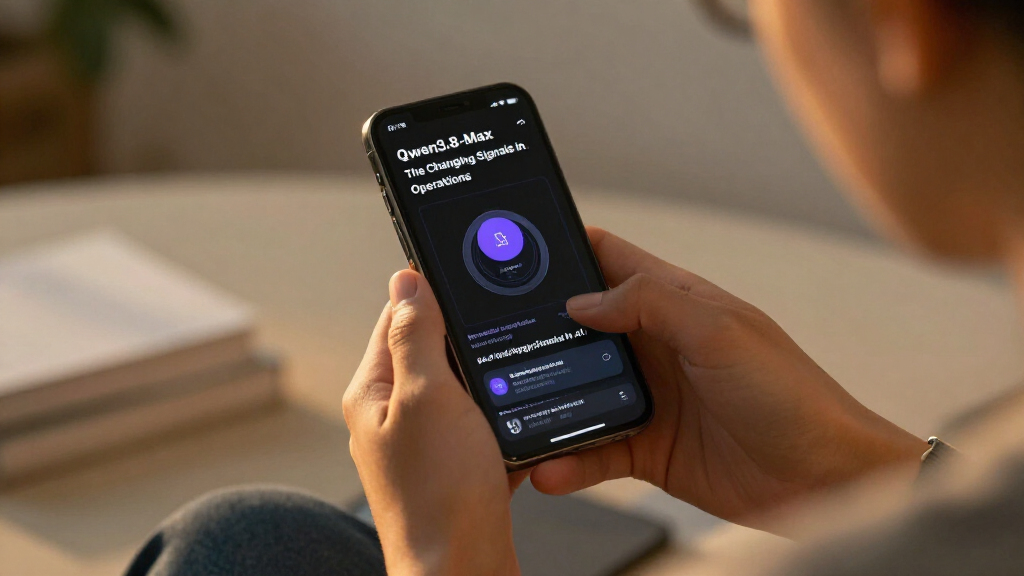
IdeaNavigator AI has proposed testing a focused service that tracks AI capability and policy news and summarizes developments for operations leads at small teams. The proposal cites a Hacker News signal score of 88/100 for a Qwen3.8-Max item, but provides no underlying model details or evidence that the product has been built or validated.
IdeaNavigator AI has proposed testing a role-specific monitor that tracks AI capability and policy developments and turns relevant items into short operational briefs for operations leads rolling out AI tools across small teams. The proposal uses an item titled “Qwen3.8-Max: A New Bar for Coding and Cowork” as an example, but does not provide technical details about the model or report that the monitoring service is already operating.
The suggested product would monitor Hacker News and similar feeds, filter developments for their relevance to a small team’s AI rollout, and summarize each item under three prompts: what changed, why it matters and what to do. The intended customer is an operations lead who has to track fast-moving news across multiple channels and decide whether a development affects the organization’s tools or practices.
IdeaNavigator AI says the Qwen3.8-Max item surfaced on Hacker News with a signal score of 88/100. The proposal does not explain how that score was calculated, what period it covers, or what comparison baseline it uses. It should be read as a score reported in the proposal, not as an independently verified measure of the model’s performance or industry impact.
The proposed business model is a subscription. For validation, IdeaNavigator AI recommends hand-delivering the Qwen3.8-Max brief and two other AI capability or policy updates to five people who fit the intended customer profile during the same week. The test would track whether any recipient changes a decision or forwards a brief to a colleague; no results from that test are included.
Testing Whether AI Briefs Change Decisions
The proposal focuses on a practical problem for small organizations: AI news is scattered, while the time and expertise available to assess it may be limited. A role-filtered briefing could help an operations lead distinguish developments that might affect an ongoing rollout from announcements with little immediate relevance. That is the product’s stated rationale, not evidence that the service has already saved time or improved decisions.
The proposed validation test looks for behavior rather than general expressions of interest. A recipient changing a decision or sharing a brief would provide an initial signal that the information is useful in a work setting. However, a five-person test would be small and exploratory; it would not establish broad demand, subscription willingness, accuracy over time, or the monitor’s ability to identify important developments consistently.
The Qwen3.8-Max example also highlights a key editorial challenge for this kind of service. A label such as “a new bar” can imply a meaningful performance advance, but the proposal gives no benchmark results, product documentation, or independent evaluation to support that characterization. A useful operations brief would need to separate the item’s claims from verified capabilities and explain what, if anything, a team should change.
Products Worth Considering

LG 34GX90SA-W 34-inch Ultragear WQHD OLED Curved Gaming Monitor

Samsung 27-Inch Odyssey QD-OLED G8 4K 240Hz Gaming Monitor

LG UltraGear 27-Inch QHD OLED Gaming Monitor, 240Hz, 0.03ms, G-SYNC Compatible, FreeSync Premium Pro, HDMI 2.1
As an affiliate, we earn on qualifying purchases.
From Scattered Feeds to Role-Based Alerts
The idea is framed as an AI operations signal monitor, rather than a general-purpose news roundup. Its proposed audience is deliberately narrow: operations leads introducing AI tools to small teams. It aims to filter news by the reader’s work and translate each relevant item into a decision-oriented summary.
The proposal argues that AI capability and policy changes move quickly enough that a same-day, role-filtered read may be more useful than a generic weekly roundup. Hacker News is named as one potential input, alongside similar feeds. The material does not identify which other sources would be monitored, how items would be ranked, or how the service would check accuracy and keep summaries current.
The Qwen3.8-Max title is presented as an example of the kind of development the monitor might surface. No release announcement, model specifications, benchmark figures, access details, or independent reporting about Qwen3.8-Max are supplied with the proposal. The article therefore does not establish what the model can do or whether it marks a technical advance.
Model Claims and Product Status
The status of Qwen3.8-Max is not established by the information provided. There are no model specifications, test results, release details, or attributed statements from its developer. The title “A New Bar for Coding and Cowork” is a characterization in the cited item, not a verified finding presented here.
It is also unclear whether the monitor exists beyond the proposal stage. No launch, working prototype, customer, subscription price, feed list, or completed user test is reported. The meaning of the 88/100 score remains unspecified, including its method and baseline. The proposed five-person test has no reported outcome, so demand and decision impact remain unconfirmed.
Five-User Test Is the Proposed Next Step
IdeaNavigator AI’s next suggested step is to prepare the Qwen3.8-Max brief plus two other AI capability or policy items and deliver all three to five operations leads matching the target profile during one week. The test would record whether recipients change a decision or forward an item, providing an early indication of practical relevance.
No timetable beyond “this week” is specified, and no results or follow-on product plans are available. If the test proceeds, the findings would help show whether the brief format earns action or sharing; they would not, on their own, verify the underlying model claims or establish a sustainable subscription market.
Source: IdeaNavigator AI
Key Questions
What is the proposed AI operations monitor?
It is a proposed service that would track AI capability and policy developments, filter them for small-team operations leads, and turn relevant items into short briefs on what changed, why it matters, and what to do.
Has Qwen3.8-Max’s performance been verified here?
No. The proposal names an item titled “Qwen3.8-Max: A New Bar for Coding and Cowork,” but provides no specifications, benchmarks, or independent evaluation of the model.
What does the 88/100 signal score mean?
The proposal reports that score for the item’s appearance on Hacker News. It does not explain the scoring method, time window, or comparison baseline, so the figure cannot be interpreted as a performance rating or a measured increase in attention.
Has the service launched or been tested with customers?
No launch or completed customer test is reported. IdeaNavigator AI proposes hand-delivering three briefs to five operations leads and tracking whether they change a decision or share an item.
Source: IdeaNavigator AI