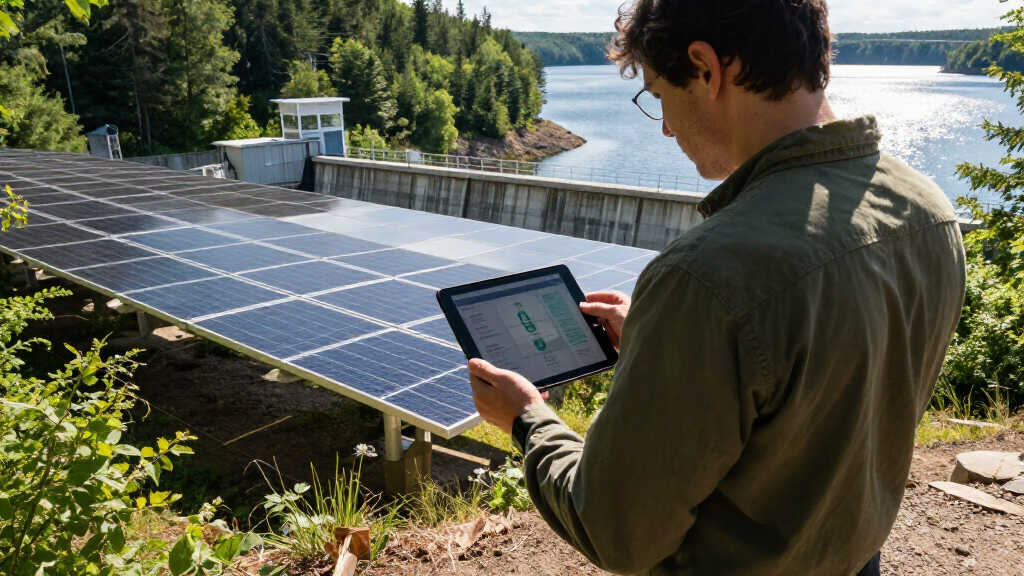

🔍 Read the full analysis: AI And Energy: Why Canada's Power Infrastructure Is Crucial on ThorstenMeyerAI.com
Get ready for Prime Big Deal Days — try Prime free
Exclusive member deals on October 6–7, plus fast free delivery. Cancel anytime.
Start your free trialAs an affiliate, we earn on qualifying purchases.
TL;DR
Canada’s abundant hydro power is crucial for AI data centres, but recent provincial restrictions and capacity constraints challenge its ability to supply growing demand. This impacts Canada’s role in global AI infrastructure.
Canada’s hydroelectric power resources, long touted as a key advantage for AI data-centre growth, are now facing **provincial restrictions and capacity constraints** that threaten its ability to support the rapidly expanding global demand for AI infrastructure. This shift challenges the assumption that Canada can reliably supply cheap, clean power for AI development, with significant implications for international negotiations and industry planning.
Recent actions by Quebec and British Columbia reveal a tightening of power supply policies. Quebec has restricted new power procurement for large data-centre projects since 2024, proposing a higher tariff of 13 ¢/kWh for data centres above 5 MW, roughly double the current large-industrial rate of 6.82 ¢/kWh, and the decision remains under regulatory review. Meanwhile, BC has allocated only 400 MW over two years, capped at 145 MW per project, insufficient for major data-centre developments like the 200 MW Lübbenau campus in Germany.
Canada’s existing data-centre capacity stood at approximately 1.4 GW in late 2025, a small fraction compared to the US’s 40.6 GW. Despite its hydro-rich reputation, the country faces a **competitive bottleneck** as provinces impose restrictions, effectively rationing power and raising costs. Ontario and Alberta shift costs to project proponents, but Alberta’s connection cap of 1,200 MW through 2028 leaves a significant backlog of over 10 GW of proposed projects, with only a fraction likely to connect.
Canada’s **fundamental resources**—over 78 GW of hydro across several provinces—are substantial, with costs below $100/MWh in key regions, and proximity to US markets offers strategic advantages. Ottawa’s goal to double capacity by 2050 hinges on a coordinated intertie strategy, yet current constraints threaten to limit growth unless infrastructure and policy barriers are addressed.
Energy is the AI policy: why Canada’s grid matters more than its labs — and why it isn’t free
Almost all the coverage leans on one assumption: Canada has abundant cheap clean power and Europe doesn’t. That assumption is about to be wrong, and the evidence is already public. Europe isn’t being offered a reservoir. It’s being offered a queue — already contested, already being repriced.
- >78 GW installed hydro; ~60% of national generation
- Lowest unit system costs: Quebec C$76/MWh, Manitoba C$91, BC C$100
- Cold climate cuts cooling load; Ontario nuclear expanding
- Ottawa: double capacity by 2050, non-emitting, plus an intertie programme
- Quebec has halted new large data-centre power procurement since 2024
- BC: 400 MW over two years, capped at 145 MW per project
- Alberta: 1,200 MW cap vs a >10 GW queue — a 1-in-8 hit rate
- Canada live capacity ~1.4 GW vs the US 40.6 GW
Procurement restricted since 2024. Data centres are the largest new line item in the supply plan; consumption forecast to rise ~7× by 2035 (200 MW → >1,000 MW).
Capped at 145 MW per project from Feb 2026. For scale: Lübbenau’s first phase alone is 200 MW.
Connection-asset payments, expansion deposits, locational marginal pricing. Shifts the cost — doesn’t remove the constraint. Nuclear expanding.
Federal MoU suspends Clean Electricity Regulations obligations; encourages made-in-Canada data centres. But 1,200 MW capped through 2028.
Energy economics push European AI compute out of Europe. Sovereignty rules push it back in. SecNumCloud requires EU-only storage; CADA’s assurance levels turn on data residency; the Digital Trade Agreement would prohibit “unjustified” localization. Three instruments, three directions. The workable answer is to tier the workloads: classified and DORA-bound work stays on EU soil regardless of price; pre-training runs and synthetic-data generation with no personal or classified data can sit where the electrons are cheap. Not all compute is sovereign compute — treating it as one undifferentiated resource is what makes the trade-off look impossible.
The sovereignty debate has been conducted as a legal argument — ownership caps, adequacy, assurance levels. All of it matters. But the binding constraint of the next five years is physical, measured in megawatts and queue positions. On that measure Canada is genuinely the best partner on offer: real hydro, a nuclear programme, cold climate, critical minerals, a government building sovereign compute. The alliance logic holds — at a smaller scale and higher price than the enthusiasm implies. Buy queue position, co-finance generation, put the sovereignty-bound workloads at home and the rest where the electrons are cheap, and tie it to interties and SMRs rather than one campus. Because Lübbenau’s lesson crosses the Atlantic: the scarce thing was never the model — it was the connection to the grid.
Implications for Canada’s Role in Global AI Infrastructure
The constraints on Canadian power supply directly impact its ability to support **large-scale AI data centres**, which require **massive, reliable, and affordable electricity**. As AI models grow more complex, demand for power in data centres accelerates, and Canada’s current restrictions threaten to diminish its competitive edge. This also influences international negotiations, as Europe and other regions seek reliable energy sources for AI development. The situation underscores that **energy security and infrastructure capacity** are critical components of national AI strategies, and Canada’s ability to meet future demand depends on resolving these provincial and infrastructural challenges.
hydroelectric power data center cooling systems
As an affiliate, we earn on qualifying purchases.
As an affiliate, we earn on qualifying purchases.
Provincial Power Policies and Global Data-Centre Growth Trends
Historically, Canada’s hydro resources have positioned it as a low-cost, clean energy leader. However, recent provincial policies—particularly in Quebec and BC—have shifted towards restricting new power procurement for data centres, citing concerns over capacity and costs. Quebec’s move to propose higher tariffs for large data-centre loads, and BC’s limited allocations, reflect a broader trend of **rationing and re-pricing** amidst growing demand.
Globally, data-centre power demand has surged from 59 GW in 2020 to 96 GW in 2024, with hotspots like Virginia experiencing seven-year connection waitlists. Europe’s major hubs are already congested, and AI investment is shifting to markets with easier power access, such as parts of North America. Germany, with 4.26 GW of data-centre load, aims to connect an additional 6 GW by 2030, illustrating the scale of infrastructure needed to support AI growth.
Canada’s resource advantage is clear, but the current policies and capacity limits mean it cannot fully capitalize on this potential, especially as demand continues to outpace infrastructure expansion.
renewable energy monitoring sensors
As an affiliate, we earn on qualifying purchases.
As an affiliate, we earn on qualifying purchases.
Unresolved Capacity and Policy Challenges
It remains unclear how quickly provinces will expand capacity or relax restrictions to meet future demand. The regulatory process in Quebec is ongoing, and the actual impact of provincial rationing on AI investment is still emerging. Additionally, whether federal initiatives will sufficiently coordinate interprovincial infrastructure expansion remains uncertain, as does the willingness of provinces to prioritize large data-centre development amidst competing demands for electricity.
power capacity management software for data centers
As an affiliate, we earn on qualifying purchases.
As an affiliate, we earn on qualifying purchases.
Next Steps in Infrastructure and Policy Adjustments
Canada’s government and provincial regulators are expected to continue discussions on capacity expansion and tariff adjustments over the coming months. Key developments include decisions on Quebec’s proposed higher tariffs, potential new interconnection projects, and federal efforts to coordinate provincial infrastructure investments. Industry stakeholders will closely monitor these regulatory outcomes, as they will determine Canada’s capacity to support future AI growth and its competitiveness in global data-centre markets.
high-capacity industrial power cables
As an affiliate, we earn on qualifying purchases.
As an affiliate, we earn on qualifying purchases.
Key Questions
How does provincial regulation affect data-centre power supply in Canada?
Provincial regulations, such as Quebec’s restriction on new power procurement and BC’s limited allocations, directly influence the availability and cost of electricity for data-centres, effectively rationing capacity and raising operational costs.
Why is Canada’s hydro power considered a strategic advantage for AI?
Canada’s extensive hydro resources provide low-cost, clean electricity essential for energy-intensive AI data-centres, giving it a potential edge over regions with less abundant or more expensive power supplies.
What are the main challenges to expanding Canada’s data-centre infrastructure?
The primary challenges include provincial restrictions on new power procurement, limited interconnection capacity, and the high costs associated with infrastructure expansion, which together slow growth prospects.
How might these constraints impact Canada’s position in global AI development?
If capacity limitations persist, Canada could lose ground to regions with more accessible power infrastructure, such as parts of the US or Europe, potentially reducing its role in future AI innovation and investment.
What actions are expected from policymakers to address these issues?
Policymakers are likely to pursue infrastructure investments, regulatory reforms, and interprovincial coordination to expand capacity and reduce bottlenecks, enabling Canada to better support AI industry growth.
Source: ThorstenMeyerAI.com
Fall yard work Picks
leaf blowers
As an affiliate, we earn on qualifying purchases.