TL;DR
APEC leaders gathered in Shenzhen on November 19, 2026, with AI, digital trade and regional cooperation on the agenda. Draft statements and frameworks had been sent to them, but their adoption was not confirmed by 05:45 UTC; APEC commitments are voluntary and do not change laws or tariffs on their own.
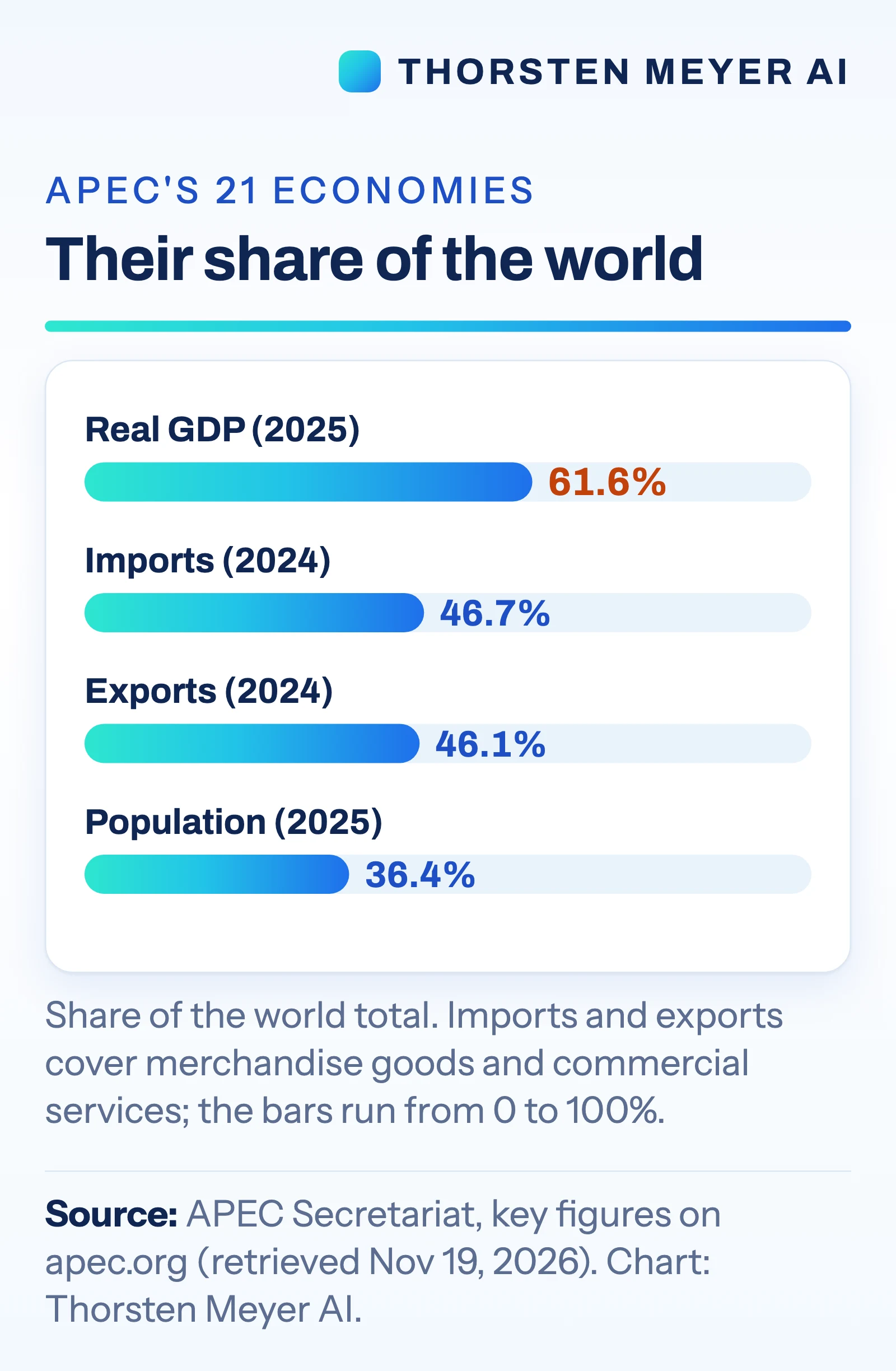
Leaders of the 21 APEC economies met in Shenzhen on Thursday, November 19, with artificial intelligence and digital trade among the issues before them. China’s President Xi Jinping called the digital economy and AI “the engines of innovation-driven growth” in remarks published by China’s foreign ministry, while a final leaders’ declaration had not been released as of 05:45 UTC. The meeting matters because APEC members account for 61.6% of world GDP, but the forum’s decisions are voluntary and do not directly change member economies’ laws, tariffs or technology rules.

Get business pricing on tech for your team
- Business-only prices and quantity discounts
- Tax-exempt purchasing
- Multiple users, one account, clear invoices
Senior officials had sent leaders several proposed texts after meetings in Shenzhen on November 14 and 15: a Chinese-proposed statement on the digital economy and AI “for people’s well-being,” a Trade Digitalization Cooperation Framework for 2027–2030, and a draft statement on a Free Trade Area of the Asia-Pacific. The material supplied for this report does not confirm whether leaders adopted any of them. APEC decisions are reached by consensus, and the forum describes its commitments as non-binding.
Some work had already been agreed earlier in the year. Trade ministers meeting in Suzhou on May 22–23 committed to “harnessing AI’s benefits for trade” and encouraged economies to share AI policies with smaller firms. Labor ministers adopted a joint statement on jobs, vocational skills and social security on September 21. Those statements establish areas of cooperation, but the source material does not indicate that they created enforceable rules.
Xi also announced that China would provide US$20 million for APEC cooperation and establish cooperation institutions covering digital technology, cross-border data flows, clean energy and small businesses. The announcement describes China’s planned contribution; the provided information does not specify a disbursement schedule, governance arrangements or project-level spending.
AI Cooperation Meets Trade Reality
The decisions could shape how governments discuss AI use in trade, digital commerce and worker preparation across economies that together account for about 46% of global goods and commercial services trade, according to APEC figures. Shared approaches may matter to businesses operating across borders, especially smaller firms looking for guidance on AI policies and digital trade practices.
The practical effect will depend on what leaders endorse and what member economies do afterward. Because APEC’s commitments are voluntary, a leaders’ declaration can set priorities and encourage cooperation, but it does not itself harmonize data rules, alter tariffs or change controls on advanced technology. The distinction is central for companies and workers seeking to understand whether the meeting signals policy change or political direction.
The economic outlook adds urgency but also uncertainty. APEC’s Policy Support Unit raised its 2026 regional growth forecast to 3.4%, from 3.2%, and forecast 3.1% growth for 2027. It attributed the stronger outlook partly to technology-related investment and trade, while warning that the gains could be uneven. Those are forecasts, not confirmed outcomes, and the source gives no basis for estimating how much of any growth would result from the Shenzhen meeting.
Products Worth Considering

Bose Home Speaker 500 Smart Speaker with Alexa, Black

Logitech MX Mechanical Wireless Illuminated Keyboard, Tactile Quiet, Graphite

DJI Mini 4K Drone Bundle with Strobe Light, Landing Gear, and Propeller Holder Strap
As an affiliate, we earn on qualifying purchases.
A Year of APEC Preparations
The Shenzhen meeting followed a series of ministerial and senior-official gatherings that prepared proposals for leaders. Trade ministers addressed AI and commerce in May; labor ministers focused on jobs, skills and social security in September; and foreign and trade ministers met by video on November 3 to prepare the leaders’ agenda. Senior officials then forwarded draft texts from their November 14–15 meetings.
APEC was founded in 1989 and has 21 member economies. Its figures put the group at 3.0 billion people, or 36.4% of the world’s population in 2025, and US$61.4 trillion in real GDP, or 61.6% of the world total that year. Its shares of global imports and exports of goods and commercial services were 46.7% and 46.1%, respectively, in 2024.
The regional outlook released November 15 reported that export values rose 22.5% year on year in the first half of 2026 and export volumes rose 10.8%, which the unit said was supported by strong semiconductor demand. These figures describe the region’s trade performance, not an effect of APEC’s latest proposals. The unit forecast goods and services export-volume growth of 6.9% for 2026 and 3.8% for 2027.
““Harnessing AI’s benefits for trade.””
— APEC trade ministers, joint statement from their May 22–23 meeting
Declaration Still Awaited
As of 05:45 UTC on November 19, the leaders’ declaration had not been published. It was therefore not yet clear whether the proposed AI statement, digitalization framework or Free Trade Area statement would be adopted, revised or left unresolved. The supplied source material also does not detail the language leaders might agree on regarding cross-border data flows, implementation, or support for smaller businesses.
The practical scope of China’s announced US$20 million contribution also remains unspecified in the information available here. More broadly, any commitments arising from the meeting would be voluntary under APEC’s stated way of working. Their effect would depend on follow-through by individual economies, which was not established at the time described.
Declaration and Follow-Through
The next immediate milestone is publication of the leaders’ declaration, which would show what language, if any, the economies agreed to by consensus. Its text should clarify whether the draft proposals advanced and which areas members chose to prioritize. Until it is available, the outcome on those proposals remains unconfirmed.
After the meeting, the significance will rest on subsequent cooperation and actions by member economies. For businesses and workers, the key signals to watch are whether governments share AI policies, support smaller firms, build the announced cooperation institutions and turn broad commitments on skills or digital trade into domestic programs. No implementation timetable for those steps was provided in the source material.
Key Questions
What was the APEC leaders’ meeting about?
Leaders met in Shenzhen on November 19, 2026, with AI, the digital economy, trade and regional cooperation among the subjects under discussion. Draft texts on AI and digital trade had been sent to them.
Did APEC adopt an AI agreement in Shenzhen?
The supplied information does not confirm adoption. As of 05:45 UTC on November 19, the leaders’ declaration had not been published, and the AI statement remained a proposal sent to leaders.
Can an APEC declaration change trade or AI laws?
APEC says its decisions are non-binding and its commitments voluntary. A declaration can set shared priorities, but it does not by itself change a member economy’s laws, tariffs or technology rules.
What did China announce at the meeting?
Xi Jinping said China would provide US$20 million for APEC cooperation and establish institutions for work on digital technology, cross-border data flows, clean energy and small businesses. The available source does not give a spending schedule or detailed governance arrangements.
Source: Thorsten Meyer AI