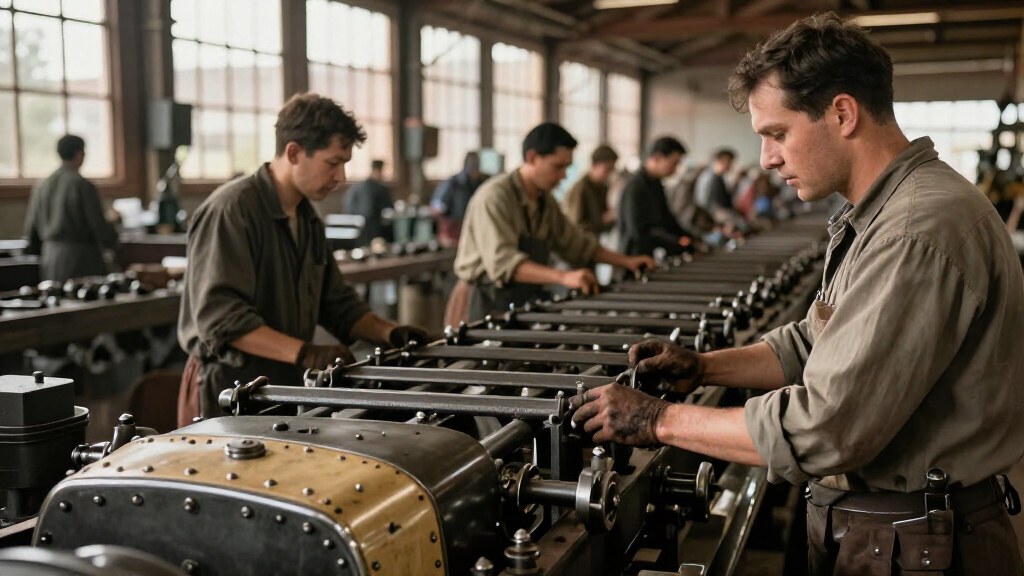

🔍 Read the full analysis: The Assembly Line’s Role In The Five-Dollar Day on ThorstenMeyerAI.com

Get business pricing on tech for your team
- Business-only prices and quantity discounts
- Tax-exempt purchasing
- Multiple users, one account, clear invoices
TL;DR
Ford introduced the moving assembly line at its Highland Park plant in 1913, cutting the labor time to assemble a Model T chassis from 12 hours 28 minutes to 1 hour 33 minutes by early 1914. On Jan. 5, 1914, the company raised minimum daily pay to $5 and shortened the workday, responding to severe turnover; the source says turnover fell to 54% that year.
Ford Motor Co. introduced a moving assembly line at its Detroit-area Highland Park plant in 1913, sharply reducing the labor time needed to build a Model T chassis, but the faster production system coincided with workers leaving at a high rate. On January 5, 1914, Ford cut the workday from nine hours to eight and raised minimum daily pay from $2.34 to $5, a move the report describes as a response to turnover rather than an effort to make workers customers for Ford cars.
In figures attributed to Henry Ford’s 1922 book, My Life and Work, assembling a chassis took 12 hours and 28 minutes when workers built it in one place. By early 1914, the moving line had brought that labor time down to 1 hour and 33 minutes. The report calculates this as an approximately 88% reduction. Ford’s account is a company-side source, not an independent production audit.
The gains came as Ford struggled to retain workers. A 1913 total of 50,448 hires was needed to maintain an average workforce of 13,623, according to figures discussed in a 1987 study by economists Daniel Raff and Lawrence Summers. The report says turnover reached 370% that year and that about one worker in ten was absent on an average day. On January 5, 1914, Ford raised minimum daily pay and reduced scheduled hours. It classified the increase as profit sharing, with eligibility subject to conditions.
The report says turnover fell to 54% in 1914. That figure is presented as a reported annual rate; the material does not provide a detailed calculation or define the exact measure used. The article also disputes a familiar explanation for the wage increase: that Ford raised pay so his workers could buy his cars. It argues instead that the company’s immediate problem was keeping enough people on the factory floor.
Pay Rose as Workers Left the Line
The episode shows that faster production did not by itself solve Ford’s labor problem. The line reduced the time required for each chassis, but the company still faced a costly cycle of hiring and replacing workers. The five-dollar day is significant as a wage and hours change linked in the report to the practical demands of staffing a high-volume factory.
The figures also complicate a simple story in which industrial efficiency automatically meant fewer jobs. The source says the assembly line made work expand before it made it shrink, and cites an increase of about a third in U.S. factory jobs between 1910 and 1920. That broad national figure does not establish that Ford’s line caused the increase, but it signals that the period’s industrial changes involved both productivity and growing factory employment.
For readers looking at automation today, the history offers a limited but relevant comparison: production technology can change the pace and organization of work while leaving employers dependent on workers. The report notes that assembly lines remain in use, with more tasks now handled by robots; it does not quantify how automation has affected employment.
Products Worth Considering

Kindle Paperwhite Signature Edition 32GB (2024) – Auto-adjusting front light, wireless charging, weeks of battery life – Metallic Black

Kindle Paperwhite 16GB (2024) – 7 Glare-Free Display, Weeks Battery Life – Black

EcoFlow DELTA 3 Portable Power Station (1024Wh, 1800W)
As an affiliate, we earn on qualifying purchases.
From Stationary Cars to Moving Work
Before Ford’s moving line, workers assembled a car around a chassis that stayed in one place, bringing components to it. The first experiment described in Ford’s book was smaller: workers divided the assembly of a flywheel magneto into separate tasks and moved the part along a line. Ford wrote that the idea drew broadly on overhead rails used in Chicago meatpacking plants.
Ford’s account says the magneto job was split into 29 operations. The time to complete it fell from about 20 minutes to 13 minutes and 10 seconds, then to seven minutes and eventually five as the company adjusted the line. A later chassis experiment used a rope and windlass to pull the frame along a 250-foot path; that reduced assembly labor to 5 hours and 50 minutes before further changes brought it down to the early-1914 figure.
The report places the wage decision against this production shift and the strain of replacing departing workers. Its references include Ford’s 1922 account and Raff and Summers’ 1987 study, which drew on earlier labor research and company surveys. Those sources differ in purpose and perspective, so the company’s production descriptions and later interpretations should not be treated as the same kind of evidence.
Limits of the Turnover Figures
The figures rely on sources with different vantage points. Ford’s production measurements come from his own 1922 account, while the 1913 hiring and workforce figures are attributed to Raff and Summers’ later study. The source report says the Henry Ford museum gives a somewhat higher turnover estimate, about 380%, than the 370% figure it uses. It does not reconcile that difference or specify how each estimate was calculated.
The material also does not detail every condition attached to the five-dollar profit-sharing arrangement, who qualified, or how pay was distributed across the workforce. It presents the decline to 54% turnover in 1914 but provides limited information about the calculation and other factors that may have contributed. The evidence supports the account of a major wage change amid a retention crisis, but not a single, fully documented explanation for every outcome.
The Report’s Next Historical Questions
The source is a historical episode published November 6, 2026, rather than a report on a new policy or pending decision. It gives no scheduled next milestone. Its immediate next step for readers is to distinguish Ford’s own account of how production changed from later research on hiring, turnover and wages.
Further evaluation would require comparing the underlying company records and labor studies, including how they define turnover and measure eligibility for the five-dollar day. The report also points toward a broader question about how factory work changes as automation advances, but it offers no new data or forecast on the effects of current robotics.
Key Questions
What was Ford’s five-dollar day?
On January 5, 1914, Ford cut the scheduled workday from nine hours to eight and raised minimum daily pay from $2.34 to $5. The source says the increase was administered as profit sharing and had conditions.
Why did Ford raise wages?
The report links the raise to high worker turnover. It says Ford hired 50,448 people in 1913 to maintain an average workforce of 13,623. The report argues the immediate business problem was retaining workers, not encouraging them to buy Ford cars.
How much faster did the assembly line make chassis production?
Figures from Henry Ford’s 1922 account put chassis assembly at 12 hours and 28 minutes of labor before the moving line and 1 hour and 33 minutes by early 1914. The source report describes that as an approximately 88% reduction.
Did turnover fall after the five-dollar day?
The source reports that turnover fell to 54% in 1914. It does not give a full calculation method or establish how much of the decline was caused by the pay change alone.
Source: ThorstenMeyerAI.com