📊 Full opportunity report: The Future Of Manufacturing Onboarding: Virtual Reality Training Explained on IdeaNavigator AI — validation score, market gap, and execution plan.

Get business pricing on tech for your team
- Business-only prices and quantity discounts
- Tax-exempt purchasing
- Multiple users, one account, clear invoices
TL;DR
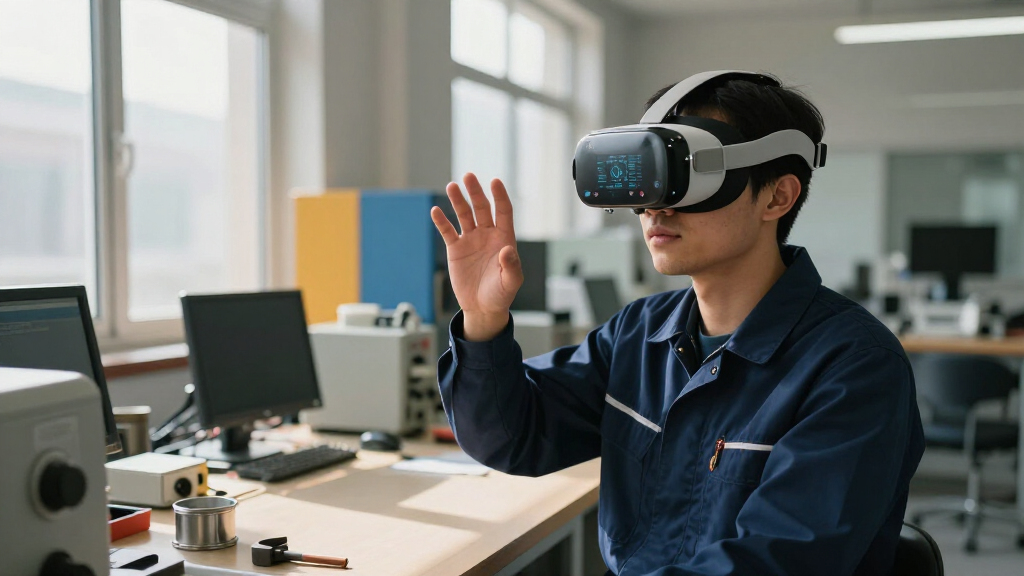
Manufacturers are piloting VR training modules for onboarding high-risk procedures, aiming to reduce safety incidents and accelerate worker readiness. The initiative responds to labor shortages and safety concerns, with promising early results in pilot programs.
Manufacturers are testing virtual reality (VR) training modules as a new approach to onboarding workers for high-risk procedures, aiming to address labor shortages and improve safety. These pilot programs focus on delivering immersive, standardized training via standalone VR headsets, with initial results showing promise in reducing time-to-competency and increasing hazard recognition.
The initiative targets mid-to-large manufacturing firms facing a severe labor shortage, with over 409,000 unfilled positions in the U.S. as of August 2025. Traditional training methods—classroom and on-the-floor sessions—are slow, inconsistent, and pose safety risks when used on live equipment. VR training offers a solution by providing risk-free, repeatable practice in a controlled environment, which can be scaled across multiple plants.
Early pilot programs involve deploying 5-10 standalone Meta Quest headsets to train workers on procedures like lockout/tagout (LOTO) and forklift safety. These modules are delivered via a cloud dashboard that tracks completion, scores hazard recognition, and assesses worker readiness. The goal is to measure improvements in training efficiency, hazard detection, and overall safety performance compared to existing methods.
Manufacturers are considering a SaaS model, offering per-seat or per-headset subscriptions, along with custom scenario development. The immersive training market is expanding at around 20% CAGR, with the broader industrial training market valued at approximately USD 14.55 billion in 2025, indicating significant growth potential for VR solutions in manufacturing.
Impact of VR Training on Manufacturing Safety and Efficiency
Implementing VR training could significantly reduce onboarding time and safety incidents, addressing critical issues like skills gaps and high replacement costs. By standardizing training across multiple locations, manufacturers can ensure consistent safety practices and faster worker ramp-up, which is essential amid ongoing labor shortages. If successful, these pilot programs may reshape industry standards for safety training and workforce development, leading to broader adoption of immersive learning technologies.
Products Worth Considering

Logitech MX Master 4 for Mac, Ergonomic Bluetooth Mouse with Haptic Feedback, Ultra-Fast Scrolling, USB-C Charging, for MacOS, iPadOS, Windo

Samsung 27-Inch Odyssey QD-OLED G8 4K 240Hz Gaming Monitor

Samsung 32-Inch Odyssey OLED G8 (G80SH) 4K Gaming Monitor
As an affiliate, we earn on qualifying purchases.
Background of VR Adoption in Industrial Training
While VR has been used in other sectors like healthcare and aviation, its application in manufacturing training is still emerging. The recent drop in hardware costs, driven by standalone headsets like Meta Quest and Pico, has lowered barriers to deployment. The push for safer, faster onboarding is driven by the urgent need to fill millions of manufacturing jobs projected through 2033, alongside increasing safety regulations and the desire for more effective training tools.
Previous efforts in industrial VR training focused on simulated environments for specific skills, but recent advances now enable scalable, cloud-connected modules for high-risk procedures. The current pilot programs are among the first to test these solutions at scale in real manufacturing settings, with early data indicating potential for substantial improvements in safety and efficiency.
Uncertainties Around Long-Term Effectiveness and Adoption
It is not yet clear how quickly manufacturers will scale these pilot programs across multiple plants or how the training outcomes will compare long-term with traditional methods. The effectiveness of VR modules in reducing safety incidents and improving retention remains to be validated through comprehensive studies. Additionally, questions about cost-effectiveness, integration with existing systems, and user acceptance are still open.
Next Steps for VR Manufacturing Training Pilots
Manufacturers involved in pilot programs are expected to collect data over the next 60-90 days, measuring time-to-competency, hazard recognition, and safety performance. Success in these pilots could lead to broader deployment and the development of additional modules for other procedures. Industry stakeholders anticipate that positive results will accelerate adoption, potentially transforming onboarding processes in manufacturing sectors.
Key Questions
How does VR training improve safety compared to traditional methods?
VR training provides a risk-free environment where workers can repeatedly practice high-risk procedures, leading to better hazard recognition and faster competency without exposing them to live hazards.
What types of procedures are suitable for VR training in manufacturing?
High-risk, complex procedures like lockout/tagout, forklift operation, and machine safety protocols are ideal candidates for VR training modules.
What are the costs associated with implementing VR training?
Costs include hardware (standalone headsets), software licensing, content development, and ongoing platform management. Many manufacturers consider these costs offset by reductions in training time and safety incidents.
When can manufacturers expect to see widespread adoption of VR training?
If pilot programs demonstrate clear benefits, industry experts expect broader adoption within the next 1-3 years, as hardware costs decline and content libraries expand.
Are there any barriers to implementing VR training in manufacturing?
Potential barriers include initial costs, integration with existing training systems, worker acceptance, and ensuring content relevance across different plants.
Source: IdeaNavigator AI