
🔍 Read the full analysis: What’s Behind The Bangladesh Garment Workers’ Highway Protests? on ThorstenMeyerAI.com

Get business pricing on tech for your team
- Business-only prices and quantity discounts
- Tax-exempt purchasing
- Multiple users, one account, clear invoices
TL;DR
Bangladesh garment workers staged highway protests on Nov. 17 and 18 after the minimum-wage board postponed a meeting where employers were expected to present a wage proposal. The current monthly minimum is 12,500 taka; workers’ formal proposal is 32,000 taka, and the board is due to meet again on Nov. 23.
Bangladesh garment workers blocked highways around Dhaka on Nov. 17 and 18 after a scheduled wage-board meeting was postponed, escalating a dispute over pay for an industry employing about four million people. The current monthly minimum wage is 12,500 taka; workers’ representatives have formally proposed 32,000 taka, but employers have not submitted an official figure.
The minimum-wage board’s third meeting was called off on the morning of Nov. 16. In a joint statement, the Bangladesh Garment Manufacturers and Exporters Association and the Bangladesh Knitwear Manufacturers and Exporters Association said they had learned from media reports that Anwar Hossain, the workers’ permanent representative on the board, had fallen ill and been admitted to hospital. The associations said the employers’ side was ready to present its proposal and asked for a new meeting date without delay. The source does not provide independent confirmation of Hossain’s condition.
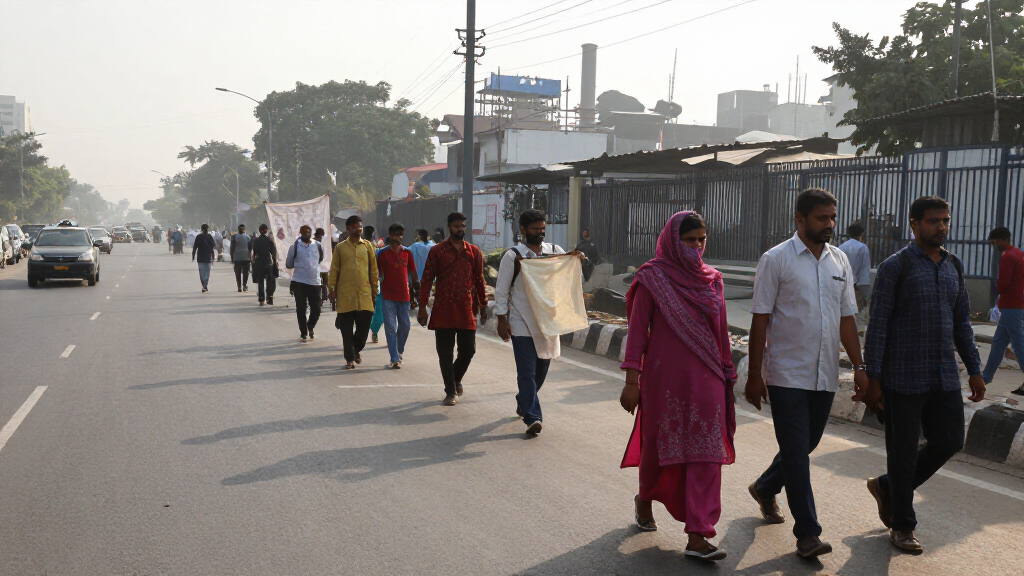
Protests followed the next day across Gazipur, Savar, Ashulia and Mirpur. Workers blocked roads, including sections of the Dhaka-Mymensingh highway. AFP reported that police used tear gas and stun grenades, while protesters threw bricks and set vehicles on fire. On Nov. 18, about 20,000 workers from one factory blocked the Dhaka-Aricha Highway in Savar, according to AP, which cited local media. Police used tear gas, stun grenades and batons; AP said the number of people injured was not immediately clear.
Factory closures and disruption were reported, although estimates varied by source. A BGMEA vice-president told The Daily Star that production had stopped at nearly 450 factories. The newspaper’s correspondents, citing industrial police and protesters, counted at least 250 closed factories in Savar, Ashulia and Hemayetpur, plus 60 in Gazipur. AFP, citing sources, reported about 500 closures among the country’s 4,500 garment factories. These figures describe different reported counts, not a single verified total.
Pay Dispute Puts Production at Risk
The dispute affects a large workforce and a major export industry, while repeated road blockages and factory shutdowns can disrupt workers’ earnings and production. The current minimum of 12,500 taka a month has been in force since Dec. 1, 2023. Workers are seeking a substantial increase: public protests have called for 30,000 taka, while the workers’ side on the board formally proposed 32,000 taka.
Employers have yet to put an official offer before the board. Before the postponed meeting, factory owners had discussed a figure of around 15,000 taka, The Financial Express reported. Owners have argued that a sharp increase could weaken Bangladesh’s price position against garment-producing countries such as India and Vietnam. They have also pointed to low prices paid by buyers and rising energy costs. These are employers’ arguments; the available reports do not establish how the parties will divide the costs of an increase.
The timing matters to workers and factories because the board chairman said the revised wage would take effect on Dec. 1, whatever amount is set, with workers receiving it in their January 2027 pay. That schedule gives the board limited time to resolve the gap, but the postponement itself does not establish whether the board can meet the stated timetable.
Products Worth Considering

Kindle Paperwhite Signature Edition 32GB (2024 Model) – Metallic Black

Bose Home Speaker 500 Smart Speaker with Alexa, Black

Logitech MX Mechanical Wireless Illuminated Keyboard, Tactile Quiet, Graphite
As an affiliate, we earn on qualifying purchases.
How the Wage Talks Reached This Point
The protests are part of a wage-board process that began before the latest highway blockades. The board’s third meeting was meant to hear the employers’ proposed figure after workers formally sought 32,000 taka per month. On Nov. 16, five labour alliances representing 55 worker organisations warned that delaying the meeting could send workers the wrong message. The board’s next meeting is scheduled for Nov. 23.
The currency equivalents in the source are its own rounded calculations using the Bangladesh Bank rate of 124.75 taka per US dollar, effective Nov. 19. On that basis, the current minimum is about $100 a month, the workers’ 30,000-taka demand about $240, and their formal 32,000-taka proposal about $257. The conversion does not change the fact that negotiations are taking place in taka.
The industry is also changing through automation. A 2024 study of factories around Dhaka found that automated lines required 30.58% fewer workers, most of them helpers. An International Labour Organization working paper, using labour-force survey data, calculated that women’s share of apparel jobs fell from 46.2% in 2016–17 to 35.2% in 2024. Those findings give context to concerns about jobs and wages, but the source does not establish that automation caused the current protests.
““We want to return to our machines.””
— A 28-year-old garment worker, speaking to AFP
The Offer and Protest Toll Remain Unknown
As of 07:00 UTC on Nov. 19, employers had not made an official wage proposal public, and the gap between workers’ formal request and the figure previously discussed by owners remained unresolved. Reports give differing counts of factories affected, so the total number closed or halted cannot be stated as a confirmed figure. AP also reported that the number injured in the Nov. 18 confrontation was not immediately clear. The source material reports no deaths, but that is not proof that no one was injured.
The authorities’ account of arrests includes allegations that people affiliated with various organisations, including banned groups, had infiltrated the protests. A Savar police officer made the allegation, but the report cited no evidence supporting it. It should therefore be treated as an unverified claim. The available coverage also does not establish whether any international garment buyers have commented on the latest wage dispute; the source says none had commented in the reports it reviewed.
Board Set to Reconvene November 23
The next scheduled step is the wage board’s meeting on Nov. 23, where employers are expected to present their position and the board can continue negotiating. Its chairman has said the new minimum wage will take effect on Dec. 1 and be paid with January 2027 wages. The amount, the parties’ response to any proposal and whether the payment timetable will hold remain open.
Further developments will also depend on whether highway protests and factory shutdowns continue. The Border Guard Bangladesh deployed 42 platoons across industrial areas in Dhaka, Gazipur and Narayanganj, according to its spokesperson as quoted by The Daily Star. Police in Savar said 117 people had been arrested since Oct. 31 and 11 cases filed. These figures and actions describe the authorities’ response; the available source does not say what steps officials or labour groups plan after the board reconvenes.
Key Questions
Why are Bangladesh garment workers protesting?
Workers are seeking higher minimum pay and protesting the delay in wage-board negotiations. Their representatives formally proposed 32,000 taka a month; demonstrations have also called for 30,000 taka.
What is the current garment-sector minimum wage?
The current monthly minimum is 12,500 taka, in force since Dec. 1, 2023, according to the source material.
Why was the Nov. 16 wage-board meeting postponed?
The employers’ associations said the meeting was postponed after workers’ representative Anwar Hossain fell ill and was admitted to hospital. The associations said they had learned of his illness from media reports and were ready to submit their proposal.
When will the board meet again?
The next meeting is scheduled for Nov. 23, 2026. The board chairman has said the new wage is due to take effect Dec. 1 and be paid in January 2027, but the amount has not been decided.
How many factories have been affected by the protests?
Reports differ. Estimates cited in the source range from at least 310 factories counted by The Daily Star’s correspondents in several areas to about 500 nationwide reported by AFP’s sources. The figures use different sources and coverage, so there is no confirmed single total.
Source: ThorstenMeyerAI.com