

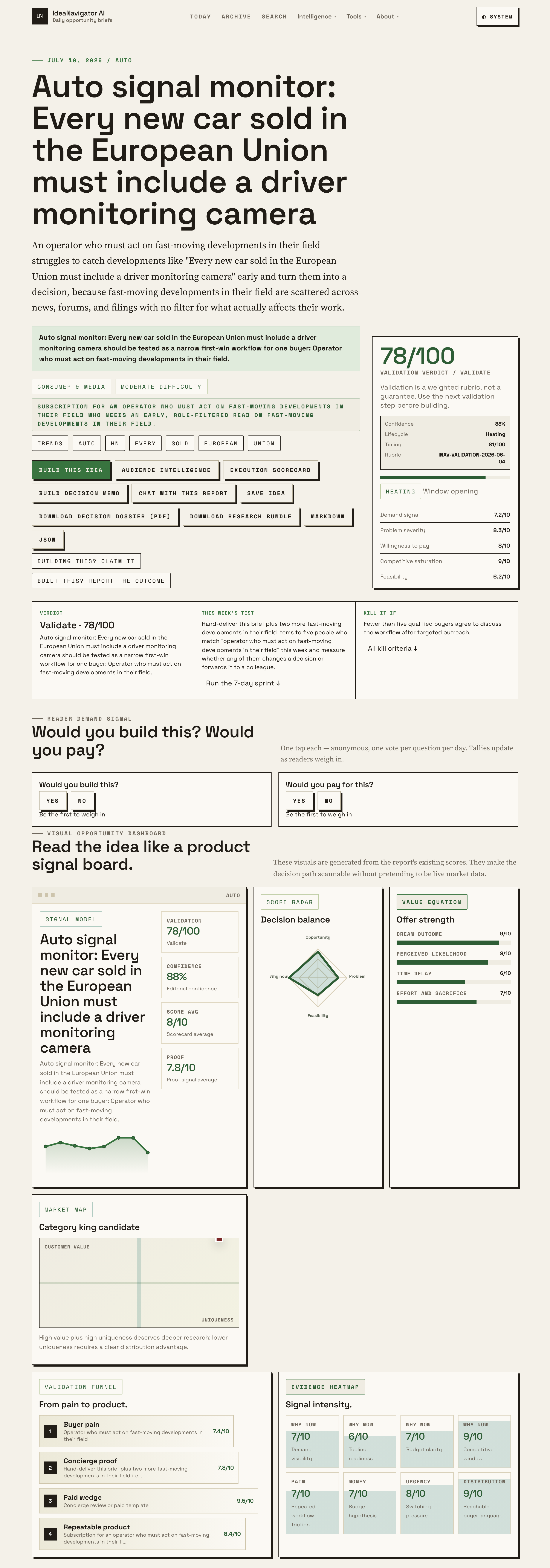
📊 Full opportunity report: Why Every New Car In The European Union Now Needs A Driver Monitoring Camera on IdeaNavigator AI — validation score, market gap, and execution plan.

Get business pricing on tech for your team
- Business-only prices and quantity discounts
- Tax-exempt purchasing
- Multiple users, one account, clear invoices
TL;DR
Under EU General Safety Regulation rules, every new car sold in the European Union must be equipped with driver monitoring systems, including camera-based drowsiness and distraction detection. The mandate stems from legislation adopted in 2019 and phased in from July 2022, applying to all new vehicle registrations from July 2024.
Every new car sold in the European Union must now include a driver monitoring system capable of detecting drowsiness and distraction, under the EU’s General Safety Regulation, which applies to all new vehicle registrations across the bloc since July 2024. The mandate has resurfaced in public discussion after the development was flagged with a high signal score on Hacker News, according to IdeaNavigator AI, prompting renewed questions about how the camera-based systems work and what data they collect.
The requirement comes from Regulation (EU) 2019/2144, the General Safety Regulation adopted in late 2019. It introduced a range of mandatory safety technologies, including driver drowsiness and attention warning and advanced driver distraction warning systems. The rules were phased in: they applied to new vehicle types from July 2022 and to all new vehicles registered in the EU from July 2024.
Compliance can be achieved through different technical approaches, but many manufacturers use a camera mounted near the steering wheel that tracks eye movement, eyelid closure, and head position to detect signs of fatigue or distraction. The system is designed to issue warnings — visual, audible, or both — when it judges that the driver’s attention has degraded. Automakers including Mercedes-Benz, BMW, and Volkswagen have shipped camera-based attention assist systems in EU models, and the regulation effectively makes some form of monitoring standard equipment rather than an optional extra.
Alongside driver monitoring, the same regulation made other systems mandatory on new cars, such as intelligent speed assistance, event data recorders, emergency stop signals, and lane-keeping support, bringing EU safety equipment rules closer to a package of what regulators call “vision zero” measures aimed at cutting road deaths.
What the Camera Mandate Means for Buyers
For consumers, the most immediate effect is that the choice to opt out has disappeared: if you buy a new car in the EU, some form of driver monitoring comes with it. That has practical consequences for privacy, since camera-based systems process biometric-adjacent data such as facial features and eye behaviour. Under the EU’s GDPR, carmakers must disclose what the systems record, and most manufacturers state that image processing happens locally in the vehicle and is not uploaded or stored long-term — claims that are consistent across major brands but that individual buyers may want to verify in their vehicle’s documentation.
For the auto industry, the mandate standardises equipment that was previously a differentiator, and it effectively functions as an enabling layer for future partially automated driving functions, since automated systems legally require a way to confirm the driver is ready to retake control. Road-safety bodies, including the European Commission, have argued that distraction and fatigue are major contributors to serious collisions, which is the policy rationale for making the warnings mandatory.
How the Requirement Reached All New Cars
: “The General Safety Regulation was adopted by the European Parliament and Council in November 2019 and entered into force in January 2020. It was part of a broader EU road-safety strategy that targeted a halving of road deaths between 2020 and 2030. The phased application dates — new type approvals from July 2022, all new registrations from July 2024 — gave manufacturers several years to integrate the required systems into their line-ups.
The regulation followed years of assessment by the European Commission and safety agencies, which concluded that driver error, including fatigue and distraction, contributes to a large share of fatal crashes in the bloc. Similar requirements have been advancing elsewhere: US regulators have moved toward mandating similar technology, and Euro NCAP, the European crash-safety body, has said it will reward cars with effective driver monitoring in its ratings, a step reported on by trade and mainstream outlets including the BBC.
Open Questions on Data and Enforcement
Several points remain unclear or disputed. It is not fully transparent across all brands exactly what the cameras record, how long any data is buffered, and under what conditions — such as a crash investigation — it could be accessed. Carmakers’ privacy statements vary in specificity, and independent verification of on-device-only processing claims is limited.
Enforcement behaviour also varies in practice: the regulation mandates the systems and sets performance criteria, but how aggressively different models warn drivers, and how false positives are handled, is not standardised in a way consumers can easily compare. No similar EU-wide mandate exists in many other markets, including the United States, where rulemaking is still in progress. Finally, whether the systems measurably reduce fatigue- and distraction-related crashes has not yet been established by post-implementation crash statistics, which will take years of data to assess.
Tighter Rules and Wider Adoption Ahead
Euro NCAP has indicated that its rating protocols will increasingly weight effective driver monitoring, which typically pushes manufacturers to improve systems beyond the legal minimum. Separately, EU rules on alcohol interlock installation and other General Safety Regulation measures continue to phase in.
Watch for privacy regulators to examine how in-cabin camera data is handled, particularly as cars with more automation reach the market and monitoring requirements tighten. Outside the EU, the direction of travel in US and UK rulemaking will determine whether driver monitoring cameras become a de facto global standard or remain a regional requirement. Consumers comparing models can check each manufacturer’s privacy policy and the vehicle handbook for what the system records and how warnings escalate.
Key Questions
Do all new cars in the EU now need a driver monitoring camera?
Since July 2024, all new cars registered in the EU must have driver drowsiness and attention warning and advanced driver distraction warning systems. Many manufacturers meet this with a camera, but the regulation sets performance requirements rather than mandating a specific sensor type.
Does the camera record video of me?
Most manufacturers state that images are processed in real time on board the vehicle and are not stored or transmitted. These are company claims; specifics vary by brand and are described in each vehicle’s privacy documentation.
Can I switch the system off?
Warnings can often be adjusted or delayed in vehicle settings, but because the system is legally required equipment, it generally cannot be permanently disabled in EU-sold cars.
Does this apply to used and older cars?
No. The requirement applies to new vehicle types from July 2022 and all new registrations from July 2024. Cars already on the road are not affected.
Why is the EU requiring this?
Regulators cite fatigue and distraction as major contributors to serious road collisions. The measure is part of the General Safety Regulation package adopted in 2019 aimed at cutting road deaths.
Source: IdeaNavigator AI
Fall Picks
fall essentials
As an affiliate, we earn on qualifying purchases.