📊 Full opportunity report: A Glow-Up Measurement App Puts Men's Skincare Progress In View on IdeaNavigator AI — validation score, market gap, and execution plan.

Get business pricing on tech for your team
- Business-only prices and quantity discounts
- Tax-exempt purchasing
- Multiple users, one account, clear invoices
TL;DR
IdeaNavigator AI has outlined a proposed app that would let men track skincare progress through weekly guided selfies, routine logs and progress scores. The concept is a product opportunity, not a report of a launched app or proven market demand; user interest, retention and subscription potential remain untested.
IdeaNavigator AI has proposed testing a skincare progress app for men that would use weekly guided selfies, routine logging and scores for skin clarity, texture and dark circles. The concept targets men newly investing in skincare who want visible feedback, but the proposal reports no launched product, user data or validation results.
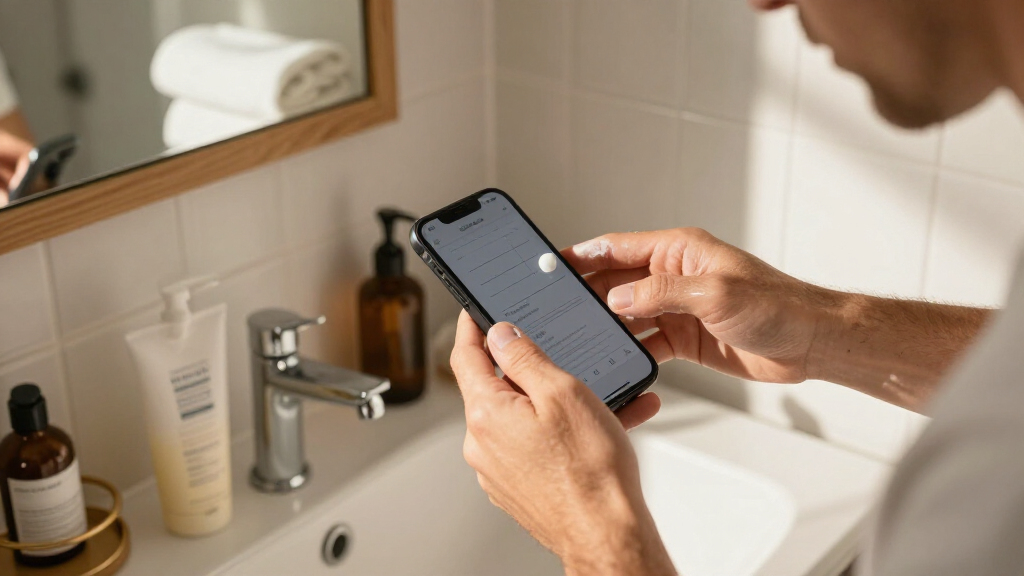
The suggested first version would ask users to take weekly guided selfies and track changes across three areas: skin clarity, texture and dark circles. It would pair those images with routine logs, streaks and progress cards framed as training metrics rather than beauty language. The idea is to give users a repeatable way to check whether their routine appears to be helping.
The proposal describes a specific potential customer: a man newly invested in skincare who wants proof of progress. It argues that existing beauty apps may feel unwelcoming to some men because of their design, tone or marketing. That is a stated problem in the concept, not a finding supported by survey results or named customer research in the material provided.
For a commercial model, IdeaNavigator AI suggests a subscription alongside affiliate recommendations for products associated with tracked needs. It also proposes a positioning test: offer the same selfie-capture technology under men’s-training branding and neutral branding, then compare conversion and retention across user segments. No pricing, test sample, results or product partners are specified.
Testing the Case for Skincare Metrics
The concept addresses a practical question for people starting a routine: how can they tell whether it is making a difference? A regular photo record could help users compare their appearance over time rather than relying only on memory. Routine logs and streaks could also make consistent use easier to monitor. These are proposed functions, however, and their usefulness has not been demonstrated in the material available.
The positioning experiment could matter as much as the image-tracking features. If a training-oriented presentation attracts or retains users who do not respond to conventional beauty branding, that would inform how a product is designed and marketed. But the proposal does not show that men broadly reject existing beauty apps or that a different tone would improve engagement; those are questions for testing.
Commercially, the idea combines tracking with product referrals. That creates a possible revenue stream but also a need to distinguish measurement from promotion. If recommendations are tied to a product’s commercial relationship rather than a user’s actual needs, trust could suffer. The proposal does not describe how scores would be calculated, how recommendations would be selected, or how commercial links would be disclosed.
men's skincare progress tracking app
As an affiliate, we earn on qualifying purchases.
As an affiliate, we earn on qualifying purchases.
A Proposed First Product Test
IdeaNavigator AI frames the app as a narrow first-win workflow, rather than a broad platform for all grooming needs. Its initial audience is one buyer type, and its proposed measures focus on a small set of visible skin concerns. The suggested weekly cadence is intended to create comparable records, while streak mechanics and progress cards would present tracking in a familiar, goal-oriented format.
The concept places the opportunity within men’s grooming technology and points to looksmaxxing culture as a reason that some potential users may be receptive to metrics and gamification. That rationale is part of the proposal; it is not accompanied by market-size figures, growth rates or independent evidence in the material provided. The claim that men’s skincare is the fastest-growing grooming segment is likewise not supported there with a date, metric or comparison baseline, so it cannot be quantified here.
The proposed test is a way to separate the appeal of the underlying tool from the effect of its branding. Using the same capture technology for both versions could help compare how presentation affects sign-up and continued use. Still, the concept does not state how users would be recruited, how long retention would be measured or what result would count as success.
guided selfie skincare monitor for men
As an affiliate, we earn on qualifying purchases.
As an affiliate, we earn on qualifying purchases.
Demand and Measurement Still Unproven
No app launch or validation results are reported. It is unknown whether the intended users want a dedicated tracker, whether weekly photos would lead them to continue using one, or whether training-oriented branding would outperform neutral presentation. The proposal gives no sample size, conversion figures, retention data or subscription pricing.
It is also unclear how the app would score skin clarity, texture or dark circles, and whether scores would be generated by automated image analysis, user assessment or another method. Lighting, camera distance and other photo conditions can affect comparisons, but the proposal does not explain how the capture process would control for them. It also does not address data storage, image privacy, clinical limits or how the app would avoid presenting cosmetic tracking as a medical assessment.
Affiliate recommendations are proposed, but their criteria and disclosures are unspecified. Without those details, readers cannot tell how the product would distinguish a measured need from a recommendation shaped by commercial incentives.
men's routine logging skincare products
As an affiliate, we earn on qualifying purchases.
As an affiliate, we earn on qualifying purchases.
Branding Test Is the Next Step
The next step described by IdeaNavigator AI is to test the same selfie-capture product with men’s-training branding versus neutral branding, then compare conversion and retention by segment. No test dates or planned launch have been announced in the material provided. A meaningful report of results would need to explain how participants were recruited, what outcomes were measured and over what period.
Further details would also be needed before the proposal could be assessed as a consumer product: how image scores work, what privacy protections apply, how recommendations are chosen and whether users would pay for the service. Until those questions are answered with product details or test evidence, the app remains a concept to validate, not a proven solution or established business.
Source: IdeaNavigator AI
men's skin clarity improvement tools
As an affiliate, we earn on qualifying purchases.
As an affiliate, we earn on qualifying purchases.
Key Questions
Has the men’s skincare tracking app launched?
No launch is reported. IdeaNavigator AI presents a product concept and a proposed validation test, not an announcement of an available app.
What would the app track?
The proposed version would use weekly guided selfies to track skin clarity, texture and dark circles, alongside routine logs and streaks. How those categories would be scored is not specified.
How would the proposed app make money?
The concept suggests a subscription model and affiliate product recommendations linked to measured gaps. It gives no pricing or details on how recommendations would be selected or disclosed.
Has men’s branding been shown to improve retention?
No results are provided. Comparing men’s-training branding with neutral branding is proposed as a test; the outcome remains unknown.
Source: IdeaNavigator AI
Fall Picks
fall essentials
As an affiliate, we earn on qualifying purchases.