
TL;DR
A manifesto published November 16 by European game union groups urges workers to avoid generative AI where possible, employers to avoid it entirely and players to support games made without it. The unions also call for consent and fair compensation before creative work is used to train AI systems. The manifesto’s reach and any studio response remain unclear.
European game union groups published a generative AI manifesto on November 16, urging studios to avoid using the technology and asking workers and players to take action. The document also calls on regulators to require consent and fair compensation before people’s work is used in AI training data.

Get business pricing on tech for your team
- Business-only prices and quantity discounts
- Tax-exempt purchasing
- Multiple users, one account, clear invoices
The text, titled “On Generative AI Usage in the Games Industry,” was published by IWGB Game Workers. Its page says members of the branch wrote it in collaboration with members of Game Workers Unite Ireland, Spain’s CSVI and the FIOM-CGIL Milan Work Council. Rock Paper Shotgun and Kotaku also identify France’s STJV and Germany’s GDRT among the groups involved. The source material does not establish how many workers these unions represent.
The manifesto asks workers to avoid genAI services where possible, organize and negotiate company agreements. It tells employers to avoid generative AI entirely, says no worker should be required to use it, and calls for precise labeling if its use cannot be avoided. The demands cover both content appearing in a finished game and behind-the-scenes work, including concept art, reference materials and pre-translations.
For players, the unions recommend supporting games made without genAI and saying so publicly. For regulators, they call for rules against using anyone’s work in training datasets without consent and fair compensation, and say workers should be able to withdraw their work. These are the manifesto’s proposals; the source material does not report that regulators or studios have adopted them.
Pressure Across Game Development
The manifesto addresses decisions at several points in game production: whether workers are asked to use AI tools, whether studios use them for visible or internal tasks, and how players learn about that use. By asking studios to avoid genAI even in early development, the unions draw a wider boundary than a policy focused only on assets shipped in a game.
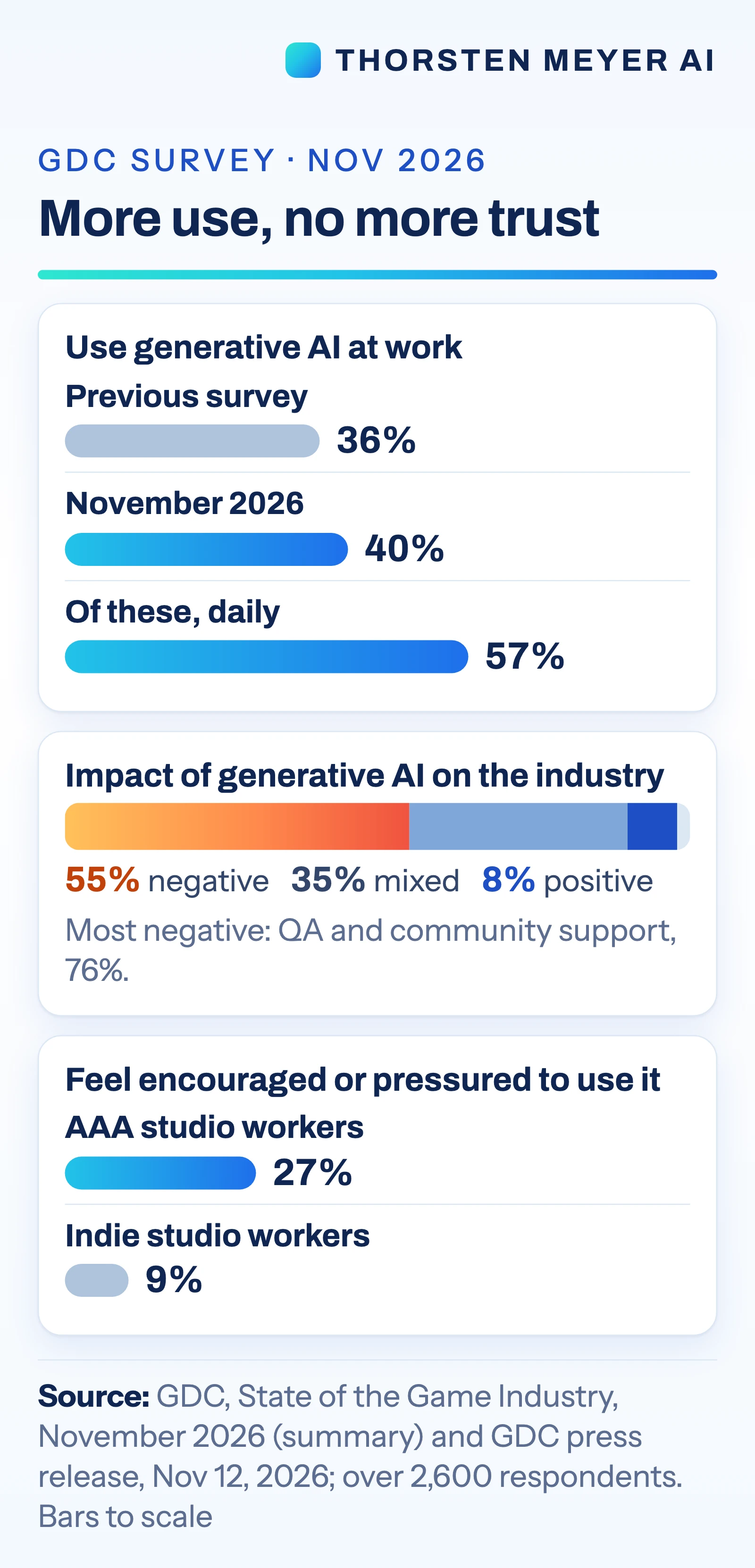
The dispute is unfolding as use of the technology is reported across the industry. The Game Developers Conference’s State of the Game Industry survey, published November 12, found that 40% of respondents use genAI at work, up from 36% in the previous survey. The same survey found 55% said it was hurting the industry. Those figures describe survey respondents’ reported use and views; they do not establish how many studios have adopted the unions’ proposals or whether AI caused job losses.
The demands could affect workplace agreements, production practices and public disclosure if studios respond. For now, the manifesto is a call to action from labor groups, rather than evidence of a sector-wide policy shift.
Products Worth Considering

Sonos One Two-Room Set Smart Speakers with Built-In Alexa, Black

Sonos Roam (Gen 1) Portable Smart Speaker, White

Apple Watch Series 12 GPS 42mm Smartwatch
As an affiliate, we earn on qualifying purchases.
A Divided Industry Debate
The unions frame their position around working conditions, employment, creative ownership, discrimination and costs. They say some workers are being compelled to use AI directly or indirectly, and argue that expectations can be set beyond what staff can meet without such tools. The document also claims genAI is reducing junior roles and that mistakes made by AI may be blamed on workers. These are claims made by the unions; the supplied material does not provide independent findings that verify them.
The manifesto describes AI training data as involving “stolen third-party data.” That is the authors’ characterization. The legality of training on particular materials remains contested in legal and policy debates, and the source material does not identify a ruling resolving the issue across the industry.
Industry representatives have previously argued for a different approach. Video Games Europe, a European trade body, wrote in 2024 that genAI was “widely expected to take video game development to the next level” and argued against AI labels in games. On November 12, Xbox CEO Asha Sharma wrote that “A small team will be able to build worlds that today demand hundreds of developers,” without naming AI in the statement cited by the source material.
““Avoid the use of generative AI entirely.””
— European game union manifesto, “On Generative AI Usage in the Games Industry”
Reach and Studio Response
The available source material does not specify how many workers the groups represent, whether any studios will change their practices, or how the unions would define and verify “unavoidable” AI use. It also reports no public response from a studio or trade body to the manifesto by the time of writing.
The GDC survey found that 34% of respondents said they had been laid off in the past two years. That figure does not show that AI caused those layoffs. The source material provides no evidence establishing a link between generative AI and the reported job losses.
Whether Studios Respond
The manifesto calls for workers to organize and negotiate company agreements, but the source material gives no timetable for negotiations or announced studio commitments. The next visible developments will be whether unions raise the demands in workplace discussions, whether studios publish or change AI policies, and whether regulators take up the proposed consent and compensation rules.
Until such responses are reported, the document’s practical effect on game production remains uncertain. Its publication makes the unions’ position explicit; it does not show that the industry has adopted it.
Key Questions
What are the unions asking studios to do?
The manifesto urges employers to avoid generative AI entirely, not require workers to use it and precisely label any use they consider unavoidable.
Does the manifesto cover AI used behind the scenes?
Yes. Its scope includes internal tasks such as concept art, reference materials and pre-translations, as well as art, sound, code and dialogue in finished games.
What does it ask players to do?
It asks players to support games made without genAI and to express that preference through comments, videos and requests for change.
Have studios agreed to follow the demands?
The source material reports no public studio response to the manifesto by the time of writing. It does not identify any studio that has agreed to change its practices.
Does the GDC survey show that AI caused layoffs?
No. It reports that 34% of respondents said they had been laid off in the previous two years, but does not establish that generative AI caused those layoffs.
Source: Thorsten Meyer AI