
🔍 Read the full analysis: Room 155 Of 175: Building An AI Film About Vallon Creux’s Fireflies on ThorstenMeyerAI.com

Get business pricing on tech for your team
- Business-only prices and quantity discounts
- Tax-exempt purchasing
- Multiple users, one account, clear invoices
TL;DR
Room 155 in the FABLE/175 series is an AI-built interactive exhibit about fictional fireflies in a fictional place called Vallon Creux. Its simulation models 96 individual rhythms that move toward shared timing, and lets visitors disturb the pattern and watch it recover. The supplied material describes the exhibit and its design brief, but does not provide independent testing or evidence about how visitors respond.
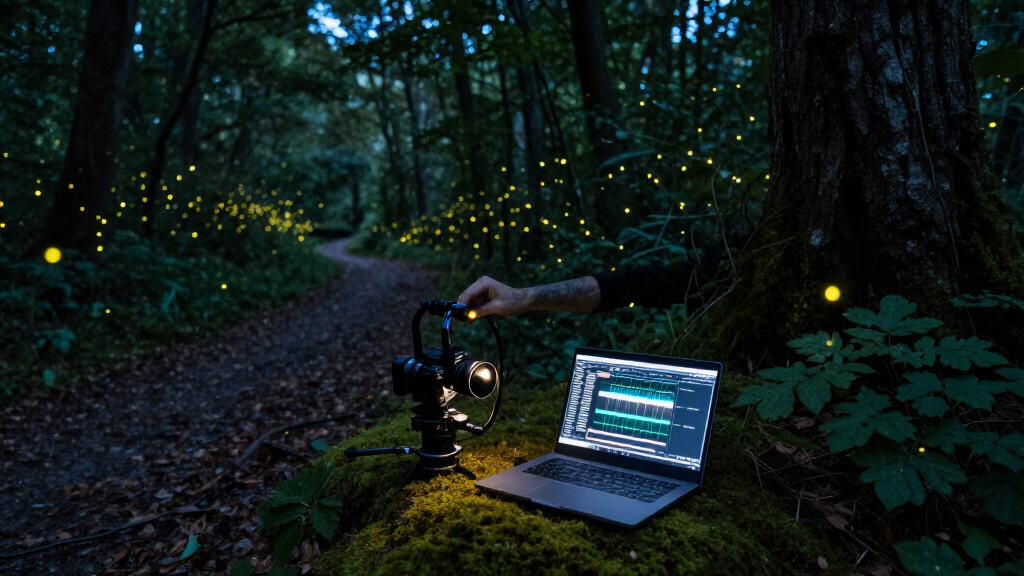
The FABLE/175 project’s Room 155, titled “Luciole — The Synchronous Fireflies of Vallon Creux,” presents an AI-built interactive simulation in which 96 virtual fireflies gradually bring their flashing rhythms into sync, as described in the original project analysis. Visitors can disturb the simulated field and watch the pattern settle again. The exhibit is not a field study: Luciole and Vallon Creux are fictional, and the fireflies are modeled organisms rather than observed insects.
The exhibit is framed as a naturalist’s field notebook, combining a dark, forest-colored display with chartreuse flashes and muted mauve annotations. Its visual design separates the simulated fireflies from the human observer’s notes. Literary-style body text and occasional handwritten accents are intended to encourage slower reading, according to the supplied project description.
Under the visuals, each of the 96 simulated fireflies acts as an oscillator with its own phase and tempo. The simulation updates those rhythms and lets nearby signals influence each individual. A control changes the strength of that influence, while a live coherence measure summarizes how closely the signals align. Pointer interaction can scatter the phases; a trace and phase diagram show the resulting disturbance and recovery using data from the simulation.
The project description says the site was made with HTML, CSS, SVG and canvas, without downloaded image assets or a prerecorded firefly sequence. It also says the animation pauses when the page is hidden or relevant views are offscreen, and that reduced-motion preferences receive a calmer presentation. The exhibit is identified as part of the FABLE/175 pipeline and is hosted at fable-25-830.netlify.app/sites/luciole/.
FABLE / 175 · ROOM 155 · AI-BUILT INTERACTIVE EXHIBIT
Room 155 of 175: Building an AI Film About Vallon Creux’s Fireflies
Luciole — The Synchronous Fireflies of Vallon Creux turns a fictional firefly gathering into an interactive simulation. Ninety-six individual rhythms move toward shared timing; visitors can interrupt the pattern and watch it respond.
A Field Notebook, Built from a Brief
The exhibit pairs a fictional naturalist’s notes with a live model. Its dark woodland display, chartreuse flashes and muted mauve annotations give the simulation the feel of a field record.
01 / PLACE
Vallon Creux
A made-up hollow created for the exhibit. The setting provides atmosphere, not evidence about a real ecosystem.
02 / ORGANISMS
Luciole
The fireflies are modeled organisms in a computer simulation, not observed insects or a documented species study.
03 / FORM
Notebook to screen
Literary-style notes and occasional handwritten accents are intended to invite slower reading, according to the project description.
How the Rhythm Changes
Each simulated firefly has an individual phase and tempo. Nearby signals can nudge those rhythms; a coupling control changes how strongly they influence one another.
From separate flashes to shared timing
The exhibit names the Kuramoto model as its basis for explaining synchronization. A live coherence measure summarizes how closely the simulated signals align.
Visitors can use pointer interaction to scatter the phases. A trace and phase diagram then show the disturbance and the model’s response.
CONCEPTUAL MODEL VIEW · NOT MEASURED RESULTS
Brief → Interaction → Observation
The room makes the relation between local signals and a shared pattern available to explore directly.
Individual rhythms
Each virtual firefly begins with its own phase and tempo.
Neighbor influence
Nearby signals affect each oscillator, with strength set by coupling.
Scatter the timing
Pointer interaction disrupts the coordinated pattern in the simulation.
Watch the response
Coherence, trace and phase diagram show how the model changes afterward.
“Breaking the sync and watching it heal.”— Art-direction brief reproduced in the exhibit
What’s Described — and What’s Unverified
Keep the exhibit’s stated features separate from conclusions that would need further evidence.
Built for the browser
The project description says it uses HTML, CSS, SVG and canvas, without downloaded image assets or a prerecorded firefly sequence.
Designed with care
It says animation pauses when the page is hidden or relevant views are offscreen, with a calmer presentation for reduced-motion preferences.
Workflow in the brief
A three-pass process and screenshot checks at three screen widths are specified. No audit records or screenshots accompany the supplied material.
Open questions
Launch date, audience size, accessibility, performance and usability remain unverified. The description also does not explain why one brief calls for “hundreds” while the exhibit description says 96.
Explore the live room: fable-25-830.netlify.app/sites/luciole/. Compare the published experience with the brief by trying the coupling control, coherence display and pointer disturbance.
Making Synchronization Visible
Room 155 makes an abstract idea—emergent synchronization—available for direct observation. Rather than showing a fixed animation of a coordinated swarm, it presents individual rhythms that influence one another. Visitors can change the coupling and introduce a disturbance, making the relationship between local interactions and a shared pattern easier to see.
The project also makes the site-building process part of the exhibit. Its source material includes the art-direction prompt behind the work, including instructions for the simulation, visual style, accessibility and performance. That offers visitors a view of how an AI-directed creative brief was translated into an interactive page, though the supplied material does not establish how much of the implementation was automated or independently reviewed.
For readers interested in AI-generated web work, the room is a specific example of an AI-built experience that combines code, visual design and an interactive model. Its stated features include reduced-motion handling and mobile adaptations, but there is no independent assessment of accessibility, performance or usability in the source material.
interactive firefly simulation kit
As an affiliate, we earn on qualifying purchases.
As an affiliate, we earn on qualifying purchases.
From Brief to Field Notebook
Room 155 is one entry in a sequence identified as 175 rooms. The exhibit’s published brief describes a fictional hollow and calls for a self-contained page built without frameworks, CDNs or external requests. It specifies a dark palette, invented naturalist notes and a central interaction: disrupt the fireflies’ synchrony, then observe whether order returns.
The brief names the Kuramoto model as the basis for explaining synchronization. In the supplied description, each firefly is represented by a rhythm that can be nudged by neighboring rhythms. The exhibit uses the model as a way to make coordinated behavior visible; it does not report biological observations about a real species or location.
The source also describes a three-pass production process: an initial build and self-critique, a critique intended to identify and fix at least ten problems, and an art-direction pass. It says screenshots were to be checked at three screen widths. These are stated workflow requirements, not independently documented results; no screenshots, audit records or detailed build history accompany the material provided.
““Luciole and Vallon Creux are fictional, created for the exhibit—not a real company, place, or field study.””
— The Room 155 project description
AI-powered educational science kits
As an affiliate, we earn on qualifying purchases.
As an affiliate, we earn on qualifying purchases.
What the Source Does Not Verify
The supplied material describes the exhibit’s design and intended behavior, but does not include independent technical testing, visitor research or confirmation that every feature in the brief appears in the live site. The description specifies 96 fireflies, while the art-direction brief also calls for “hundreds”; the material does not explain that difference. The 96-organism count is used in the exhibit description, but the final implementation details are not independently verified here.
It is also unclear when the room went live, how many people have visited it, whether the three-pass critique was completed as specified, or how the page performs across devices and assistive technologies. The fictional setting should not be read as evidence about firefly behavior in a particular ecosystem.
As an affiliate, we earn on qualifying purchases.
Testing the Live Experience
The room is available at fable-25-830.netlify.app/sites/luciole/, where visitors can explore the simulation and consult the prompt link described in the source. The next practical step for readers is to compare the published experience with the brief: test the coupling control, observe the coherence display, and see how the page responds to a pointer disturbance.
No further release, evaluation or project milestone is announced in the supplied material. Any claims about usability, accessibility, performance or audience response would require additional evidence from the creators or independent testing.
As an affiliate, we earn on qualifying purchases.
Key Questions
What is Room 155?
Room 155 is an interactive AI-built exhibit in the FABLE/175 series. It presents a field-notebook-style simulation of fireflies moving from separate rhythms toward synchronized flashing.
Are Vallon Creux and Luciole real?
No. The project description says both the place and the exhibit’s fireflies are fictional. It is a simulation, not a field study.
How does the firefly simulation work?
Each simulated firefly has its own rhythm, represented as an oscillator. Nearby signals can influence that rhythm, and a control changes the strength of that influence. The exhibit’s coherence measure summarizes how closely the simulated flashes align.
Can visitors change the synchronization?
Yes. The project description says visitors can change the coupling strength and use pointer interaction to scatter the phases. The simulation then shows how the pattern responds and recovers under its rules.
Has the exhibit been independently tested?
The supplied material does not include independent testing, accessibility audits or visitor studies. It describes intended features, including reduced-motion handling and mobile support, but does not provide audit results.
Source: ThorstenMeyerAI.com
Halloween Picks
halloween
As an affiliate, we earn on qualifying purchases.