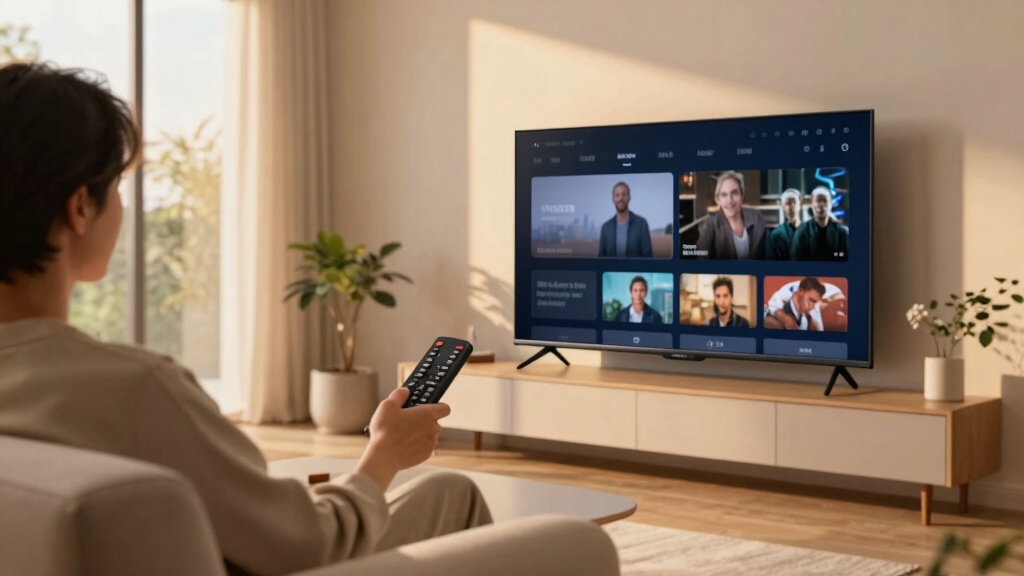

📊 Full opportunity report: The Trojan Horse in Your Living Room: How Smart TVs Became the World’s Most Sophisticated Ad Surveillance Network on ThorstenMeyerAI.com — validation score, market gap, and execution plan.

Get tech for your team delivered free — and shop member deals
- Fast, free delivery on millions of items
- Access to Prime Big Deal Days deals on October 6–7
- Prime Video, Amazon Music and more included
TL;DR
Smart TVs use Automatic Content Recognition to capture and transmit detailed fingerprints of what viewers watch, primarily for targeted advertising. Legal actions are underway, revealing the extent of user data collection.
Major smart TV manufacturers, including Samsung, LG, Sony, Hisense, and TCL, are collecting detailed screen fingerprints via Automatic Content Recognition (ACR) technology and selling this data to advertisers, according to peer-reviewed research and recent lawsuits. This practice, long suspected, is now confirmed through legal filings and technical documentation, raising significant privacy concerns for consumers.
Research published at the 2024 ACM Internet Measurement Conference, verified by Samsung’s own technical documentation, and reinforced by lawsuits filed by the Texas Attorney General, confirm that smart TVs record and transmit miniature screenshots every 15 to 500 milliseconds. These images are converted into perceptual fingerprints, which identify precisely what is displayed on the screen—be it broadcast TV, streaming content, or work presentations—and are sold to advertising networks.
Legal actions, including a 2025 lawsuit from Texas Attorney General Ken Paxton, accuse manufacturers of enrolling consumers in this data collection system without clear consent, often using dark patterns to obscure privacy disclosures. Samsung settled with Texas in February 2026, agreeing to obtain express consent and improve transparency, but other manufacturers remain under legal challenge.
The ad market for connected TVs is projected to grow to nearly $52 billion by 2029, with a significant share of advertising dollars shifting from traditional TV to connected platforms that monetize viewer data. This economic shift underscores the importance of understanding how these devices operate and the privacy implications involved.
The TV is the
trojan horse.
Roku loses $82M/year on hardware. Vizio sold to Walmart for $2.3B for the data, not the TVs. Both make it back many times over by selling what you watch.
ACR captures screenshots every 500 milliseconds (Samsung) · 10ms image / 48 kHz audio (LG). Tracks HDMI inputs — laptops, consoles, work presentations. Opt-out requires 200+ clicks across 4+ menus. Texas AG sued 5 manufacturers Dec 2025; Samsung settled Feb 2026 with no monetary penalty. Patent for next horizon — emotion recognition — granted to Samsung in 2014.
Hardware bleeds. Platform prints.
The financial filings tell the story. The TV is sold below cost. The ARPU recovers the loss many times over through advertising and data sales.
- Q1-Q4 2025 margin-13.8% → -23.3%
- Q1 2026 estimate-28.6%
- 2026 guidance$610M revenue, neg mid-teens margin
- Mgmt framing“Treats devices as loss leader for platforms”
household
- Gross margin51-52% · 2026 guidance
- Growth rate+18% YoY
- Revenue mix87.7% of total revenue
- SourceAds + streaming rev share + data sales
Eight moments. One steepening curve.
Nine years of effective non-enforcement after the 2017 Vizio settlement. The November 2024 UCL paper provided the empirical foundation. Texas filed thirteen months later.
From what you watch. To how you react.
The patent was granted in November 2014. Combined with ACR, the advertising signal evolves from “what you watched” to “how you reacted to each specific ad” — emotional response per impression at population scale.
- 500ms screenshotsSamsung; 10ms LG
- Fingerprint matchingShazam-style perceptual hash
- HDMI inputs trackedLaptops, consoles, work
- 20+ million Vizio householdsPlus all Samsung/LG/Sony/Roku
- Samsung LED ES8000+Webcam since 2012
- On-device processingNPU power increases YoY
- Voice + face recognitionAlready shipping features
- Network infrastructureIdentical to ACR pipeline
- Patent US 8,879,854Granted Samsung Nov 2014
- FACS Action Units44 facial muscles → 6 emotions
- Emotions detectedAngry · fear · sad · happy · surprise · disgust
- Ad signal valueEmotional response per impression
Three scenarios. One question.
Whether the regulatory enforcement curve continues steepening or plateaus at the Texas-Samsung template. 30/50/20 probability allocation reflects the structural setup.
- Samsung template propagatesSony, LG settle by end-2026.
- 60-75% opt-in ratesConsent dialog is only friction.
- 10-20% ARPU compressionAbsorbed via more aggressive inventory.
- Next horizon proceedsEmotion recognition rolls out 2027-28.
- Outcome: Surveillance economy survives; cosmetic governance only.
- 5-10 states adopt templateCA, NY, CO, WA follow Texas.
- FTC partial action 2027Subset of manufacturers.
- EU enforcement materializes$200-500M fines per major.
- Class actions $300-800MPer-manufacturer settlements.
- Outcome: CTV market $44B 2028 vs $46.89B projection.
- Major data breach or harm caseCatalyzes federal legislation.
- 40-60% opt-out rates30-50% ARPU compression.
- Next horizon stallsEmotion recognition prohibited.
- Walmart impairment$2.3B Vizio acquisition write-down.
- Outcome: CTV market $40B 2028 vs $46.89B projection.
The smart TV is the most successful Trojan horse in consumer electronics history. It captured one of the last places people still trusted — the living room — and turned it into a continuous behavioral sensor for the global advertising market. The fight in 2026-2028 is over the terms of consent, not over whether the surveillance happens.
Four assignments. By role.
Disable ACR. Treat firmware updates as resets.
Samsung “Viewing Information Services” off. LG “Live Plus” off. Sony “Samba Interactive TV” off. Vizio “Viewing Data” off. Block ACR endpoints at DNS layer (Pi-hole, NextDNS) for defense-in-depth. Isolate TV on its own VLAN if your network supports it. Consider not connecting the TV to internet at all if you watch through a separate streaming device.
Position based on 30/50/20 scenarios.
Roku, Walmart (post-Vizio), CTV-platform ecosystem face material regulatory tail risk through 2027-2028. Samsung Texas template lacks monetary penalty (manufacturer-friendly precedent). But the regulatory curve is steepening from 2017 → 2024 → 2025-2026 → present. Hisense and TCL face additional Chinese-ownership market-access risk in the U.S.
Adopt the Samsung template voluntarily.
Sony, LG, Hisense, TCL — voluntary adoption is cheaper than litigation. Hisense’s restraining order is the warning shot. The Samsung settlement requires no monetary penalty but does require explicit consent and rewriting consent screens. Most cost-effective compliance is to roll out updated consent flows nationally rather than maintain state-specific variants. The “California effect” applies.
Establish federal connected-device framework.
State-by-state enforcement is structurally inefficient. The FTC GM/OnStar template (20-year order, 5-year CRA-sharing ban, affirmative consent, deletion rights) is structurally appropriate for smart TVs. EU AI Act biometric provisions provide the template for the next-horizon emotion-recognition framework. Federal action through 2026-2027 is the logical extension of the Samsung template.
Implications of Data Collection on Consumer Privacy
This practice signifies a fundamental shift in how consumer data is collected and monetized through everyday devices. The detailed fingerprints and potential biometric data, such as emotional responses, could enable highly targeted advertising and behavioral profiling, raising serious privacy and ethical concerns. The weak regulatory environment in the U.S. compared to the EU AI Act means these practices may continue with limited oversight, impacting millions of consumers.
As an affiliate, we earn on qualifying purchases.
Background on Smart TV Data Practices and Legal Actions
Since 2017, the industry has collected and sold viewer data through ACR technology, with limited regulatory repercussions. The FTC settled with Vizio over similar practices, but enforcement was minimal. Recent peer-reviewed research and lawsuits have exposed the extent of data collection, revealing that manufacturers record high-frequency screen captures and sell this data to targeted advertising networks. The legal landscape is evolving, with Samsung settling in early 2026 and other companies still contesting regulations.
The market for connected TV advertising has grown rapidly, yet viewer engagement with ads remains low, prompting platforms to seek more invasive data collection methods. The potential for biometric and emotional data collection through facial expression analysis further expands the scope of surveillance, edging toward real-time emotional profiling.
“The TV is the Trojan horse. The ad business is the actual product, and the mechanism—ACR—is capturing detailed fingerprints of everything on your screen, then selling that data to advertisers.”
— Thorsten Meyer, author
As an affiliate, we earn on qualifying purchases.
Unclear Scope of Biometric and Emotional Data Collection
While high-frequency screen fingerprinting is confirmed, the extent to which biometric data, such as facial expressions and emotional responses, are being collected and used remains unclear. Samsung holds patents for emotion recognition, but it is not yet confirmed whether these are actively deployed in consumer devices or just in development stages. The potential for real-time emotional profiling raises further privacy concerns that are still under investigation.
As an affiliate, we earn on qualifying purchases.
Legal and Regulatory Developments in 2026
Legal actions against remaining manufacturers continue, with possible settlements or stricter regulations. The FTC and other agencies are likely to increase oversight of biometric and ACR data collection practices, especially as new patents and technologies emerge. Consumers may see enhanced privacy disclosures and opt-in requirements, but the full scope of biometric data collection remains uncertain. Industry adaptation to evolving regulations will shape the future of smart TV surveillance.
As an affiliate, we earn on qualifying purchases.
Key Questions
Are my smart TV’s data collection practices legal?
Legal status varies by jurisdiction. In the U.S., some manufacturers have settled with regulators, requiring clearer consent, but enforcement is ongoing, and practices may still be considered invasive or deceptive.
Can I prevent my smart TV from collecting data?
Many manufacturers offer privacy settings, but these are often complex or insufficient. The recent legal settlements aim to improve transparency, but consumers should review privacy disclosures carefully.
What is the significance of biometric data collection in smart TVs?
Biometric data, such as facial expressions and emotional responses, could enable highly targeted advertising and behavioral profiling, raising serious privacy and ethical concerns.
Will regulations stop smart TVs from collecting data?
Regulatory efforts are increasing, but enforcement varies. Some companies have settled, while others remain under legal challenge. Future regulations may impose stricter limits on data collection practices.
How does this affect the future of advertising?
As ad spending shifts to connected platforms, detailed viewer data will become more valuable, potentially leading to more invasive advertising strategies driven by biometric and emotional insights.
Source: ThorstenMeyerAI.com
Halloween Picks
halloween
As an affiliate, we earn on qualifying purchases.