

Productive environments signal your social class because they are often well-resourced, with access to technology, quality spaces, and supportive structures. These settings foster skills like collaboration, problem-solving, and confidence, which can lead to better opportunities. When environments are scarce or poorly equipped, it limits social mobility and reinforces existing inequalities. If you keep exploring, you’ll discover how these spaces shape perceptions and outcomes beyond just individual success.

Get business pricing on tech for your team
- Business-only prices and quantity discounts
- Tax-exempt purchasing
- Multiple users, one account, clear invoices
Key Takeaways
- Access to well-resourced environments signals socio-economic advantage, reinforcing social stratification.
- Productive environments foster skills and behaviors linked to upward mobility, differentiating social classes.
- Physical and technological quality of environments reflects societal inequalities and influences perceptions of opportunity.
- Environments act as subtle class markers by shaping social interactions, expectations, and cultural capital.
- Inequitable access to high-standard environments perpetuates disparities in education, employment, and social status.
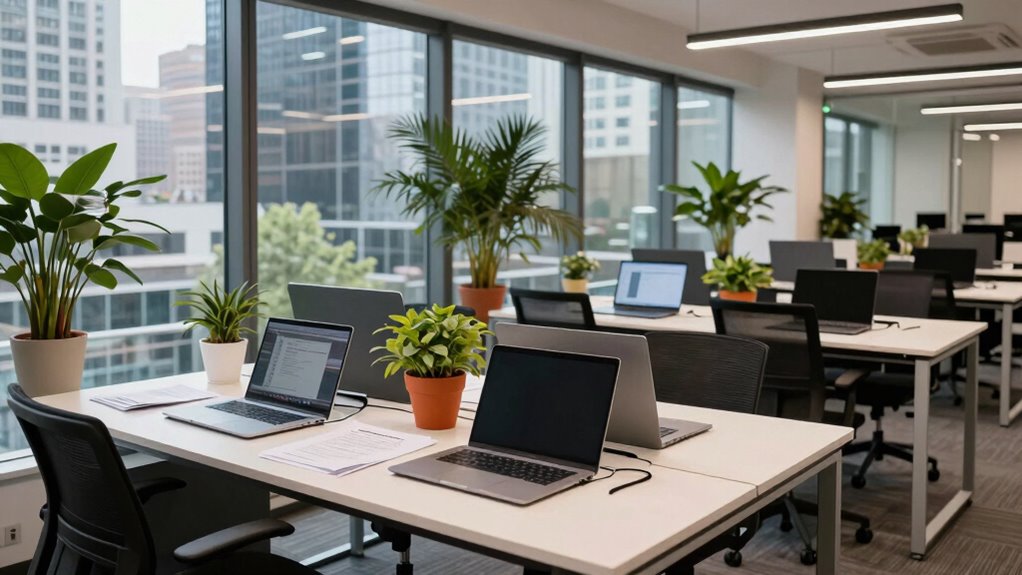
Have you ever wondered what sets high-performing classes apart from others? The answer lies partly in the environment surrounding the students—their productive environments. These settings influence more than just academic achievement; they serve as powerful markers of social class. When you step into a classroom or work environment that’s well-organized, encouraging, and resource-rich, you immediately sense the difference. These environments foster positive workplace dynamics—where collaboration, discipline, and motivation thrive—and that, in turn, impacts social mobility. A productive environment doesn’t just help students do well academically; it signals access to opportunities that can elevate their social standing over time.
You might notice that students in such environments develop skills that are highly valued in society—effective communication, problem-solving, and teamwork. These skills are often reinforced by the workplace dynamics within the classroom, where the atmosphere encourages active participation and mutual respect. This kind of setting enables students to thrive, making them more confident and better prepared for future challenges. Conversely, students in less structured or resource-scarce environments often struggle to develop these vital skills, which can hinder their social mobility. The environment, thus, becomes a subtle yet potent class marker, distinguishing those with access to high-quality educational settings from those without. Additionally, the resources available within a productive environment further enhance learning opportunities and influence student outcomes. A well-resourced environment can also include educational technology, which has been shown to boost engagement and learning efficiency.
Furthermore, a productive environment signals a broader socio-economic advantage. It’s not just about the physical space or materials; it’s about the support systems, expectations, and cultural capital embedded within the setting. Schools and workplaces that promote high standards and foster a sense of achievement tend to attract families and individuals who value education and personal growth. This creates a cycle where productive environments reinforce social stratification, making social mobility more attainable for some and more elusive for others. When you’re in a setting that emphasizes growth and opportunity, you’re more likely to envision a future beyond your current social class. That vision becomes a catalyst for upward mobility, perpetuating the divide between those who have access to these environments and those who don’t. Additionally, the physical environment itself—such as access to natural light and sustainable design—can influence student well-being and engagement, further emphasizing the importance of environmental quality.
Research also shows that physical environment can significantly impact student engagement and motivation, demonstrating the importance of well-designed spaces for fostering learning. The quality of physical surroundings, including factors like cleanliness, safety, and aesthetics, plays a crucial role in shaping the learning experience and outcomes. In essence, productive environments act as a class marker because they reflect and reinforce societal inequalities. They shape not only what you learn but also how you see your place in society. If you’re lucky enough to be in a setting that cultivates excellence and opportunity, it can open doors that remain shut for others. That’s why these environments matter—they are more than just spaces for learning; they are gateways to social mobility and indicators of class distinction.
educational technology tools for classrooms
As an affiliate, we earn on qualifying purchases.
As an affiliate, we earn on qualifying purchases.
Frequently Asked Questions
How Do Cultural Differences Influence Perceptions of Productive Environments?
Cultural differences shape how you perceive productive environments through cultural norms and work etiquette. In some cultures, a busy, loud workspace signals productivity, while in others, quietness and orderliness are valued. Your expectations depend on these norms, influencing how you judge a space’s effectiveness. Recognizing these variations helps you understand that productivity standards vary worldwide, and what’s productive in one culture may not be in another.
What Role Does Technology Play in Defining a Productive Workspace?
Ever wonder how technology shapes your workspace? It plays a crucial role by providing collaborative tools that streamline communication and boost efficiency. Ergonomic design guarantees comfort, reducing fatigue and increasing focus. These elements help create an environment where productivity thrives. As technology evolves, it continues to define what makes a workspace effective, ultimately influencing your ability to perform at your best. Isn’t it time you leveraged these tools for a better work experience?
Are There Environmental Factors That Disproportionately Affect Lower-Income Groups?
Environmental factors do disproportionately impact lower-income groups, deepening socioeconomic disparities. You’ll find that environmental inequities, like exposure to pollution, poor housing conditions, and limited access to green spaces, hinder productivity and health. These disparities make it harder for lower-income communities to create productive environments, often trapping them in cycles of disadvantage. Addressing these issues requires targeted policies to reduce environmental inequities and promote equitable access to healthy, conducive work and living spaces.
How Do Companies Measure the Productivity of Different Environments?
You analyze workplace ergonomics and noise levels because they dramatically impact productivity—like a tiny change can boost output or tank morale overnight. Companies measure environment productivity through surveys, monitoring tools, and performance metrics, paying close attention to how ergonomic setups reduce discomfort and how noise levels hinder concentration. By evaluating these factors, they determine which environments foster focus and efficiency, giving them a competitive edge and highlighting disparities across different settings.
Can Virtual Environments Serve as Effective Productivity Markers?
Yes, virtual environments can serve as effective productivity markers. You notice virtual cues like activity levels, timely responses, and engagement patterns, which act as productivity signals. These cues help you evaluate whether someone is focused or distracted, enabling better collaboration and management. While not perfect, virtual environments provide valuable insights into work habits, making them useful tools for assessing productivity across different settings.
ergonomic office furniture for productivity
As an affiliate, we earn on qualifying purchases.
As an affiliate, we earn on qualifying purchases.
Conclusion
In the end, productive environments aren’t just spaces—they’re the new currency of class. They carve out a path where success is measured by your surroundings, turning your workspace into a mirror reflecting your worth. Just as a garden flourishes with care, so too does your social standing bloom in well-maintained spaces. Remember, your environment isn’t just a backdrop; it’s the stage where your class story unfolds—so choose and craft it wisely.
As an affiliate, we earn on qualifying purchases.
collaborative learning desk setup
As an affiliate, we earn on qualifying purchases.
As an affiliate, we earn on qualifying purchases.
Halloween Picks
halloween
As an affiliate, we earn on qualifying purchases.