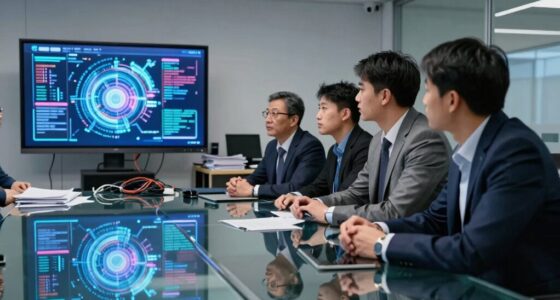
Buying office tech based solely on future needs often backfires because technology advances quickly, making your investments obsolete faster than expected. You may end up buying hardware that becomes incompatible, or cloud platforms that limit your options later. Overestimating needs can lead to unnecessary costs and inflexibility. Instead, focusing on adaptable, scalable solutions can better prepare you for change without costly upgrades. If you want to avoid common pitfalls, stay tuned for more insights.

Get business pricing on tech for your team
- Business-only prices and quantity discounts
- Tax-exempt purchasing
- Multiple users, one account, clear invoices
Key Takeaways
- Rapid technological advances can render future-proofed equipment outdated quickly, leading to wasted investment.
- Overestimating future needs often results in unnecessary expenses and underutilized hardware or software.
- Early platform choices may limit flexibility and compatibility as new technologies emerge.
- Building overly rigid systems reduces adaptability, increasing costs for frequent upgrades or replacements.
- Focusing solely on future needs can distract from current requirements, risking suboptimal present-day performance.
Are you planning to upgrade your office technology with the future in mind? If so, you might think that investing heavily now will save you headaches down the line. However, buying with the future in mind often backfires because technology evolves faster than we predict. For example, when you focus solely on the latest hardware upgrades, you risk investing in equipment that quickly becomes outdated or incompatible with new systems. Instead of creating a seamless, future-proof setup, you find yourself constantly replacing or retrofitting components. The same applies to cloud integration. While cloud solutions are flexible and scalable, choosing a platform too early or without considering long-term compatibility can limit your options later. You might end up locked into a specific vendor or technology that doesn’t adapt well to future changes, creating more headaches than benefits.
Thinking ahead often leads to overestimating what you’ll need in the future. You might buy advanced hardware and cloud services that seem perfect now but become redundant as your business shifts or as newer, more efficient technologies emerge. The rapid pace of innovation means today’s cutting-edge solutions quickly become yesterday’s news. Trying to future-proof your office tech can lead to unnecessary expenses, especially if you end up paying for features or capabilities that never materialize or aren’t as useful as anticipated. It’s tempting to think that more power, storage, or connectivity will serve you forever, but the reality is that your needs are likely to change, and sticking with what is current and adaptable often makes more sense. Additionally, understanding the pace of technological change can help set realistic expectations for upgrades and investments. Recognizing the importance of technological adaptability can guide more sustainable and flexible decision-making. Being aware of the limitations of predictions helps prevent over-investing in technologies that may become obsolete quickly. Moreover, staying informed about emerging trends allows you to make more strategic technology choices that align with your evolving requirements. When you incorporate future flexibility into your planning, you’re more likely to develop a resilient office setup that can handle unforeseen changes effectively.
Another pitfall is the assumption that future needs are predictable. Technology trends tend to shift unpredictably, and what seems like a wise investment today may be irrelevant in just a few years. Instead of betting on a specific technology or hardware upgrade, focus on flexible systems that can adapt. Modular hardware and cloud platforms that support easy upgrades and integrations are smarter choices. These allow you to expand or pivot as your requirements evolve, without the hefty costs of overhauling your entire setup. In the end, it’s better to invest gradually, prioritizing scalability and compatibility, rather than trying to build a perfect, future-proof system that may never truly come to fruition.
Products Worth Considering

LG UltraGear 32GX870A-B 32-inch 4K UHD OLED Dual-Mode Gaming Monitor

Apple Watch Series 10 GPS 46mm with Silver Aluminum Case and Blue Cloud Sport Loop

Samsung 32-Inch Odyssey G5 QHD Gaming Monitor (G50F)
As an affiliate, we earn on qualifying purchases.
Frequently Asked Questions
How Often Should Companies Update Their Office Technology?
You should update your office technology every 3 to 5 years, aligning with the typical upgrade cycle. This helps you avoid tech obsolescence, where devices become outdated and less efficient. Waiting too long risks security vulnerabilities and productivity dips, while frequent updates can be costly. By sticking to a regular schedule, you maintain peak performance, security, and compatibility without overspending or unnecessary replacements.
What Are the Hidden Costs of Future-Proofing Office Tech?
The hidden costs of future-proofing office tech include underestimated expenses in cost estimation and increased upgrade frequency. You might think you’re saving money by investing in advanced systems, but frequent upgrades can quickly add up. Additionally, unforeseen compatibility issues and training requirements contribute to hidden costs. These factors can strain your budget and disrupt productivity, making it essential to carefully evaluate whether future-proofing truly aligns with your company’s long-term needs.
How Can Businesses Balance Current Needs With Future Upgrades?
You can balance current needs with future upgrades by choosing scalable technology that integrates smoothly with existing systems, ensuring easy upgrades. Focus on solutions that support flexible technology integration, allowing you to adapt as your business grows. Additionally, invest in employee training now, so your team can efficiently handle new tech later. This proactive approach helps you stay agile, avoiding costly overhauls and keeping your office tech aligned with both present and future demands.
Are There Industries Where Future-Proofing Is More Effective?
You might think future-proofing works everywhere, but industries with high adaptability, like tech or creative fields, benefit most. These sectors face fewer innovation constraints, allowing them to evolve quickly without costly overhauls. However, in highly regulated industries like healthcare or finance, strict compliance can hinder adaptability, making over-investment in future-proofing risky. Focus on flexibility and scalability instead of rigid future-proofing to stay resilient in changing times.
What Are Common Mistakes When Planning for Future Office Tech?
When planning for future office tech, you often make the mistake of relying too heavily on upfront investments, assuming they’ll cover all future needs. This approach ignores rapid technology obsolescence, which can render your equipment outdated faster than expected. To avoid this, focus on flexible, scalable solutions that can adapt over time, rather than overcommitting to expensive, long-term investments. This strategy helps you stay current without risking costly obsolescence.
Conclusion
Thinking ahead might seem like planting seeds for tomorrow’s orchard, but in office tech, it often turns into watering a distant, uncertain garden. Your future needs are like shifting sands—hard to predict and even harder to hold onto. By focusing on current realities, you build a sturdy bridge that connects today’s demands with tomorrow’s growth. Don’t chase shadows; instead, craft a foundation that adapts as the landscape of technology continues to shift beneath your feet.