

Currently, robots and AI systems don’t pay taxes because they aren’t considered legal entities. The idea behind a “robot tax” is to ask companies that use automation to contribute financially, helping to offset job losses and fund social programs. Critics argue that taxing robots could slow innovation and harm economic growth. To understand the debates and the potential impacts of such proposals, there’s more to explore on how these ideas could shape our future society.
Key Takeaways
- Currently, robots and AI systems do not pay taxes; the robot tax is a proposed policy to address automation’s economic impact.
- The robot tax aims to generate revenue from automation to offset job losses and fund social safety nets.
- Critics argue that taxing robots could hinder innovation, economic growth, and make companies relocate to less-regulated countries.
- Defining what counts as a “robot” or “AI system” for taxation remains complex and debated among policymakers.
- The concept of a robot tax is part of broader discussions on AI regulation and how to fairly distribute automation’s economic benefits.
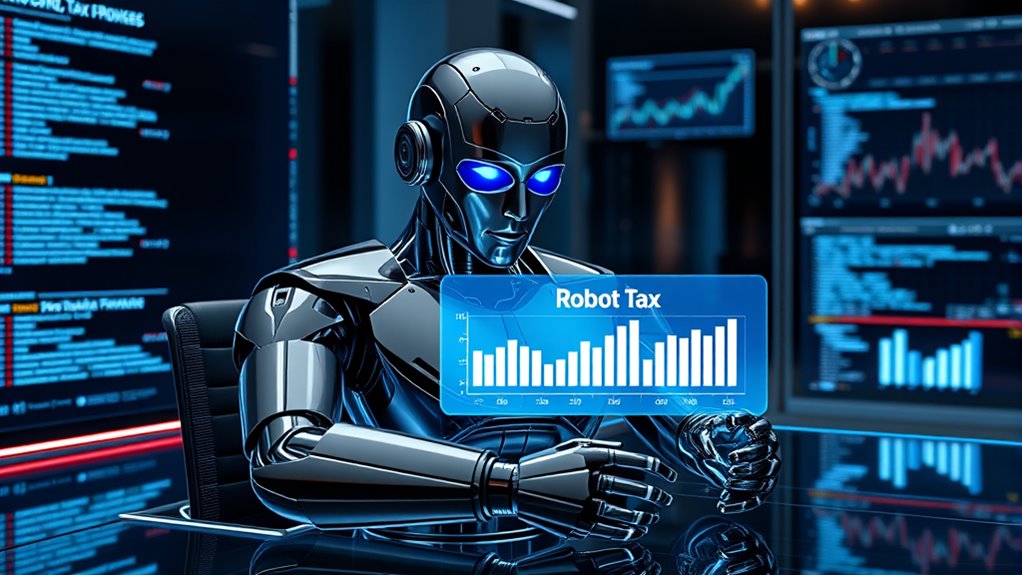
As robots become more advanced and integrated into the workforce, the idea of them paying taxes is gaining traction. Many policymakers and economists are starting to consider how AI regulation could influence this possibility. The core issue revolves around whether machines, which now perform tasks historically done by humans, should contribute financially to the economy in the same way people do. This debate is rooted in the belief that if robots generate profits or reduce employment, they should shoulder some of the fiscal responsibilities that come with economic activity. The idea of a “robot tax” is seen by some as a way to create a fairer system that accounts for the economic impact of automation.
As robots advance, the debate over their tax contributions raises questions about economic fairness and automation’s societal impact.
On one hand, proponents argue that robots and AI systems contribute to economic growth, but they don’t pay taxes or social contributions like human workers do. Without some form of AI regulation, this creates gaps in tax revenue, especially as automation replaces jobs and shrinks the tax base. A robot tax could help offset income losses from displaced workers and fund social safety nets. It would also incentivize companies to balance automation with human employment, aligning technological progress with societal well-being. However, critics warn that taxing robots might hinder innovation or lead to unintended consequences, such as discouraging investment in AI development or pushing companies to relocate to countries with more lenient regulations.
The economic impact of implementing such a tax is complex. While it could generate new revenue streams, it might also slow economic growth if businesses see it as a burden. You need to consider how AI regulation would be structured—would it target specific types of automation, or all AI implementations? Would the tax be based on the value generated by the robots, or on their capacity to replace human workers? These questions are central to understanding how a robot tax could influence innovation and competitiveness. Critics also warn that defining what constitutes a “robot” or “AI system” for tax purposes might be complicated, especially as technology becomes more advanced and integrated into existing products and services.
Ultimately, whether robots should pay taxes depends on balancing economic impact and fairness. As you look at the broader picture, it’s clear that AI regulation will play a vital role in shaping future policies. The goal isn’t just about collecting revenue but ensuring that technological progress benefits society as a whole, without leaving certain groups behind or stifling innovation. The debate continues, but one thing’s certain: the intersection of AI regulation and economic impact will be central to how we adapt our tax systems for an increasingly automated world.
As an affiliate, we earn on qualifying purchases.
Frequently Asked Questions
How Would a Robot Tax Be Enforced Globally?
You’d need a robust international enforcement system for a robot tax, relying on agreements between countries. By establishing cross border compliance standards, governments can guarantee companies pay the tax regardless of where their robots operate. Cooperation through treaties and shared regulations would help prevent tax evasion. Ultimately, coordinated efforts would be essential to monitor and enforce robot tax policies across borders effectively.
Could Robot Taxes Impact Innovation and Technological Growth?
Imagine a world where robots handle most jobs, and the idea of robot taxes sparks debate. You might worry these taxes could slow down innovation and technological growth, but they could also fund Universal Basic Income, supporting workers. With the right balance, robot taxes could maintain Innovation Incentives, encouraging companies to develop new technologies while ensuring economic stability. Ultimately, thoughtful policies can help foster progress without stifling creativity.
Are There Alternative Policies to Address Automation’s Economic Effects?
You can consider policies like Universal Basic Income to support those displaced by automation, providing a safety net. Workforce retraining programs help you adapt skills for new job opportunities, easing economic impacts. These alternatives focus on supporting individuals rather than taxing robots directly. By investing in UBI and retraining, you foster a resilient economy that benefits from technological progress while ensuring social stability.
How Do Robot Taxes Compare to Traditional Corporate Taxes?
Think of robot taxes as a targeted tool, unlike traditional corporate taxes that focus on profits. You see, robot taxes aim to create automation incentives by taxing firms that replace human labor, addressing labor displacement directly. While corporate taxes fund general government activities, robot taxes specifically target automation’s impact. This approach can better balance innovation and employment, making it a strategic way to handle economic shifts caused by automation.
What Are the Ethical Considerations of Taxing Robots?
You face moral dilemmas when taxing robots, as it raises fairness debates about their role in society. You might wonder if it’s just to impose taxes on machines that replace human jobs or if doing so unfairly shifts burden onto workers. Balancing technological advancement with social equity pushes you to contemplate whether taxing robots promotes fairness or hampers innovation. Ultimately, you must weigh ethics against economic benefits.
As an affiliate, we earn on qualifying purchases.
Conclusion
So, as you consider the future, remember this: robots don’t pay taxes, but the economy does. The idea of a “robot tax” aims to balance progress with responsibility, yet it’s more than just numbers—it’s about shaping a fair society. Will we embrace innovation or cling to old rules? The choice is ours. As technology advances, so must our mindset—because in this dance between man and machine, fairness is the tune we must learn to play.
As an affiliate, we earn on qualifying purchases.
As an affiliate, we earn on qualifying purchases.