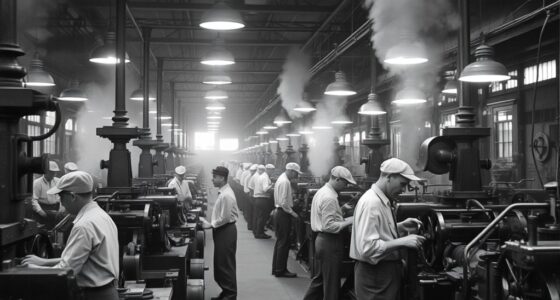

Government retraining programs can seem like PR stunts, but many are making genuine efforts to prepare workers for industry demands. Significant investments are directed toward industry-specific training, apprenticeships, and public-private partnerships to develop practical skills. However, their success often depends on continual adaptation and strategic collaboration. Some initiatives deliver real results, while others fall short or serve political aims. To discover how effective these programs truly are and what factors influence their success, keep exploring the details.
Open a free Amazon Business account
Business pricing, bulk buying and tax-exempt orders.
As an affiliate, we earn on qualifying purchases.
Key Takeaways
- Many programs lack industry relevance, leading to questions about their actual effectiveness in workforce development.
- Significant government investments aim to modernize training, but measurable success depends on tangible skill improvements.
- Programs like apprenticeships and public-private partnerships show promise but vary widely in outcomes.
- Countries like Singapore successfully combine subsidies and structured on-the-job training, serving as effective models.
- Critics argue some initiatives may serve political purposes without delivering substantial, long-term employment benefits.

Are government retraining programs effectively preparing workers for today’s evolving job market? This question is at the heart of ongoing debates about whether these initiatives genuinely equip individuals with the skills they need or merely serve as public relations stunts. The truth is, governments are investing significant funds into various programs, signaling a strong commitment to workforce development. For example, over $80 million has been allocated through the USDOL for State Apprenticeship Expansion grants, aiming to expand apprenticeship opportunities across sectors. These apprenticeships are designed to provide hands-on, industry-relevant training that directly addresses labor shortages. Similarly, the Promise Scholarship Program has allocated $141 million for the 2025–26 budget, offering up to $6,500 per student for education expenses, encouraging more people to pursue post-secondary education and technical training.
Despite these investments, the effectiveness of retraining efforts often hinges on how well programs align with actual industry needs. The federal government’s annual investment of over $700 billion in higher education reveals a different challenge: many graduates find themselves unemployed or working in jobs that don’t require a college degree. This disconnect raises questions about whether current training efforts truly prepare workers for the jobs that exist. To address this, programs like the Workforce Investment and Opportunity Act, which spends about $4.1 billion, aim to better coordinate training with labor market demands. Meanwhile, about $1.4 billion flows into Career and Technical Education through the Perkins Act, emphasizing skills training in high-demand sectors. Additionally, the integration of performance tuning principles can enhance program efficiency by optimizing resource allocation and outcomes.
Many government investments in higher education do not translate into better employment outcomes.
Some initiatives, like the modernization efforts signed into action by President Trump, focus on high-paying skilled trades, aiming to make workforce programs more relevant and effective. Public-private partnerships are crucial here, as they help develop industry-specific training that matches real-world needs. Countries like Singapore demonstrate effective models by subsidizing training courses and providing structured on-the-job training programs with substantial funding for employee salaries. These initiatives guarantee that workers gain practical skills quickly and stay competitive.
However, the success of these programs depends on ongoing adaptation and strategic collaboration. Governments worldwide are also working to upskill public sector employees and implement career counseling efforts that better align education paths with employment opportunities. While some programs serve as a genuine bridge between education and employment, others risk being perceived as political showpieces if they lack tangible results. Ultimately, whether retraining programs are successful or just PR stunts depends on their ability to deliver measurable, industry-relevant skills that meet the needs of today’s dynamic labor market.
As an affiliate, we earn on qualifying purchases.
Frequently Asked Questions
How Are Retraining Program Participants Selected?
You might wonder how retraining program participants are chosen. Usually, eligibility depends on factors like recent graduation, seeking in-demand jobs, or meeting specific educational requirements. Selection methods often involve ranking applicants based on assessment scores, with veterans and those with preference status getting priority. Agencies make certain that preference-eligible veterans are considered first, and programs verify providers’ compliance with eligibility criteria to select participants effectively.
What Funding Sources Support These Retraining Initiatives?
Did you know that over $500 million from the American Rescue Plan is allocated for workforce system transformation? You see, funding for retraining initiatives comes from federal sources like WIOA, state programs such as Minnesota’s DEED, and private sector contributions like employer grants. These diverse streams aim to boost skills, create jobs, and support workforce development through partnerships, policy reforms, and community investments.
Are There Long-Term Employment Statistics Post-Program?
You’re wondering about long-term employment stats after retraining programs. While some studies show benefits lasting over 33 years, most data focus on short-term outcomes, like employment within two to five years. You should know that many programs lack rigorous, long-term tracking, making it hard to confirm sustained employment or earnings over decades. So, while initial results look promising, the long-term impact remains uncertain due to limited systematic follow-up.
How Do Programs Adapt to Rapidly Changing Industries?
You might think retraining programs are static, but they actually evolve faster than your favorite tech gadgets. They adapt by updating curricula to include emerging skills like AI and digital literacy, partnering with employers to align training with industry needs, and integrating new technologies. While industry shifts are rapid, these programs try to stay ahead, often retooling quickly to keep up with the ever-changing job landscape.
What Metrics Determine a Program’s Success or Failure?
When evaluating a program’s success, you should look at relevant metrics like completion rates, incident reporting, and job satisfaction. You also need to assess retention rates, earnings outcomes, and skill acquisition to see if participants meet learning objectives. Additionally, consider long-term impacts like economic effects, organizational alignment, and stakeholder feedback. These indicators help you determine if the program effectively achieves its goals or if it falls short.
As an affiliate, we earn on qualifying purchases.
Conclusion
So, next time you hear about government retraining programs, ask yourself: are they truly helping people adapt and thrive, or are they just a public relations stunt? While some initiatives do offer real opportunities, others fall short of making a lasting impact. It’s up to you to stay informed and demand genuine change. After all, isn’t your future worth investing in with honest, effective programs that truly prepare you for what’s next?
industry-specific training courses
As an affiliate, we earn on qualifying purchases.
As an affiliate, we earn on qualifying purchases.
career and technical education tools
As an affiliate, we earn on qualifying purchases.
As an affiliate, we earn on qualifying purchases.
Flea & tick season Picks
flea and tick prevention
As an affiliate, we earn on qualifying purchases.